CATEGORIES
TAGS
Why Podcasts Influence Buying: 70% of Listeners Purchase
Podcasts wield remarkable power over consumer purchasing decisions. 70% of podcast listeners have purchased a product after hearing about it on a podcast, demonstrating an influence that rivals traditional advertising channels. This guide reveals the psychological mechanisms, data trends, and strategic approaches marketers need to harness podcast-driven sales effectively. You’ll discover why authentic host endorsements outperform conventional ads and how to leverage these insights for measurable results.
Table of Contents
- Introduction To Podcast Influence On Buying Behavior
- Mechanisms Behind Podcast Buying Influence
- Quantifying Podcast Influence With Data And Trends
- Common Misconceptions About Podcast Influence On Buying
- Comparative Framework: Podcasts Versus Other Advertising Channels
- Practical Applications For Marketers And Brands
- Conclusion And Future Outlook For Podcast-Driven Buying Influence
- Explore Prodcast Solutions To Amplify Your Podcast Marketing
Key Takeaways
| Point | Details |
|---|---|
| Authentic host endorsements build strong trust and drive purchases | Listeners view hosts as trusted friends, making their product recommendations highly credible and actionable |
| Emotional storytelling and intimacy deepen connections to brands | 65% of listeners feel more emotionally connected to brands featured in podcasts compared to other media formats |
| Podcast ads outperform social media in engagement and conversion | Podcasts generate 2X higher engagement and 1.6X higher conversion rates than social media advertising |
| Product relevance and repetition are critical for success | Repeated mentions increase purchase likelihood by 25% while irrelevant ads cause 40% of listeners to disengage |
| AI analytics enable precise ROI tracking and targeting | Modern platforms identify trending products and measure campaign impact across thousands of podcast episodes |
Introduction to Podcast Influence on Buying Behavior
North American podcast audiences represent one of the most engaged consumer segments available to marketers today. Unlike passive media consumption, podcast listening occurs during focused activities like commuting, exercising, or working, creating sustained attention spans that traditional advertising rarely achieves. This intimacy fosters parasocial relationships where listeners develop genuine trust in hosts, treating their recommendations as advice from close friends rather than commercial pitches.
The numbers validate this unique dynamic. Research reveals that podcast influence extends far beyond awareness, directly motivating purchase behavior at rates that surprise many marketing professionals. When hosts authentically integrate products into their content, listeners respond with loyalty and action. This phenomenon stems from the audio format’s ability to combine storytelling, emotion, and sustained engagement in ways visual media cannot replicate.
Several factors distinguish podcasts from other channels:
- Listeners actively choose and commit time to specific shows, indicating high interest and receptivity
- Audio-only format reduces distractions, keeping attention focused on the host’s message
- Long-form content allows detailed product explanations and authentic integration
- Repetitive listening builds familiarity and trust over multiple episodes
- Niche shows attract highly targeted audiences with specific interests and needs
Marketers who understand these dynamics can grow their podcast audience using data insights while simultaneously driving measurable sales. The platform’s intimate nature creates opportunities for brands willing to align authentically with the right hosts and content themes.
Mechanisms Behind Podcast Buying Influence
The psychological foundation of podcast buying influence rests on trust, authenticity, and emotional connection. Hosts become familiar voices in listeners’ daily routines, establishing credibility that transcends typical advertiser-consumer relationships. When these trusted figures endorse products, their recommendations carry the weight of personal advice rather than paid promotion.
Emotional storytelling amplifies this effect dramatically. 65% of listeners report feeling more emotionally connected to brands featured in podcasts compared to other media formats. Hosts weave products into narratives about their own lives, challenges, and successes, creating relatable contexts that resonate deeply. This narrative integration makes products feel like solutions rather than sales pitches.
Parasocial relationships form the backbone of podcast influence. Listeners spend hours hearing a host’s voice, opinions, and personality, developing one-sided emotional bonds that mirror real friendships. These relationships make audiences naturally receptive to recommendations because they genuinely care about the host’s experiences and value their judgment.
Key psychological drivers include:
- Consistency over time builds credibility as listeners observe hosts using products repeatedly
- Vulnerability and authenticity in storytelling create emotional investment in outcomes
- Perceived similarity between host and listener increases trust in shared preferences
- Repeated exposure through multiple episodes reinforces brand recall and consideration
Pro Tip: Align product messaging authentically with host personality and podcast theme for maximum impact. Forced endorsements destroy trust faster than any advertising can build it.
Successful podcast advertising effectiveness depends entirely on maintaining this delicate balance between promotion and authenticity. Listeners immediately detect disingenuous endorsements, responding with skepticism or outright rejection.
Quantifying Podcast Influence with Data and Trends
Hard data confirms what qualitative research suggests: podcasts drive measurable purchasing behavior at impressive rates. 70% of listeners purchase products they hear about on podcasts and repeated mentions increase purchase likelihood by 25%, demonstrating clear ROI potential for brands investing in this channel. These statistics represent real consumer actions, not just awareness or consideration metrics.
Product category performance varies significantly, with certain verticals showing exceptional conversion rates. Health and wellness products dominate podcast mentions and purchases, followed closely by technology gadgets, productivity tools, and lifestyle items. These categories benefit from podcast audiences’ tendency toward self-improvement and early adoption of innovations.
| Product Category | Purchase Rate | Average Mentions per Episode | Listener Demographic |
|---|---|---|---|
| Health & Wellness | 45% | 3.2 | 25-44 years, health-conscious |
| Tech Gadgets | 38% | 2.8 | 18-35 years, early adopters |
| Books & Education | 32% | 4.1 | 30-55 years, professional |
| Lifestyle Products | 28% | 2.5 | 25-45 years, urban |
AI-based analysis platforms revolutionize how marketers track and optimize podcast campaigns. These tools identify trending products across thousands of shows, measure sentiment around brand mentions, and attribute sales to specific podcast episodes or hosts. Real-time data enables rapid strategy adjustments, maximizing ROI throughout campaign lifecycles.
Key trend indicators include:
- Seasonal spikes in specific product categories align with podcast content themes
- Cross-podcast mentions of the same product signal emerging trends worth investigating
- Host enthusiasm levels correlate strongly with listener purchase intent
- Episode download velocity predicts product mention reach and impact
Marketers leveraging AI tools for podcast marketing insights gain competitive advantages through precision targeting and performance measurement. Traditional attribution models fail to capture podcast influence accurately, making specialized analytics essential.
Common Misconceptions About Podcast Influence on Buying
Many marketers approach podcast advertising with outdated assumptions that undermine campaign effectiveness. The most damaging misconception holds that all podcast ads work equally well regardless of relevance or integration quality. Reality proves far more nuanced: 40% of listeners ignore intrusive or irrelevant podcast ads, with ad effectiveness depending heavily on alignment between product, host, and audience.
Another widespread myth suggests that host-read ads automatically guarantee success. While host-read formats outperform pre-recorded spots, they only work when the host genuinely uses and believes in the product. Listeners detect inauthentic endorsements instantly, responding with skepticism that damages both brand and host credibility. Authenticity trumps format every time.
Some marketers believe podcast advertising requires massive budgets to achieve meaningful results. Niche shows with smaller but highly engaged audiences often deliver better ROI than popular shows with broader demographics. Micro-targeting passionate communities yields superior conversion rates compared to spray-and-pray approaches on major podcasts.
Common mistakes to avoid:
- Generic ad scripts that ignore podcast content themes and audience interests
- One-time mentions expecting immediate results without building familiarity
- Choosing podcasts based solely on download numbers rather than audience alignment
- Intrusive mid-roll placements that disrupt narrative flow and irritate listeners
Pro Tip: Avoid generic ads by customizing messages to fit podcast tone and listener preferences. Invest time understanding each show’s unique voice before developing creative.
Marketers who study podcast advertising myths and truths develop more sophisticated strategies that respect audience intelligence while delivering measurable results. Success requires treating podcasts as relationship channels rather than impression vehicles.
Comparative Framework: Podcasts Versus Other Advertising Channels
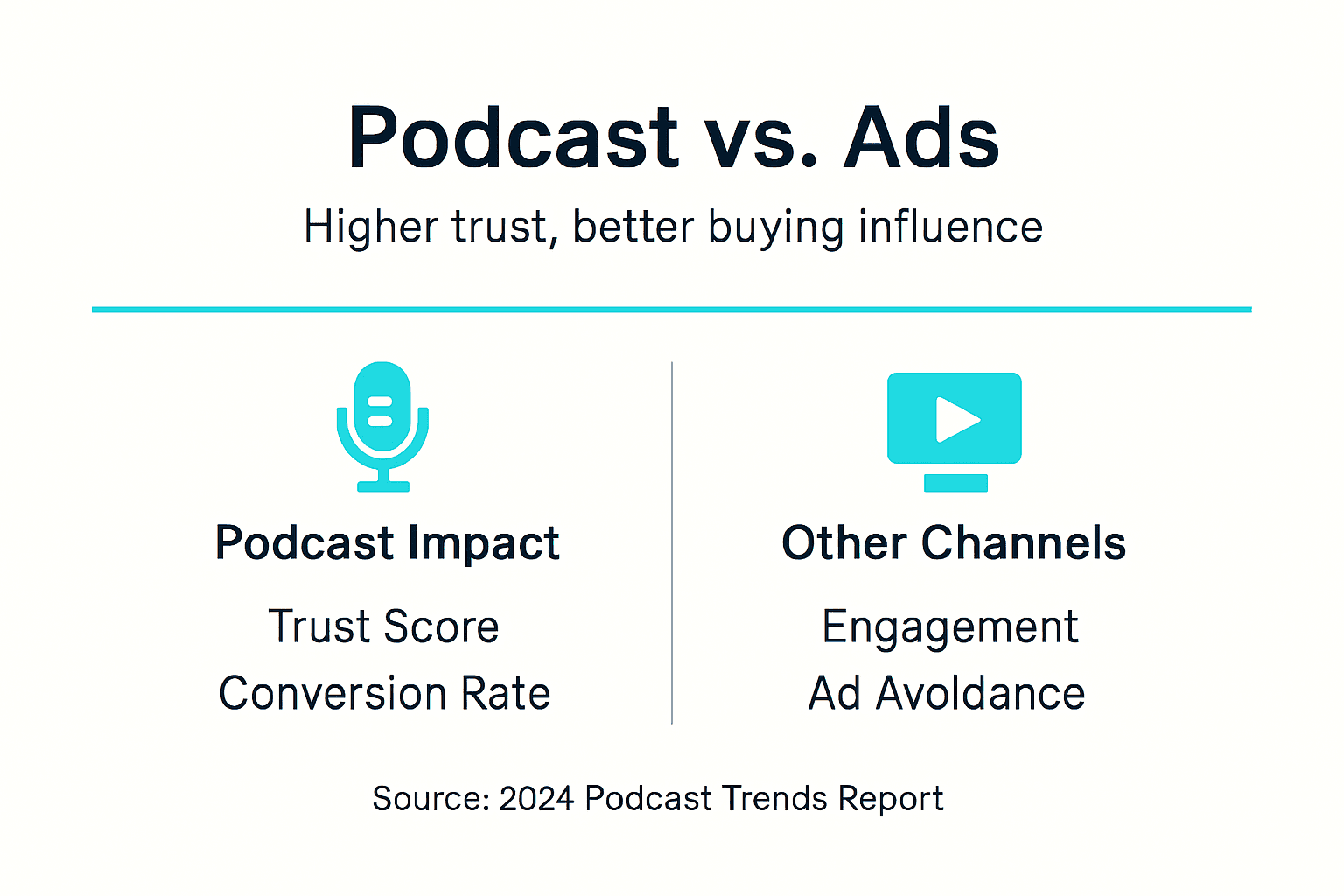
When evaluated against social media, display advertising, and traditional media, podcasts demonstrate superior performance across multiple critical metrics. Podcasts have 2X higher engagement and 1.6X higher conversion than social media ads due to deeper trust and focused attention. This performance gap stems from fundamental differences in how audiences consume and respond to content.
Social media ads face immediate disadvantages: users scroll rapidly past sponsored content, algorithms limit organic reach, and ad fatigue sets in quickly. Podcast listeners actively choose content, commit sustained attention, and develop trust over multiple episodes. This creates receptivity that paid social placements struggle to achieve regardless of budget.

| Channel | Engagement Rate | Trust Score | Conversion Rate | Ad Avoidance |
|---|---|---|---|---|
| Podcasts | 63% | 8.2/10 | 4.8% | 15% |
| Social Media | 31% | 5.1/10 | 2.9% | 58% |
| Display Ads | 18% | 3.8/10 | 1.2% | 72% |
| Traditional Radio | 24% | 6.3/10 | 2.1% | 44% |
Real-world examples validate these comparative advantages. Brands running parallel campaigns across channels consistently report podcast placements generating higher quality leads with better lifetime value. The focused attention podcasts command translates directly into message retention and purchase intent.
Key differentiators include:
- Voluntary engagement versus interruptive advertising reduces resistance
- Long-form content allows detailed product education impossible in 15-second spots
- Host credibility transfers to brands through association and endorsement
- Niche targeting reaches specific demographics with precision matching
Marketers comparing podcast marketing effectiveness to other channels discover that podcast budgets often deliver multiples of the ROI achieved through traditional digital advertising. The channel’s efficiency improves further when campaigns leverage data-driven targeting and measurement.
Practical Applications for Marketers and Brands
Implementing effective podcast marketing requires systematic approaches that maximize authenticity while measuring impact rigorously. Marketers should follow proven frameworks that align brand objectives with podcast audience characteristics and host credibility.
- Identify podcast genres and hosts whose audiences match your target demographics precisely
- Research host authenticity and audience engagement metrics before approaching shows
- Develop customized messaging that respects each podcast’s unique tone and content themes
- Negotiate multi-episode placements to benefit from repetition’s 25% recall boost
- Implement tracking mechanisms linking podcast mentions to website traffic and sales
- Monitor campaign performance continuously, adjusting creative and placements based on data
- Build long-term relationships with high-performing hosts for sustained brand presence
AI platforms transform campaign management by identifying optimal opportunities automatically. Repeated episodic mentions increase recall by 25%, and AI tools enable targeted product mentions and ROI tracking across entire podcast ecosystems. These technologies analyze thousands of episodes simultaneously, surfacing trending products and emerging opportunities human analysts would miss.
Strategic considerations include:
- Seasonal alignment between product launches and relevant podcast content cycles
- Category exclusivity negotiations preventing competitor mentions on the same shows
- Attribution modeling that captures podcast’s role in multi-touch customer journeys
- Content co-creation with hosts developing authentic integration opportunities
Pro Tip: Choose podcasts where product relevance and host authenticity maximize listener trust. Perfect demographic alignment means nothing if the host cannot credibly endorse your offering.
Marketers exploring data-driven podcast marketing strategies gain competitive advantages through precision and accountability. Modern tools eliminate guesswork, replacing intuition with actionable intelligence. Dynamic podcast ads for product discovery enable real-time optimization based on listener response and market conditions.
Conclusion and Future Outlook for Podcast-Driven Buying Influence
Podcast advertising’s growth trajectory through 2026 and beyond positions it as an increasingly critical channel for marketers targeting engaged, affluent consumers. Emerging technologies enhance targeting precision and measurement accuracy, making podcast campaigns more accountable and effective. AI-driven analytics identify micro-trends and optimize placements in real time, dramatically improving ROI.
Authenticity, emotional connection, and relevance will remain the foundation of podcast marketing success regardless of technological advances. Listeners reward genuine endorsements while punishing transparent cash grabs. This dynamic protects podcast advertising’s effectiveness by maintaining quality standards and audience trust.
Key future developments include:
- Programmatic podcast advertising enabling automated buying at scale
- Enhanced attribution modeling connecting podcast exposure to offline purchases
- Interactive ad formats allowing listeners to respond or purchase directly within apps
- Synthetic voice technology enabling personalized ad creative at individual listener levels
- Cross-platform measurement tracking podcast influence across entire customer journeys
Marketers who master podcast buying influence today position themselves advantageously for tomorrow’s audio-first landscape. The intimate, trusted relationships podcasts foster create long-term brand equity that compounds over time, delivering value far beyond immediate conversions.
Explore Prodcast Solutions to Amplify Your Podcast Marketing
Understanding podcast buying influence is just the beginning. Prodcast transforms these insights into actionable marketing strategies through AI-powered analytics that track product mentions, audience sentiment, and conversion patterns across thousands of podcasts. Our platform identifies which products trend in specific categories, revealing real-time opportunities for brand positioning and partnership.

Discover authentic endorsements through our Podcast Moments feature, which surfaces genuine host recommendations and product discussions. Implement data-driven marketing strategies tailored to podcast trends, maximizing ROI while building lasting audience relationships. Leverage AI in podcasting to measure campaign impact with precision impossible through traditional methods. Prodcast bridges the gap between podcast insights and marketing execution, turning conversations into commerce.
FAQ
Why do listeners trust podcast hosts more than traditional ads?
Listeners perceive hosts as friends through parasocial relationships developed over hours of sustained engagement. Hosts share personal stories, vulnerabilities, and authentic experiences that create emotional bonds traditional advertising cannot replicate. This trust makes endorsements feel like advice from someone who genuinely cares about the listener’s wellbeing.
How can marketers measure the ROI of podcast advertising?
Using AI-driven analytics and tracking product mentions helps attribute sales and engagement to specific podcast episodes. Advanced platforms monitor listener behavior, website traffic patterns, and conversion events, connecting podcast exposure to measurable business outcomes. Promo codes and custom landing pages provide additional attribution data.
Which product categories perform best with podcast marketing?
Health, wellness, tech gadgets, and lifestyle products show higher purchase conversion via podcasts due to audience demographics and content alignment. Podcast listeners skew toward educated, affluent consumers interested in self-improvement and innovation. These categories naturally fit podcast content themes, enabling authentic integration that drives results.
What common mistakes should marketers avoid in podcast ads?
Avoid irrelevant ads, one-time mentions, and intrusive formats that reduce listener trust and engagement. Generic scripts ignoring podcast themes alienate audiences instantly. Forcing hosts to read inauthentic endorsements damages credibility for both brand and show. Learn from common podcast advertising mistakes to optimize campaign effectiveness.
Recommended
- Learning From Podcasts: Smart Tips for Listeners and Brands | Prodcast
- What Is Podcast Shopping? 29% Plan AI Buying in 2026 | Prodcast
- What Is Podcast Shopping? 29% Plan AI Buying in 2026 | Prodcast
- Podcast Products: 35% More Buys from AI-Driven Picks | Prodcast
- Come convincere i clienti indecisi ad acquistare dal tuo eCommerce | The Rope
- Dr. Carlos Todd Interviewed For the Couples Expert Podcast with Stuart Fensterheim - Mastering Conflict