CATEGORIES
TAGS
Unlock podcast curation: drive product visibility & engagement
TL;DR:
- Podcast curation filters and contextualizes content, adding strategic value beyond simple aggregation.
- Effective curation involves discovery, evaluation, selection, annotation, and synthesis for marketing impact.
- AI tools enhance scalable, personalized podcast curation, but human judgment remains essential.
Podcast audiences are not just growing fast, they are buying. With 504 million global listeners tuning in by 2026 and podcast fans being 54% more likely to purchase products they hear about, the channel is impossible to ignore. But here is where most content marketers get stuck: they confuse podcast curation with aggregation, recommendation algorithms, or just sharing episode links. These are not the same thing, and the gap between them is where real marketing value lives. This guide walks you through what podcast curation actually means, how to build a practical framework for it, and how to turn those curated moments into multi-channel assets that move the needle.
Table of Contents
- Defining podcast curation: Beyond aggregation
- The marketer’s podcast curation framework
- Curation at scale: The role of AI and algorithms
- Turning curated podcasts into marketing assets
- Why most brands misuse podcast curation (and how to fix it)
- Discover smarter podcast curation tools
- Frequently asked questions
Key Takeaways
| Point | Details |
|---|---|
| Curation vs. aggregation | True podcast curation adds strategic value, context, and relevance—not just episode collection. |
| AI boosts marketing potential | Artificial intelligence helps marketers scale and personalize podcast discovery and insights. |
| Repurpose for wider reach | Each curated podcast can yield multiple assets and extend marketing reach by up to 400 percent. |
| Niche beats trending | Focusing on niche podcasts delivers better alignment and audience engagement than chasing trends. |
Defining podcast curation: Beyond aggregation
Let’s clear something up right away. Podcast curation is not the same as podcast aggregation. Aggregation is what apps like Spotify or Apple Podcasts do by default: they collect episodes and surface them based on popularity or listening history. Curation is something else entirely. It requires a human (or a well-trained system) to filter, contextualize, and add meaning to what is being shared.
Think of it this way. A music playlist app aggregates songs. A music curator builds a playlist with a story, a mood, and a reason for every track. The same logic applies to podcasts.
According to content curation definition frameworks, curation is the act of selecting, organizing, and presenting content in a way that adds value for a specific audience. And as curated podcast content insights from Prodcast show, that value is especially high when the content is filtered through a clear marketing lens.
Here is a quick comparison to make the differences concrete:
| Approach | What it does | Value added |
|---|---|---|
| Aggregation | Collects all available episodes | Low: no filtering or context |
| Algorithmic recommendation | Surfaces content based on behavior data | Medium: personalized but not strategic |
| Podcast curation | Filters by topic, brand fit, and insight potential | High: contextual, narrative-driven, strategic |
So what does great curation actually deliver? A few things:
- Contextual relevance: You are not just sharing a podcast. You are connecting it to a specific marketing goal or audience need.
- Narrative: Curated content tells a story. It shows your audience why this episode matters right now.
- Strategic insight: You are pulling out the moments, quotes, and product mentions that actually matter to your brand.
“Curation adds value and context, distinguishing it from simple aggregation and turning raw content into something genuinely useful for your audience.”
This is the foundation everything else builds on. Once you understand what curation really is, you can start doing it well.
The marketer’s podcast curation framework
Okay, so you are sold on the idea. Now what? Here is a practical five-step framework you can start using today.
1. Discovery Start by identifying podcasts that are relevant to your industry, your audience, and your brand’s voice. Do not just chase the biggest shows. Filtering podcasts by topic relevance, audience alignment, and engagement potential is the foundation of smart curation. Use tools, RSS feeds, and category searches to build an initial list.
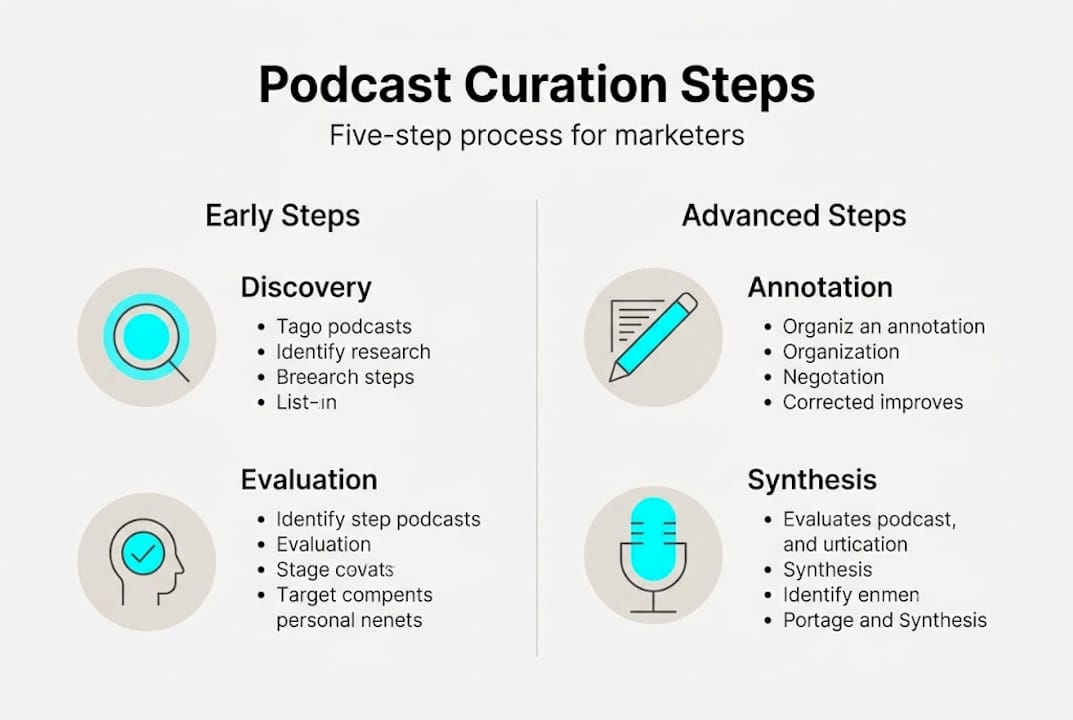
2. Evaluation Not every podcast on your list deserves your attention. Evaluate each one using these criteria: host credibility, episode consistency, audience psychographics (who is actually listening?), and engagement signals like reviews, social shares, and community activity.
3. Selection Pick the episodes and moments that directly connect to your marketing goals. Are you trying to surface trending product mentions? Capture expert opinions? Find social proof for a campaign? Your selection should be intentional, not random.
4. Annotation This step is where most marketers skip ahead and lose value. Tag your selected content with metadata: topic, speaker, key quote, product mentioned, emotional tone, and intended use. This makes it searchable and reusable. Focusing on podcast niche content pays off here because niche episodes tend to have denser, more specific insights worth tagging.
5. Synthesis Now connect the dots. What patterns are you seeing across episodes? What products keep coming up? What questions do hosts keep asking? Synthesis is where curation becomes strategy. Podcast curation research backs this up, showing that structured curation processes significantly improve content output quality and marketing relevance.
Pro Tip: When annotating episodes, create a simple tagging system with three layers: topic tag, brand relevance score (1 to 5), and intended asset type (clip, quote, blog hook). This makes repurposing podcast content dramatically faster down the line.
Here is a rough look at what curation saves compared to creating content from scratch:
| Task | Creating from scratch | Curating existing content |
|---|---|---|
| Research time | 4 to 6 hours | 1 to 2 hours |
| Production cost | High | Low to medium |
| Time to publish | Days to weeks | Hours to days |
| Audience trust signal | Moderate | High (third-party validation) |
Curation at scale: The role of AI and algorithms
Here is the honest truth: manual curation does not scale. If you are tracking dozens of podcasts across multiple industries, you need help. That is where AI comes in.
Modern AI tools can do things that would take a team of analysts weeks to accomplish. They can scan transcripts, identify product mentions, flag key moments, and match content to specific audience profiles. This is not science fiction. It is happening right now.
“LLM-as-judge frameworks match human-level judgment in evaluating podcast content for profile-aware curation, enabling scalable personalization without sacrificing quality.”
That is a big deal. It means AI can now replicate the nuanced decisions a skilled curator makes, and do it across thousands of episodes simultaneously.
Here is what AI-powered curation brings to the table:
- Speed: Processes hours of audio content in minutes through transcript analysis.
- Personalization: Matches content recommendations to specific audience profiles or brand criteria.
- Bias reduction: Removes the human tendency to favor familiar shows or popular names over genuinely relevant content.
- Consistency: Applies the same filtering criteria every time, without fatigue.
You can explore AI applications in curating podcasts to see how platforms are already using these capabilities in practice. And if you want to go deeper on how data-driven podcast recommendations work at scale, the mechanics are more accessible than you might think.
But here is the catch. AI is not a replacement for human judgment. It is a multiplier. The hype vs. reality in curation debate is real, and the brands winning with AI curation are the ones pairing automated discovery with human editorial decisions.
Pro Tip: Use AI to handle discovery and flagging, then apply human review for final selection and annotation. This hybrid approach gives you scale without losing the strategic layer that makes curation valuable.
Turning curated podcasts into marketing assets
Curation without distribution is just a really organized folder. Once you have your curated content, the next step is turning it into assets that actually reach people and drive results.

Here is the process:
1. Select your best moments From your annotated library, pull the clips, quotes, and insights that are most relevant to your current campaign or content calendar.
2. Clip and format Short audio clips (60 to 90 seconds) work brilliantly on social. Pull key quotes for graphics. Use episode summaries as blog post hooks or email intros.
3. Repurpose across channels One curated episode can generate a surprising number of assets. Repurposing one episode can yield six to eight distinct content pieces, resulting in a 400% extension of your content reach. That is a serious return on a single hour of curation work.
4. Distribute strategically Match each asset to the right channel. Short clips go to Instagram Reels or LinkedIn. Quotes become Twitter or X posts. Longer summaries become blog content or newsletter features. Use effective repurposing strategies to map assets to platform behavior.
5. Measure and iterate Track engagement, click-through rates, and conversions per asset type. This tells you which podcast formats and topics resonate most with your audience, feeding back into your curation criteria.
Some best practices to keep in mind:
- Always credit the original podcast and host. It builds goodwill and often earns you organic amplification.
- Keep clips focused on a single idea. Multi-topic clips confuse audiences and underperform.
- Use product mentions as social proof, especially when the host is a trusted voice in your niche.
- Build a content calendar around your curation cadence so distribution stays consistent.
Why most brands misuse podcast curation (and how to fix it)
Here is something we see constantly: brands treat podcast curation like a content shortcut. They share an episode link in a newsletter, call it curation, and wonder why nobody cares. That is not curation. That is forwarding an email.
Real curation requires you to have a point of view. Why does this episode matter to your audience? What does it say about your industry? How does it connect to what your brand actually stands for?
The other big mistake is chasing trending shows instead of relevant ones. A podcast with 2 million downloads is impressive, but if the audience does not overlap with your buyers, it is noise. Understanding podcast popularity is useful context, but popularity should never be your primary filter.
The brands doing this well use curated content as a springboard for thought leadership. They pull a quote, add original commentary, and publish it as a perspective piece. That combination of third-party credibility and original voice is genuinely hard to replicate. It builds authority fast.
The fix is simple: combine data-driven selection with your own editorial layer. Let the data tell you what is being talked about. Let your brand voice tell your audience why it matters.
Discover smarter podcast curation tools
Podcast curation is powerful on its own. But doing it at scale, consistently, across hundreds of episodes? That is where you need the right tools behind you.

Prodcast is built exactly for this. It scans podcast transcripts to surface product mentions, trending topics, and key discussion moments across thousands of shows. You get structured, searchable data instead of hours of manual listening. Explore podcast moments to see what is being said about your category right now. Or check out Mass Persuasion if you want to understand how brands are showing up in audio conversations at scale. Visit Prodcast to see the full picture and start turning podcast conversations into real marketing intelligence.
Frequently asked questions
How is podcast curation different from podcast aggregation?
Podcast curation adds context and value through strategic filters tied to marketing goals, while aggregation simply collects episodes without any editorial judgment or insight.
How can marketers use curated podcasts to boost engagement?
Marketers transform curated episodes into blogs, social clips, and email segments, with one episode yielding six to eight assets and up to 400% more content reach.
What role does artificial intelligence play in podcast curation?
AI enables scalable, personalized curation by using LLM frameworks that match human-level judgment to align podcast content with specific audience profiles and brand needs.
Should brands prioritize curation of trending or niche podcasts?
Niche podcasts are growing three times faster than large shows, and brands consistently see stronger results by aligning curated content with their audience’s specific interests rather than chasing popularity.