CATEGORIES
TAGS
Streamlining podcast product search: your guide

TL;DR:
- Effective podcast product discovery depends on understanding metadata quality, timely engagement signals, and using AI tools with natural language queries.
- Patience is essential, as metadata updates can take two to three weeks to reflect in search rankings, requiring repeated, scheduled searches.
You’d think finding a product a podcast host just raved about would take thirty seconds. It rarely does. Streamlining podcast product search is one of those problems that sounds simple until you’re twenty minutes deep into a show, pausing and rewinding, trying to remember if the host said “AG1” or “AG One” and which episode it was anyway. Most podcast enthusiasts don’t realize how much of the discovery problem is actually a metadata and signal problem, not a content problem. This guide will walk you through exactly how podcast platforms rank and surface content, which tools actually help, and how to build a search workflow that saves you real time.
Table of Contents
- How podcast discovery apps like Pod Seek transform product search
- Metadata mastery: optimizing titles, descriptions, and transcripts for efficient search
- Leveraging freshness and engagement signals to find trending products fast
- Smart workflows: crafting a retrieval-first shortlist for efficient product discovery
- Evaluating metadata updates and search results: timing and expectations
- Why podcast product search needs a human-centered, metadata-aligned approach
- Explore trending podcast product moments with Prodcast
- Frequently asked questions
How podcast discovery apps like Pod Seek transform product search
Here’s the honest truth about most podcast apps: their search is basically a keyword box from 2012. You type “best protein supplements” and you get a list of show titles, sorted by… nobody knows. That’s the grind so many of us have accepted.
Pod Seek, launched in 2026, is a genuine shake-up. It was built specifically for discovery, not playback. No ads, no subscription wall. Just a clean interface designed to help you find the good stuff before you commit your ears to it. What makes it different is AI-powered question answering about podcast content before you even subscribe. You can ask it something like “Which fitness podcasts talk about creatine timing this month?” and actually get a useful answer. That’s a different animal from scrolling through show art.
It also pulls in richer data than most apps:
- Transcripts indexed for each episode, so product mentions are actually searchable
- Funding and sponsorship information tied to shows, which matters when evaluating whether a recommendation is organic or paid
- Person tags linking hosts and guests across shows, great when you’re tracking a specific expert’s recommendations
- Sync with Castro for immediate listening after you’ve found what you want
The role of AI in podcast discovery is expanding fast, and apps like Pod Seek show what it looks like when AI is applied to the search problem specifically, not just the listening experience.
Pro Tip: When using AI-powered discovery apps, phrase your questions the way you’d ask a knowledgeable friend. “What supplements did the FoundMyFitness podcast mention this week?” beats “fitness supplements podcast.” Conversational queries match transcript language more closely and return sharper results.
Metadata mastery: optimizing titles, descriptions, and transcripts for efficient search
Here’s something most listeners don’t think about but probably should: when you search for a product in a podcast app, you’re not searching audio. You’re searching text fields submitted via RSS feed. That changes everything about how you should think about efficient podcast finding.

Podcast apps prioritize keywords in show titles and episode descriptions, with transcripts mainly helping web indexing rather than in-app search. So if a host mentioned a specific book on a “Mindset Monday” episode with no other identifying information in the title, that product mention is basically invisible to the search index.
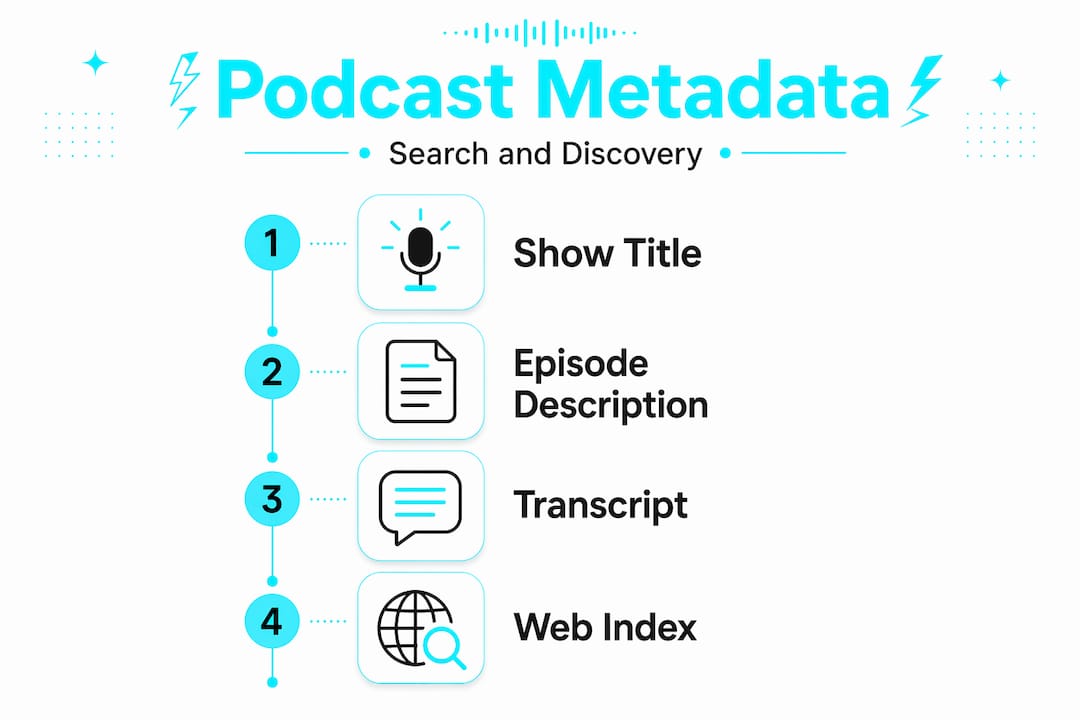
Here’s how the major metadata fields stack up for search impact:
| Metadata field | In-app search impact | Web/Google impact | Product discovery value |
|---|---|---|---|
| Show title | Very high | High | High if keyword-rich |
| Episode title | High | Medium | High for specific products |
| Episode description | High | High | Very high if detailed |
| Transcript | Low | Very high | High on AI-powered platforms |
| Tags/categories | Medium | Low | Medium |
The practical takeaway for listeners: when searching for product recommendations, go beyond the show title. Paste a product name directly into the search bar. If a show has detailed episode descriptions, that product name will surface. If it doesn’t, you’ll need to rely on tools like Prodcast that mine transcript-level data instead.
A few signals to look for when evaluating whether a show’s metadata is search-friendly:
- Episode titles that name specific products, guests, or topics rather than vague hooks
- Descriptions that run more than two sentences and include specific terms
- Shows that publish chapters or timestamps, which signals metadata care
- Consistent naming conventions across episodes (search engines love patterns)
Podcast product metadata strategies are also worth understanding from the creator side, since it helps you predict which shows will be easier to search and which will require more digging. And if you want to go deeper on how creators can boost podcast discoverability, that’s a useful lens on why some shows surface for your queries and others don’t.
Pro Tip: When a product search in your app returns nothing, switch to Google and search: "site:[podcastplatform.com] “[product name]”`. This taps into transcript-level and web-indexed content that in-app search misses entirely.
Leveraging freshness and engagement signals to find trending products fast
You can find a podcast from 2019 raving about a product that’s been discontinued for three years. The metadata might be perfect. The engagement numbers might still look solid. But the recommendation is stale. This is why freshness is not optional when you’re looking for what’s actually trending now.
Recent publishing activity and listener engagement heavily influence podcast rankings on Spotify and Apple Podcasts. What that means for you: newer episodes from actively publishing shows will float higher in search results, naturally surfacing fresher product mentions.
Here’s the framework I’d actually use for finding trending product recommendations quickly:
- Filter by publication date first. Set your app to show episodes from the last two weeks. Most major apps have this filter; use it before you type a single search term.
- Look for engagement signals. High comment counts, review mentions of specific episodes, and social shares all indicate a recommendation landed.
- Check the listen-through rate if visible. Apps like Spotify for Podcasters publish this data publicly for some shows. A high completion rate on a specific episode means the content, including any product plugs, resonated.
- Cross-reference with community chatter. Subreddits, Discord communities, and X posts often surface product mentions faster than any search tool.
“The shows that consistently rank for product-related searches aren’t necessarily the biggest ones. They’re the ones publishing frequently, getting completions, and earning follows right after discovery. Freshness and listener action are the real ranking fuel.”
Think of it this way: podcast search and engagement are a feedback loop. When listeners search, find, and follow, it signals to the platform that the show is relevant for that query. That elevates it for the next person searching the same thing. Riding that wave means you need to be searching while that signal is fresh, not six months later.
Key things to watch for when scanning for fresh product trends:
- Episodes tagged “new” or “this week” in show descriptions
- Shows with weekly publishing cadences in competitive niches like fitness or business
- Guests who are themselves product founders or investors (they almost always mention tools they use)
Smart workflows: crafting a retrieval-first shortlist for efficient product discovery
Most people approach podcast product search like a treasure hunt. They browse. They hope. They stumble. A retrieval-first approach flips that entirely. You define what you want, then you build a shortlist of shows and episodes likely to have it. Less wandering, more finding.
Build shortlists using episode titles and descriptions that match your natural search queries for quicker retrieval. That’s the core move. Here’s how to make it practical:
- Write out your query in plain English first. Something like “What resistance bands are fitness coaches recommending in 2026?” Write it before you search anything.
- Break it into search-friendly fragments. “resistance bands fitness podcast 2026” and “best resistance bands coach recommendation” are two searches, not one.
- Search both the show title and episode title fields separately. Some apps let you filter by field; use that when available.
- Score each result by metadata quality. Does the episode description mention the product specifically? Does the show publish transcripts? Higher quality metadata means higher confidence in what you’ll find inside.
- Build a shortlist of 5 to 10 episodes. Don’t try to process everything. A focused shortlist you actually listen to beats a giant list you never open.
- Return to this process every 2 to 3 weeks. Indexing delays mean fresh content takes time to surface, so your search from today won’t catch everything published today.
The podcast discovery workflows that actually work all share one thing: they treat search as a repeatable process, not a one-time event. You’re not just looking for one product. You’re building a radar for your niche.
Pro Tip: Save your best-performing search queries as bookmarks or notes. Rerunning the same query every few weeks is one of the most efficient ways to catch new episodes that just entered the index.
Evaluating metadata updates and search results: timing and expectations
Here’s where a lot of people get frustrated and give up too early. You try a new search approach, or a podcast host updates their episode descriptions with richer product detail, and you check back two days later expecting it to show up. It doesn’t. So you assume the strategy doesn’t work.
Metadata changes take 2 to 3 weeks to be reflected in search rankings due to ingestion lags in podcast platforms. The RSS feed has to be re-crawled, processed, and reindexed before any changes appear in search. That’s just the reality of how these systems work.
What this means for your search strategy:
- Don’t judge a search approach in the first week. Give it at least two to three weeks before drawing conclusions about whether a particular query or filter is working.
- Revisit the same searches on a schedule. Set a calendar reminder every two weeks to rerun your top queries. You’ll often find new results that weren’t there last time.
- Use engagement data as a leading indicator. Follow counts and social mentions often surface a trending product episode before it climbs in search rankings.
- Track which shows update their metadata regularly. Shows that actively maintain their descriptions and tags will surface faster after publishing new product-relevant content.
Patience here isn’t passive. It’s part of the podcast SEO timeline tips that separate listeners who consistently find great product recommendations from those who give up and go back to Google.
Why podcast product search needs a human-centered, metadata-aligned approach
Here’s the uncomfortable thing about relying entirely on AI tools for podcast product discovery: the AI is only as good as the text it’s reading. And most of that text was written by humans who may or may not have thought carefully about how their content gets found.
I’ve seen this pattern play out repeatedly. A listener gets excited about an AI-powered discovery app, uses it for a week, and then complains it “doesn’t understand” what they’re looking for. But the real issue isn’t the AI. It’s that the shows they’re searching within have terrible episode descriptions, vague titles, and no transcripts. The AI has nothing to work with.
This is why understanding metadata isn’t just a creator problem. It’s a listener problem too. When you understand why some shows surface and others don’t, you become a smarter searcher. You gravitate toward shows with higher metadata quality. You recognize when a product mention that makes you pause the episode is likely to be findable again later, and when it isn’t.
There’s also the human habit trap to watch for. Keyword stuffing can trigger spam filters and reduce rankings, harming discovery. This applies to how listeners should think about search too. If you try to force hyper-specific product queries (“best blue light blocking glasses biohacking podcast cold plunge 2026”), you’ll often get nothing. Natural language queries that mirror how a host would actually describe an episode perform better.
The best data-driven podcast search strategy is one where you bring human judgment to the signals: use AI apps for scale and speed, but use your own understanding of how metadata works to interpret the results. The feedback loop between engagement signals and ranking rewards that combination over time. There’s no shortcut that replaces knowing how the system actually works.
Explore trending podcast product moments with Prodcast
Understanding the mechanics of podcast product search is one thing. Actually seeing those mechanics in action, pointing at real products being discussed right now, is where it gets genuinely useful.

Prodcast indexes thousands of podcast episodes and surfaces the exact moments of product discovery that matter to you. You can filter by niche, including fitness, business, and technology, to find what hosts are actually recommending to their audiences this week. Want to see how a specific product like Mass Persuasion or Monster Energy Drink is being discussed across different shows? It’s all there, timestamped and searchable. Every tactic covered in this guide comes to life when you have a platform built specifically to surface these product moments at scale.
Frequently asked questions
What is the best way to find trending products mentioned in niche podcasts?
Focus on recently published episodes with strong listener engagement and search shows with clear, keyword-rich titles and descriptions matching your interests. Listener behavior after search and recent publishing activity both affect which shows rise in platform rankings.
How do podcast transcripts affect product search?
Transcripts improve web search indexing for podcasts but have limited impact on in-app search, which depends more on metadata like titles and descriptions. Transcripts help Google indexing while directory searches rely primarily on RSS metadata fields.
Why shouldn’t I stuff keywords in my podcast descriptions?
Excessive keywords can trigger spam filters on podcast platforms, reducing your visibility and making it harder for listeners to find relevant content. Keyword stuffing harms discovery by lowering engagement quality signals alongside the ranking penalty.
How long does it take for metadata changes to affect podcast search rankings?
Podcast platforms typically take 2 to 3 weeks to ingest and reflect metadata updates in their search rankings, so patience and scheduled monitoring are essential. RSS.com advises waiting 2 to 3 weeks after any metadata changes before evaluating their impact.
Can AI-based podcast apps improve how I search for products?
Yes, AI-powered apps like Pod Seek enable conversational search and more relevant recommendations before subscription, which genuinely improves the product discovery experience. Pod Seek uses Apple foundation models to let you ask natural language questions about a show’s content before you commit to subscribing.