CATEGORIES
TAGS
Podcast reviews and listener behavior: driving growth in 2026

Most podcast marketers assume that racking up five-star reviews is the secret to climbing the charts. More reviews, higher ranking, more listeners. It sounds logical. But here’s the thing: podcast reviews don’t directly influence algorithmic rankings on Apple Podcasts or Spotify. Not even close. So why do reviews still matter so much? Because their real power isn’t in the algorithm. It’s in the minds of your listeners. Reviews shape credibility, drive listening decisions, and reveal behavioral patterns that smart marketers can actually use.
Table of Contents
- Why podcast reviews matter more than you think
- What reviews really tell you: decoding listener behavior
- Emotional versus analytical review content: why it matters
- The indirect impact of reviews on podcast growth
- Expert perspectives: debunking ranking myths and applying real insights
- Leverage podcast reviews for smarter marketing with Prodcast
- Frequently asked questions
Key Takeaways
| Point | Details |
|---|---|
| Not a ranking factor | Podcast reviews do not directly affect platform rankings but do influence growth through behavior. |
| Credibility and conversions | Positive reviews grow listener trust and boost click-through and subscription rates. |
| Emotional reviews drive referrals | Emotionally charged reviews result in more referrals and retention than analytical ones. |
| Actionable insights | Analyzing review content helps marketers optimize messaging and campaign strategy. |
Why podcast reviews matter more than you think
With that misconception set aside, let’s dig into why reviews remain crucial for marketers and audience growth.
The myth is stubborn. Ask almost any podcaster and they’ll tell you reviews help them rank. It feels true because correlation is easy to spot. A show gets a wave of reviews and suddenly downloads spike. But the spike isn’t caused by the reviews. It’s caused by the same momentum that generated the reviews in the first place.
What reviews actually do is influence people. Real humans browsing for their next favorite show. When someone lands on your podcast page and sees 400 glowing reviews, they’re far more likely to hit play. Reviews build credibility and increase click-through rates and subscriptions by shaping listener behavior before a single second of audio plays.
And as podcast ratings research confirms, no major platform uses review counts as a direct ranking signal. The platforms that matter most are watching engagement, not star counts.
Here’s what reviews genuinely do for your show:
- Build social proof that converts browsers into subscribers
- Signal trustworthiness to first-time listeners who don’t know your brand yet
- Provide qualitative feedback that quantitative metrics miss entirely
- Attract brand partnerships by demonstrating an engaged, vocal audience
- Support data-driven discovery strategies when analyzed at scale
“The shows that win aren’t always the ones with the most reviews. They’re the ones whose reviews make a stranger feel like they’re already part of the community.”
That’s the real edge. Social proof isn’t just a vanity metric. It’s a conversion tool.
What reviews really tell you: decoding listener behavior
Once it’s clear reviews influence listeners, the next step is to use this feedback to decode what drives audience loyalty.
A study analyzing over 12,000 listener reviews found something fascinating. Listeners develop parasocial intimacy with hosts, meaning they feel a genuine personal bond even though the relationship is one-sided. When hosts change or content shifts, listeners experience real nostalgia and sometimes abandon the show entirely. That’s not just interesting. It’s actionable intelligence.

For marketers, this means review text is a goldmine of behavioral signals. Here’s what recurring themes in reviews typically reveal:
| Theme found in reviews | What it signals for marketers |
|---|---|
| “I feel like I know the host” | Strong parasocial bond, high retention potential |
| “This show changed since Season 2” | Content drift risk, loyalty erosion warning |
| “I recommend this to everyone” | High referral intent, ideal for word-of-mouth campaigns |
| “I’ve listened since the beginning” | Long-term loyalty, strong brand ambassador candidate |
| “The ads feel natural here” | High ad receptivity, premium sponsorship opportunity |
To actually extract these signals, here’s a practical approach:
- Collect reviews in bulk across platforms, not just Apple Podcasts
- Tag recurring words and phrases by theme (trust, nostalgia, recommendation intent)
- Track sentiment shifts over time, especially after format or host changes
- Cross-reference review themes with download and completion rate data
- Use insights to inform content decisions and grow your podcast audience with precision
Pro Tip: Don’t just read reviews. Categorize them. A spreadsheet with columns for sentiment, theme, and date can reveal trends that a quick scroll never would.
Emotional versus analytical review content: why it matters
Marketers also need to understand that not all reviews are equal. What’s said and how it’s said matters for referrals and retention.
There are two types of review language worth knowing. Affective content is emotional. Think: “This podcast makes me feel less alone” or “I cried during episode 47.” Cognitive content is analytical. Think: “The production quality is excellent” or “The guest lineup is well-curated.”
Research shows that affective review content boosts referral and repurchase behaviors, while cognitive content actually suppresses them. Emotional reviews make people want to share. Analytical reviews make people feel informed but not necessarily moved to act.
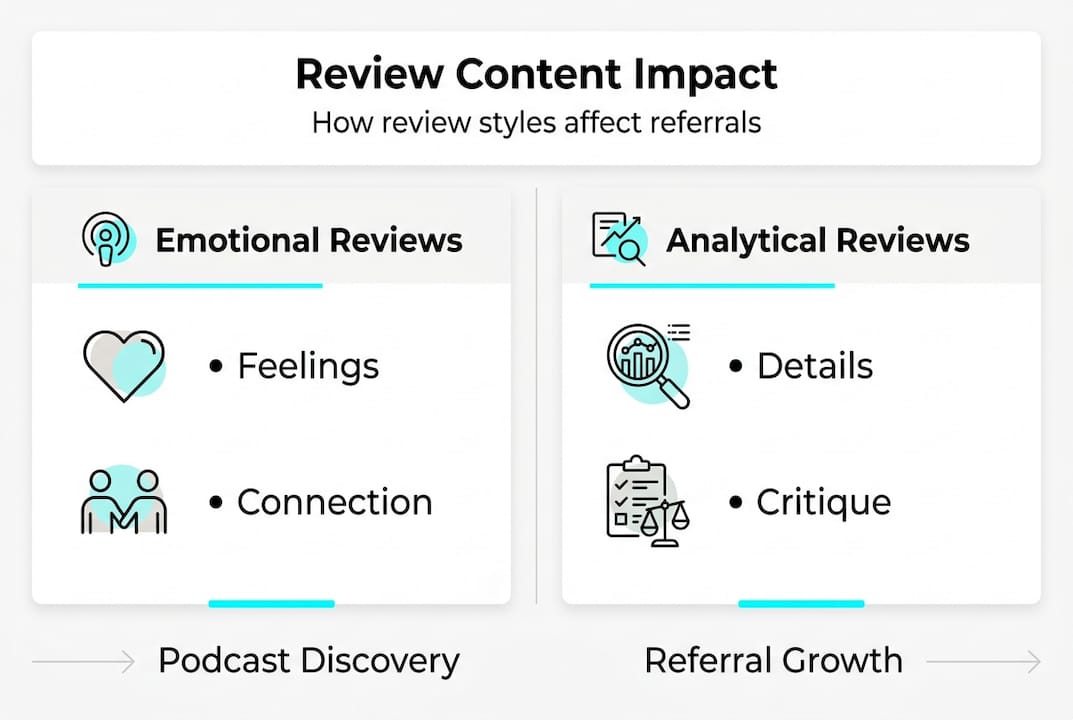
| Review type | Language style | Impact on referrals | Best use for marketers |
|---|---|---|---|
| Affective | Emotional, personal, story-driven | High positive impact | Testimonials, ad copy, social proof |
| Cognitive | Analytical, feature-focused, logical | Neutral to suppressive | Product comparisons, B2B pitches |
So what does this mean practically? When you’re pulling reviews for a campaign, prioritize the emotional ones. Those are the nuggets that make a stranger feel something. Use them in ad creative, on landing pages, and in pitch decks to brand partners.
Here’s what to look for when mining reviews for campaign material:
- Personal transformation stories (“This show helped me quit my job and start a business”)
- Emotional connection language (“I feel understood,” “This is my therapy”)
- Spontaneous recommendation intent (“I’ve sent this to 10 friends”)
- Specific episode or moment callouts that reveal what content resonates most
Pro Tip: Build a swipe file of your most emotionally charged reviews. Revisit it before every campaign brief. It’ll keep your messaging grounded in what listeners actually feel, not what you assume they feel.
A data-driven marketing strategy that incorporates review sentiment analysis will consistently outperform one built on gut instinct alone.
The indirect impact of reviews on podcast growth
Let’s tie this together by examining how reviews, while not direct signals, still influence podcast growth and ranking via engagement.
Here’s the chain reaction that actually happens. A listener reads a compelling review. They subscribe. They listen to three episodes back to back. They complete each one. They follow the show. Every one of those actions is an engagement signal that platforms like Spotify and Apple Podcasts do track and reward.
So reviews don’t boost rankings directly. But they trigger the behaviors that do. Reviews act as conversion levers rather than direct ranking factors, converting casual browsers into active listeners who generate the engagement metrics platforms actually care about.
And encouraging listener reviews indirectly boosts rankings by increasing plays, follows, and completion rates. The review is the spark. The engagement is the fire.
Here’s a practical sequence to make this work for your show:
- Ask for reviews at peak emotional moments in episodes, not just at the end
- Respond to reviews publicly when possible to signal community and encourage more
- Feature standout reviews in your social content to amplify their reach
- Use review themes to create content that drives even more completions
- Track the correlation between review surges and engagement metric lifts to prove ROI
The conversion funnel here is real. A browser sees strong reviews, becomes a listener, completes episodes, follows the show, and eventually becomes a brand advocate. That’s the full journey. Reviews are just the entry point, but they’re a critical one. Monitoring advertising effectiveness alongside review trends gives you a complete picture of what’s actually moving the needle.
Expert perspectives: debunking ranking myths and applying real insights
Now that we’ve discussed the mechanisms, here’s what experts say, the nuances, and how to translate reviews into marketing action.
The debate among podcast industry experts is real. Some claim that a surge in reviews signals algorithmic trust to platforms, nudging rankings upward. Others point to platform documentation and say there’s simply no evidence of a direct connection. The truth, as platform research confirms, is that no major platform has confirmed reviews as a ranking factor. The perception persists because growth and reviews often happen simultaneously, but correlation isn’t causation.
“Chasing reviews for ranking purposes is like watering plastic plants. It looks productive but nothing actually grows.”
What Apple and Spotify do confirm is that engagement metrics drive visibility. Completion rates, follows, shares, and saves are the signals that matter algorithmically. Reviews matter for the human layer, not the machine layer.
So here’s your actionable checklist for turning review insights into campaign wins:
- Monitor review text weekly, not just star ratings
- Flag emotional language and recurring themes for content and ad strategy
- Use review sentiment shifts as early warning signals for audience dissatisfaction
- Incorporate top reviews into influencer briefs and partnership pitches
- Align your content calendar with the themes listeners praise most
- Explore influencer marketing strategies that amplify what reviews already confirm listeners love
The marketers who win here aren’t the ones obsessing over star counts. They’re the ones reading between the lines and using what they find to build smarter campaigns.
Leverage podcast reviews for smarter marketing with Prodcast
Ready to turn all these insights into action? Here’s how Prodcast can help you master review-driven strategies.
Prodcast is built for exactly this kind of work. Instead of manually scrubbing through hundreds of reviews and transcripts, the Prodcast platform uses AI to surface the moments, mentions, and sentiment patterns that matter most to your brand. You get structured, searchable data from thousands of podcasts, so you can see what listeners are actually saying and caring about right now.

For podcast marketers and brand managers, that means less guesswork and more signal. You can track which products are getting organic mentions, identify which shows have the most emotionally engaged audiences, and build campaigns grounded in real listener behavior. Podcast Moments lets you pinpoint the exact clips and discussions driving the most listener response, so you can act on insights before your competitors even notice the trend.
Frequently asked questions
Do podcast reviews improve my ranking on Apple or Spotify?
Podcast reviews don’t directly improve rankings on major platforms, but they drive the engagement behaviors like listens, follows, and completions that algorithms do reward.
Why should marketers track review content, and not just star ratings?
Star ratings tell you sentiment at a glance, but review text reveals the deeper story. Analysis of 12,000 listener reviews shows that themes like trust, nostalgia, and host intimacy are the real drivers of loyalty and churn.
What type of review is most likely to increase referrals and repurchases?
Affective, emotion-driven reviews consistently outperform analytical ones when it comes to driving referrals and repeat engagement. Emotional language moves people to act.
How do reviews help with podcast product promotion?
Reviews build social proof that directly influences listener decisions, making them more likely to trust and act on product mentions from hosts they already feel connected to.
Recommended
- Podcast content trends to boost engagement in 2026 | Prodcast
- Podcast content trends to boost engagement in 2026 | Prodcast
- How to grow my podcast audience with proven 2026 strategies | Prodcast
- Grow Podcast Audience Using Data-Driven Insights | Prodcast
- Master DJ video marketing to grow your fanbase in 2026 | Music Video Marketplace Blog