CATEGORIES
TAGS
Podcast Revenue Models: Maximize Earnings and Audience Value

TL;DR:
- Podcast revenue streams include advertising, memberships, affiliate deals, merchandise, and branded content.
- Niche shows can earn more per listener through targeted sponsorships and memberships.
- Combining multiple monetization models enhances income stability and growth opportunities.
Podcast monetization is messier and more exciting than most people realize. A show with 500 loyal listeners can sometimes out-earn one with 50,000 casual subscribers. That gap exists because the revenue models available to podcasters today go way beyond slapping a pre-roll ad at the top of an episode. Sponsorships, memberships, affiliate deals, live events, digital products, branded content — the toolkit is deep. Yet most creators still default to chasing download numbers and waiting for ad networks to come calling. This guide breaks down every major model, what the data actually says about each one, and how you can build a revenue mix that fits your show right now.
Table of Contents
- Understanding the podcast revenue landscape
- Sponsorships and advertising: The dominant force
- Memberships, paid subscriptions, and niche community power
- Emerging models: Affiliate, commerce, and branded content
- Choosing your revenue mix: What actually works?
- Podcast revenue models: What the data doesn’t tell you
- Turn knowledge into podcast income with Prodcast
- Frequently asked questions
Key Takeaways
| Point | Details |
|---|---|
| Ads drive most revenue | Sponsorships and advertising provide the largest share of podcast income, especially for shows with broad reach. |
| Membership potential | Engaged niche audiences can generate stable income through paid subscriptions and memberships, even at small scale. |
| Diversified models matter | Combining affiliate, merchandise, and branded content strategies increases resilience and long-term growth. |
| Audience quality over size | Deep engagement delivers higher per-listener value than large but passive download numbers. |
Understanding the podcast revenue landscape
Let’s start with the full picture. Podcast revenue models fall into several distinct buckets: advertising and sponsorships, paid subscriptions and memberships, affiliate marketing, merchandise, live events, digital products, and branded content. Each one has a different risk profile, a different income ceiling, and a different relationship with your audience.
Here’s a quick side-by-side look at how the major models stack up:
| Revenue model | Market share | Typical earnings | Best for |
|---|---|---|---|
| Advertising and sponsorships | 41 to 60% | $18 to $50 CPM | Mid-to-large shows |
| Paid subscriptions and memberships | 20 to 23% | $5 to $20 per fan/month | Niche, engaged audiences |
| Affiliate marketing | Growing | 5 to 30% commission | Any size show |
| Merchandise | Varies | $10 to $50 per item | Brand-loyal communities |
| Live events and digital products | Emerging | $50 to $500+ per ticket | Established creator brands |
| Branded content | Emerging | Custom deals | Thought-leader shows |
The monetization models research tells a clear story: advertising still dominates, but it’s far from the only game in town. Niche shows, in particular, are finding that direct listener support and affiliate income can be far more stable than chasing CPM rates.
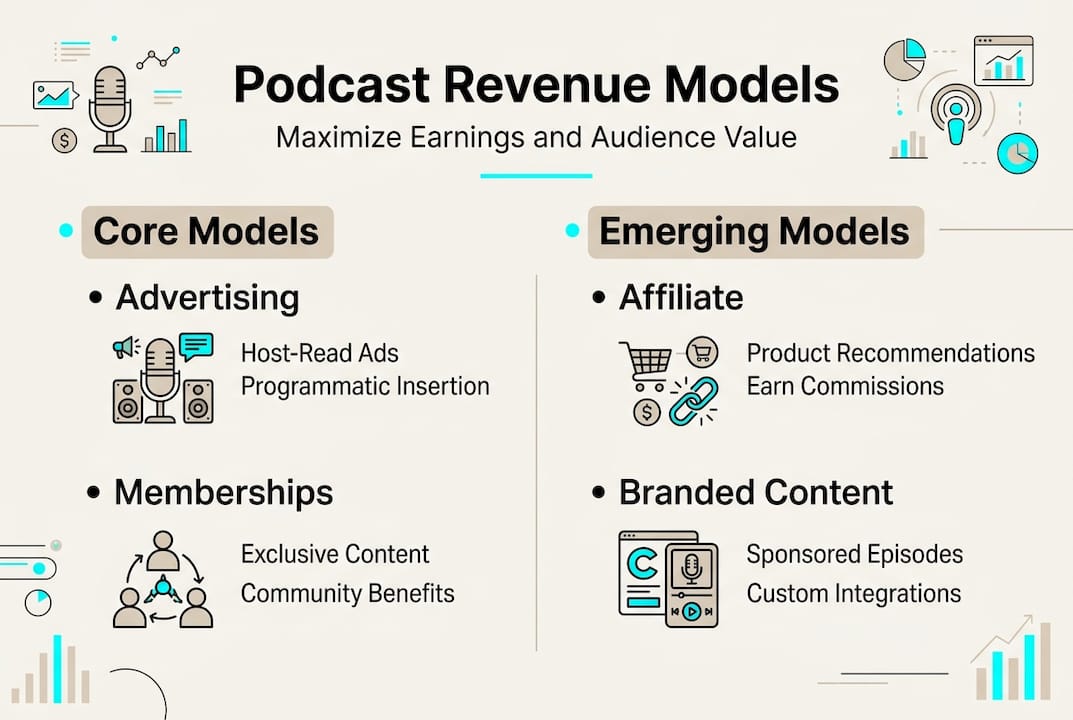
Here’s what’s interesting about the niche versus broad show dynamic. A true-crime show with 200,000 downloads per episode will naturally gravitate toward programmatic ads and big-brand sponsorships. But a B2B software podcast with 3,000 highly targeted listeners? That show might earn more per listener through consulting referrals, premium content, or software affiliate deals. The revenue model should follow the audience, not the other way around.
Some key models to keep on your radar:
- Advertising and sponsorships: The most established path, but requires consistent download numbers to attract most networks.
- Memberships and subscriptions: High loyalty, recurring income, and a direct relationship with your biggest fans.
- Affiliate marketing: Low barrier to entry, works at any audience size, and ties income directly to listener trust.
- Merchandise and live events: Great for community building, though logistics can be complex.
- Branded content and digital products: High upside, especially for shows with strong host authority.
The smartest podcasters treat these not as competing options but as layers they build over time.
Sponsorships and advertising: The dominant force
With all revenue models mapped out, it’s time to drill deeper into the biggest one: advertising and sponsorship. Advertising and sponsorships account for 41 to 60% of podcast revenue across the industry. That’s a massive chunk, and it’s not going anywhere soon.
The core mechanic here is CPM, which stands for cost per mille, or cost per 1,000 listens. Sponsors pay a set rate for every thousand downloads an episode receives. Rates vary significantly by niche and audience size:
| Show size (monthly downloads) | Typical CPM range | Notes |
|---|---|---|
| Under 5,000 | $15 to $25 | Direct outreach required |
| 5,000 to 50,000 | $20 to $35 | Network eligible |
| 50,000 to 200,000 | $30 to $50 | Premium sponsor access |
| 200,000+ | $40 to $80+ | Custom deal territory |
The podcast ad industry trends show that host-read ads consistently outperform programmatic placements. Listeners trust the host. When a host genuinely recommends a product they use, that endorsement carries real weight. That’s why sponsorship cost data often shows smaller, more engaged shows commanding higher effective CPMs than larger, more passive audiences.
So how do you actually attract sponsors? Here’s a practical sequence:
- Build your audience analytics dashboard. Know your listener demographics, geographic distribution, and average listen-through rate. Sponsors want proof of engagement, not just raw numbers.
- Create a one-page media kit. Include your show’s mission, audience profile, download stats, and available ad formats (pre-roll, mid-roll, host-read, sponsored segments).
- Target relevant brands directly. Don’t wait for networks. Research brands that already advertise on similar shows and reach out with a personalized pitch.
- Start with affiliate-style deals. If a brand won’t commit to a flat CPM, offer a performance-based arrangement using a custom promo code. This lowers their risk and proves your audience converts.
- Deliver results and report back. Share redemption rates, listener feedback, and any sales data you can access. Sponsors who see ROI renew. It’s that simple.
Pro Tip: A podcast with 2,000 highly targeted listeners in the cybersecurity space can charge premium rates that a general tech show with 20,000 downloads cannot. Niche specificity is a pricing advantage, not a limitation.
“Advertising and sponsorships account for 41 to 60% of podcast revenue” — but that leaves 40 to 59% of income sitting on the table for creators who diversify.
Memberships, paid subscriptions, and niche community power
Beyond ads, direct listener support is transforming creator income. Let’s look at memberships and subscriptions. This model flips the dynamic entirely. Instead of selling your audience’s attention to a brand, you’re asking your audience to invest directly in you. And when done right, it works beautifully.

Platforms like Patreon have made this model mainstream. Memberships represent 14.8% of all payments across creator platforms, and top shows earn over $100,000 per month. Even at a modest scale, the math is encouraging: 100 fans paying $5 per month generates $500 in recurring monthly income. Scale that to 500 fans at $10 per month and you’re looking at $5,000 monthly, before a single sponsor deal.
The most common membership perks include:
- Ad-free episodes: The single most popular perk across every platform.
- Early access: Releasing episodes 24 to 72 hours early for paying members.
- Bonus content: Extended interviews, behind-the-scenes clips, Q&A sessions.
- Private community access: Discord servers, Slack groups, or private forums where members interact with the host and each other.
- Physical perks: Stickers, signed merch, or handwritten notes for higher tiers.
The podcast membership strategies that actually sustain over time share one trait: they reward the super-fans, not just the casual listeners. The goal isn’t to convert every listener into a paying member. It’s to give your most passionate 1 to 5% a reason to go deeper.
Pro Tip: Before launching a membership, survey your existing audience. Ask what they’d actually pay for. The answers will surprise you, and they’ll tell you exactly which perks to lead with.
Sustainable membership growth comes from consistent interaction. Reply to member comments. Acknowledge their support on air. Make them feel like insiders, not just subscribers. That emotional connection is what keeps the monthly charge from feeling like a bill.
Emerging models: Affiliate, commerce, and branded content
Now that we’ve covered the core and established models, let’s turn to newer, high-upside opportunities. Emerging formats including affiliate deals, branded content, live events, and merchandise are diversifying creator earnings and attracting entirely new audiences to podcasting as a medium.
Affiliate marketing is the most accessible of these. You recommend a product, share a custom link or promo code, and earn a commission when your listeners buy. Commission rates typically range from 5% for physical goods up to 30% or more for software and digital products. The beauty of affiliate income is that it scales with trust, not downloads. A small show whose host genuinely loves a product can drive serious conversions.
Some creative ways creators are blending commerce into their content:
- Book recommendations with affiliate links: Common in business and self-improvement podcasts, where hosts regularly cite books. Platforms like Bookshop.org offer affiliate programs that align well with this format.
- Tool and software reviews: Tech and productivity shows regularly mention apps and platforms. Embedding affiliate links in show notes and episode descriptions turns those mentions into trackable income.
- Curated product roundups: Some creators publish weekly or monthly lists of products discussed across recent episodes, turning their content into a shopping resource.
- Branded content segments: A sponsor funds a dedicated segment within the episode, often tied to a specific topic the host would cover anyway. It’s more integrated than a traditional ad and commands higher rates.
The podcast commerce strategies that work best right now are the ones where the product recommendation feels like a natural extension of the conversation. Listeners can smell a forced endorsement from a mile away.
This is also where AI in podcast revenue is starting to make a real difference. AI tools can surface which products are being mentioned most frequently across thousands of episodes, giving marketers a real-time signal of what audiences are actually hearing and caring about. That’s a significant edge for brands trying to find the right shows for affiliate or branded content partnerships.
Pro Tip: Blending affiliate commerce with branded content creates a double revenue opportunity. You earn the affiliate commission when listeners buy, and the brand pays for the placement. Done transparently, this is completely legitimate and very lucrative.
The alternative revenue streams data confirms that creators who combine three or more models see significantly more income stability than those who rely on a single source.
Choosing your revenue mix: What actually works?
With all the models on the table, how should you choose your podcast’s monetization approach? The honest answer is that there’s no universal formula. But there is a framework that helps.
For small podcasts, prioritizing an engaged niche over raw downloads is the smartest starting move. Services and consulting can yield the highest per-listener value of any model. A business coach with a 1,000-listener podcast who converts even 1% into a $2,000 consulting client earns $20,000 from a single episode. No CPM rate touches that.
Here’s a practical four-step framework for building your revenue mix:
- Assess your audience first. Who are they? What do they buy? What problems are they trying to solve? Your revenue model should answer those questions, not ignore them.
- Test two or three models simultaneously. Don’t go all-in on one stream. Run a small affiliate program while you pitch sponsors. Launch a basic membership tier while you’re still building your ad income.
- Measure results after 90 days. Which model generated the most income per hour invested? Which one your audience responded to most positively? Double down on that.
- Iterate annually. The podcast landscape shifts. What works in 2026 may look different in 2027. Build flexibility into your strategy from the start.
Pro Tip: AI tools are genuinely useful for content production and transcript analysis, but distribution remains the biggest bottleneck for most shows. Invest in your audience growth strategy as seriously as your monetization strategy. Revenue follows reach.
The podcast audience insights consistently show that listener loyalty, not listener volume, is the real currency of podcast monetization. Build the loyalty first. The revenue follows naturally.
Podcast revenue models: What the data doesn’t tell you
Here’s the uncomfortable truth most monetization guides skip: the majority of podcasts that fail to earn meaningful income don’t fail because of bad content. They fail because of mismatched revenue strategies and weak distribution. A brilliant show with the wrong monetization model for its audience size will always underperform a mediocre show with the right one.
The data shows us what works on average. But averages hide the real story. Deep engagement beats surface-level reach every single time. A host who genuinely connects with 500 listeners has more monetization power than one who passively entertains 50,000.
Podcasting is not a winner-takes-all field. That’s actually great news. You don’t need to be the top show in your category to build a sustainable income. You just need to serve a passionate sub-niche with real consistency and design your revenue streams around what that specific community values. AI and podcast growth tools are making it easier than ever to understand those community signals at scale. Use them. Build for community and flexibility, not just ad dollars, and you’ll be in a far stronger position than most.
Turn knowledge into podcast income with Prodcast
Ready to put these monetization strategies to work? Prodcast is built for exactly this moment. The platform analyzes podcast transcripts across thousands of shows to surface which products, brands, and tools are trending in real conversations. For creators, that means knowing which affiliate opportunities are heating up before everyone else catches on. For marketers, it’s a live signal of what audiences are actually hearing and responding to.

Explore Podcast Moments to see how Prodcast captures the exact product mentions and key discussion points that drive listener action. Or head to the Prodcast platform to discover trending products and sponsorship opportunities across your niche. The data is already there. You just need to know where to look.
Frequently asked questions
What is the most profitable podcast revenue model in 2026?
Sponsorships and advertising still generate the majority of podcast income, accounting for up to 60% of overall revenue for many shows, though combining multiple models consistently outperforms any single stream.
How much can a small podcast realistically earn from memberships?
With just 100 loyal fans at $5 per month, a podcast could generate $500 monthly, and top Patreon shows earn over $100,000 per month, proving that scale is not a prerequisite for meaningful membership income.
Are affiliate links and branded content effective for podcasters?
Yes, these emerging formats are on the rise and help creators of all sizes diversify income while giving marketers access to targeted, highly engaged audiences who trust the host’s recommendations.
Do you need a large audience to monetize a podcast?
No, niche podcasts with engaged listeners can earn more per fan through memberships, consulting, or targeted sponsorships than broad-reach shows relying solely on programmatic ad revenue.