CATEGORIES
TAGS
Podcast privacy concerns: what every listener should know

TL;DR:
- Podcast platforms collect detailed listener data, often tracking IP, location, and behavior for advertising.
- Sensitive genres like health and lifestyle pose higher privacy risks due to re-identification possibilities.
- Using VPNs, privacy tech, and limiting sharing can help protect your podcast listening and content privacy.
Every time you hit play on your favorite health, entrepreneurship, or lifestyle podcast, you leave behind a trail of data you probably never think about. Most people assume podcast listening is private, almost like putting in earbuds and disappearing. But major platforms like Spotify collect your listening history, IP address, device details, and demographic information, then use it for advertising, analytics, and creator reporting. That gap between what feels private and what actually is private is wider than most listeners realize. This guide breaks down exactly where your data goes, why certain genres carry extra risk, and what you can do about it starting today.
Table of Contents
- How podcast platforms collect and use your data
- Hidden risks in niche and health-focused podcast genres
- What the law says (and doesn’t say) about podcast privacy
- Steps listeners and creators can take to protect privacy
- Why podcast privacy concerns are more urgent than most people realize
- Explore podcasts safely with Prodcast’s privacy-aware platform
- Frequently asked questions
Key Takeaways
| Point | Details |
|---|---|
| Podcast data is not fully anonymous | Platforms use metadata that can sometimes be pieced together to reveal individual habits, especially in small niches. |
| Health and lifestyle podcasts are higher risk | Sensitive topics and small audiences make privacy breaches and inference more likely in these genres. |
| Legal protection is limited | No U.S. federal privacy law covers podcasts, so listener data safety depends on patchwork rules and platform policies. |
| Practical steps reduce your risk | Tools like VPNs and privacy-focused apps help listeners and creators protect their podcast activities. |
How podcast platforms collect and use your data
Now that you know how privacy gets lost in the shuffle, let’s look deeper at exactly what information platforms gather behind the scenes.
When you stream an episode, you’re doing more than just listening. You’re sending signals. Your IP address, your device type, your location, how long you listened, where you paused, and what you skipped all get logged. Data-driven podcast services are built on this kind of behavioral data, and most listeners have no idea how detailed that picture becomes.
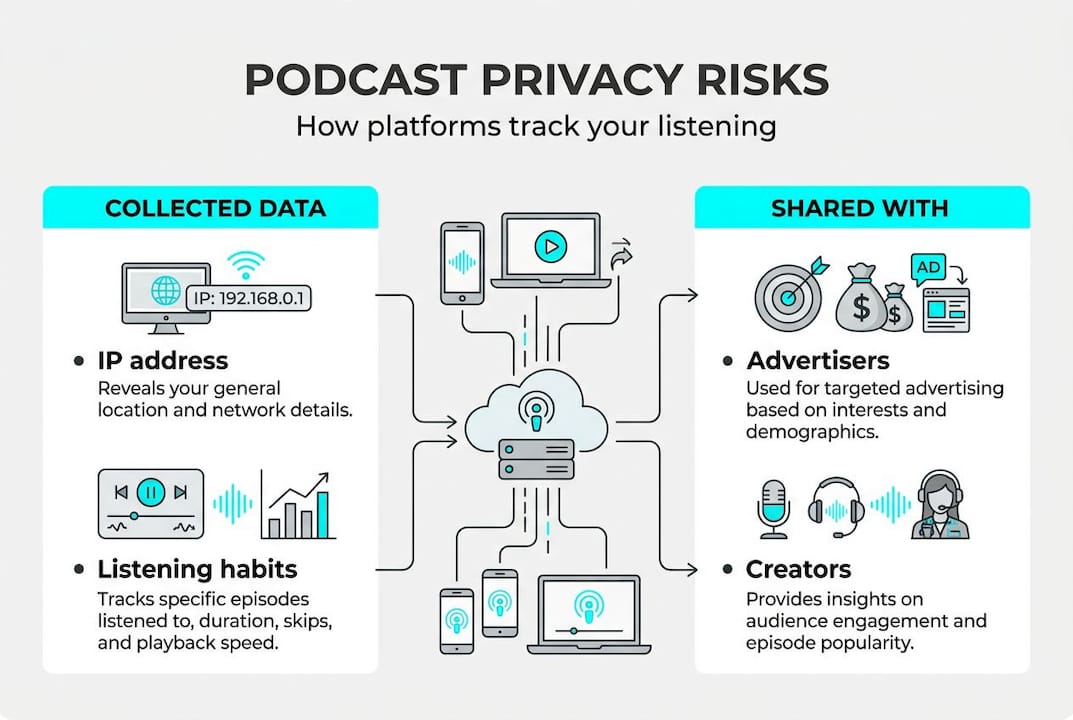
Here’s a breakdown of what’s typically collected and what gets shared:
| Data type | Collected by platform | Shared with creators |
|---|---|---|
| Listening history | Yes | Aggregated only |
| IP address | Yes | No |
| Device and OS info | Yes | No |
| Demographics (age, gender) | Yes | Aggregated only |
| Episode completion rate | Yes | Yes (anonymized) |
| Geographic location | Yes | Aggregated only |
The word “anonymized” does a lot of heavy lifting in that table. Platforms aggregate and anonymize data but still track IPs, demographics, and usage patterns, which is more than enough to build surprisingly specific user profiles. Anonymization sounds reassuring, but when you combine IP data with listening time, genre preferences, and device fingerprints, you can often re-identify individuals, especially in smaller audience groups.
This is the difference between personally identifiable information (PII), like your name or email, and metadata, which is everything else. Metadata feels harmless. It isn’t. Researchers have repeatedly shown that metadata alone can reveal political beliefs, health conditions, relationship status, and daily routines.
Among top podcast platforms, the data collection practices vary, but the core model is similar: your behavior funds the ecosystem. Understanding how platforms analyze podcast metadata helps you make smarter choices about where and how you listen. The same is true for event data ownership, where user data practices in digital entertainment spaces often follow similar patterns.
Pro Tip: Use a VPN when streaming podcasts to mask your IP address, and consider private browsing mode to reduce the trackable signals you send to platforms.
Hidden risks in niche and health-focused podcast genres
While major platforms hold a lot of power, there are special risks for those who follow or create content in sensitive genres.
Health, lifestyle, and entrepreneurship podcasts attract deeply engaged audiences. That engagement is also what makes them a privacy concern. When your listening habits cluster around topics like fertility, mental health, chronic illness, or financial struggle, that metadata starts to say a lot about your personal life.
Smaller niche audiences are especially vulnerable. If a health podcast has 5,000 regular listeners and you’re one of them, cross-referencing your IP, location, and listening pattern with other data sources makes it much easier to narrow down who you are. This process, called de-anonymization or re-identification, is not theoretical. It’s a documented risk in data science.
The stakes got very real after the Roe v. Wade decision. Privacy risks in health podcasts and apps escalated sharply, and menstrual tracking apps led to charges for hundreds of women, showing how health-adjacent digital behavior can have real legal consequences.
“Digital trails from podcast and health apps represent a genuine threat to bodily autonomy. Privacy-enhancing technology isn’t optional anymore, it’s a form of self-defense.” — Electronic Frontier Foundation
The EFF highlights these digital trails as serious threats and recommends privacy-enhancing tech as a frontline response. You can also explore privacy considerations in health conversations to understand where the risks are most concentrated.
For creators in these niches, the risks are different but just as real. Sharing personal health journeys, family details, or financial situations on a public show can create a permanent, searchable record that follows you.
Here are some practical tactics for listeners and creators in sensitive genres:
- Use open-source podcast apps that don’t require account creation
- Avoid linking your podcast app to social media profiles
- Enable local encryption on your device
- Creators: set clear content boundaries before you hit record
- Use a separate email address for podcast subscriptions
- Review app permissions regularly and revoke unnecessary access
What the law says (and doesn’t say) about podcast privacy
Understanding the technical issues is only half the story. The law adds its own uncertainties.
Here’s the uncomfortable truth: there is no federal law specifically regulating podcast privacy in the United States. What exists is a patchwork of state-level regulations and platform-specific terms of service. That means your rights depend heavily on where you live.
| Region | Privacy framework | Podcast-specific rules |
|---|---|---|
| United States | State laws (CCPA, etc.) | None federal |
| European Union | GDPR | Applies to platforms operating in EU |
| California | CCPA/CPRA | Right to opt out of data sale |
| Other US states | Varies widely | Often minimal |
The EU’s GDPR gives listeners meaningful rights: access to their data, the right to delete it, and the right to opt out of profiling. Most American listeners don’t have those same protections unless they’re in California or a handful of other progressive states.
For advertising data trends in podcasting, the legal gray zone creates real opportunities for platforms to monetize listener behavior in ways users never explicitly agreed to.
Here’s what you can do based on your legal environment:
- Check your state’s privacy laws. California, Colorado, Virginia, and Connecticut have the strongest protections.
- Submit a data access request. Most major platforms are legally required to tell you what they hold on you.
- Review and update privacy settings on every platform you use, not just your main one.
- Read the terms of service for any new podcast app before downloading, especially free ones.
- For creators: consult a digital media attorney if you’re collecting listener emails or running sponsorships.
The legal landscape is evolving, but slowly. Until it catches up, your best protection is informed behavior.
Steps listeners and creators can take to protect privacy
Laws and platforms can only do so much; your own action is the strongest line of defense.
Privacy protection doesn’t have to be complicated. A few consistent habits go a long way. The role of podcast data analytics in the industry means platforms are always looking for more signal. Your job is to give them less.
For listeners:
- Use a VPN to mask your IP address and general location
- Choose podcast apps that don’t require a social login
- Avoid completing optional demographic surveys inside apps
- Clear your listening history periodically
- Opt out of personalized advertising in platform settings
- Don’t use your real name when creating accounts on niche health or lifestyle platforms
For creators:
- Avoid sharing your home city, neighborhood, or daily routine on air
- Use a P.O. box instead of a home address for listener mail
- Consider a pseudonym, especially in entrepreneurship or personal finance niches
- Be selective about what sponsors you promote and what data they collect from your audience
EFF recommends VPNs, privacy-enhancing tech, and minimizing data sharing as the top strategies for anyone concerned about their digital footprint. And for creators specifically, setting clear content boundaries and using pseudonyms can meaningfully reduce exposure.
The numbers make this real. Over 210 women faced legal consequences tied to health app and podcast data misuse following changes in reproductive rights law. Privacy isn’t abstract. It has direct, personal consequences.
Pro Tip: Be cautious with links shared in show notes or episode descriptions. Some contain tracking pixels or affiliate redirects that log your click behavior and device data without any visible warning.
Why podcast privacy concerns are more urgent than most people realize
With these practical steps covered, it’s worth stepping back to reconsider how podcast privacy risk is evolving even faster than most guides admit.
Podcasting feels safe. You’re not posting. You’re not commenting. You’re just listening. That invisibility is exactly what makes it risky. The digital trail you leave behind while listening is often more revealing than what you share on social media, precisely because it feels unconscious and unfiltered.
Most privacy guides focus on social media or browsing habits. Podcast listening data sits in a different category: it’s behavioral, habitual, and deeply personal. The shows you return to every week say something about your health concerns, your financial anxieties, your values. When that data gets matched across platforms, the profile that emerges is surprisingly intimate.
The belief that “I’m not famous, so no one cares” is outdated. Data isn’t collected to target individuals manually. It’s fed into systems that make automated decisions about you, from ad targeting to insurance risk modeling. You don’t need to be a public figure to be affected.
Understanding how podcast services work at a data level is the first step toward making genuinely informed choices about where you listen and what you share.
Explore podcasts safely with Prodcast’s privacy-aware platform
If you’re rethinking how you listen, there’s a safer way to connect with trending and niche podcasts.
Prodcast is built around the idea that great podcast content should be easy to find without requiring you to hand over your entire digital identity. Instead of endless algorithmic rabbit holes, you get curated collections of trusted moments, product mentions, and expert insights pulled directly from transcripts.

Privacy-minded listeners love the experience because it puts discovery back in your hands. Explore Podcast Moments to find the exact clips and recommendations that matter to you, or browse the Game Changers collection for standout insights from entrepreneurship and lifestyle shows. Less noise. More signal. And a whole lot less data left behind.
Frequently asked questions
Can podcast hosts see who listens to their shows?
Podcast platforms share aggregated insights but do not share individual PII with podcasters, though metadata can still identify small or highly engaged listener groups.
Are certain podcast genres riskier for privacy?
Yes, health, lifestyle, and niche podcasts carry greater privacy risks because sensitive topics combined with smaller audiences make re-identification more likely through metadata cross-referencing.
What’s the best way to keep my podcast habits private?
EFF recommends privacy-enhancing tech, VPNs, and minimal data sharing as the most effective strategies for protecting your listening habits.
Is sharing personal stories on my podcast safe?
Creators should limit identifiable details and consider pseudonyms, since oversharing in entrepreneurship or sensitive genres can create a permanent public record with real personal and legal consequences.
Recommended
- Podcast content discovery tools: find and analyze shows | Prodcast
- Podcast content discovery tools: find and analyze shows | Prodcast
- Boost podcast discoverability: proven steps for more list… | Prodcast
- Boost podcast discoverability: proven steps for more list… | Prodcast
- Privacy & Safety — How Caia Keeps Your Conversations Private