CATEGORIES
TAGS
Podcast cross promotion guide for targeted marketing
TL;DR:
- Podcast cross promotion offers targeted, high-trust opportunities for brands to reach niche audiences effectively.
- Success depends on niche alignment, authentic host reads, and clear formal agreements.
- Ongoing relationships and data-driven optimization maximize long-term campaign impact.
You’ve set the budget, picked your shows, and launched your podcast ads. But the clicks aren’t coming in, and you can’t figure out why. Sound familiar? Reaching niche audiences through traditional podcast advertising is genuinely hard, and wasted ad spend is a real frustration. That’s exactly why smart marketers are turning to podcast cross promotion as a smarter, more targeted alternative. Host-read style promos consistently deliver 3.4x to 5.1x return on ad spend with recall rates between 60 and 70 percent. This guide walks you through every step of building a cross promotion strategy that actually works.
Table of Contents
- What is podcast cross promotion and why does it matter?
- Preparing for successful cross promotion: Finding the right partners
- Step-by-step: Executing an effective podcast cross-promotion campaign
- Measuring outcomes and optimizing future podcast promotions
- Podcast cross promotion: What others miss (and how to get it right)
- Supercharge your next podcast cross promotion
- Frequently asked questions
Key Takeaways
| Point | Details |
|---|---|
| Choose compatible partners | Select podcasts with similar audience size, quality, and niche focus to maximize impact. |
| Use host-read ads | Host-read promos in cross promotion consistently drive higher recall and measurable ROI. |
| Track and optimize results | Leverage data tools to monitor outcomes and continuously improve cross-promo strategies. |
| Formalize agreements | Always use formal contracts for episode swaps to ensure clarity and professionalism. |
What is podcast cross promotion and why does it matter?
Podcast cross promotion is when two or more podcasts agree to mention, feature, or promote each other to their respective audiences. Think of it as a handshake deal between creators who share similar listeners. One podcast host talks up another show during an episode, and the other does the same in return. It’s a direct, trust-based exchange that puts your brand in front of exactly the right ears.
This is fundamentally different from standard podcast advertising. In a traditional ad buy, you pay for a slot and hope the audience sticks around long enough to hear it. Cross promotion feels native. It fits into the show’s flow, and because it comes from a trusted host’s mouth, listeners are far more receptive to it.
Why does this matter for marketers and brands? A few reasons.
Benefits of podcast cross promotion:
- Better targeting. You’re reaching listeners who already have a proven interest in content that overlaps with yours.
- Higher trust. Host-endorsed recommendations carry weight. Listeners have built real relationships with their favorite podcasters.
- Cost efficiency. Many cross promotions are structured as swaps, which means no media spend required.
- Brand alignment. Being featured on a podcast that shares your values signals quality to new listeners.
- Rich data. Cross promo activity generates behavioral signals you can use to understand what audiences actually care about.
Here’s a quick snapshot of how cross promotion stacks up against traditional podcast ads:
| Factor | Traditional podcast ad | Podcast cross promotion |
|---|---|---|
| Cost | Media buy required | Often a value swap |
| Audience targeting | Broad | Niche and precise |
| Listener trust | Moderate | High (host-endorsed) |
| Integration | Pre-roll, mid-roll | Organic within content |
| Data potential | Limited | Rich behavioral insights |
The numbers back this up. Podcast advertising effectiveness research confirms that host-read formats, which mirror what you get in a cross promotion, consistently outperform standard formats with 3.4x to 5.1x ROAS and recall rates of 60 to 70 percent. Niche targeting through data tools also surfaces consumer insights across categories that you just can’t get from a standard ad buy.
For brands, that’s not just a traffic play. That’s audience intelligence. When you see which shows are talking about your product category, you understand what consumers are actually thinking about right now.
Cross promotion also works well as a research tool. Analyzing which podcasts are gaining traction in your niche, what language their hosts use to describe products, and which topics consistently pull listener attention can sharpen your entire marketing strategy. Not just your podcast spend.
Preparing for successful cross promotion: Finding the right partners
Now that you understand the value of cross promotion, let’s get tactical by finding the best partners. This is where a lot of marketers stumble. They see a podcast with decent numbers and assume it’s a fit. But audience size alone is a very incomplete picture.
Choosing the right cross promotion partner starts with niche alignment. Ask yourself: would a listener of that show also genuinely care about my show or product? If the answer isn’t a clear yes, move on. A highly engaged audience of 5,000 loyal fitness fans is more valuable to a wellness brand than a general interest show with 50,000 passive listeners.
Criteria for evaluating a cross promotion partner:
- Niche alignment. Topics, tone, and values should overlap naturally.
- Audience size compatibility. Aim for partners within one order of magnitude of your listener count. A show with 1,000 listeners partnering with one that has 100,000 creates an imbalance that rarely benefits both sides.
- Production quality. Polished audio on your end should be matched by your partner. A quality mismatch hurts the listener experience and reflects on your brand.
- Engagement signals. Reviews, social activity, and community size often say more than raw download numbers.
- Content freshness. A podcast that hasn’t released an episode in three months is a red flag, regardless of past numbers.
Here’s a comparison of partner types by risk level:
| Partner profile | Fit quality | Risk level |
|---|---|---|
| Same niche, similar size | Excellent | Low |
| Adjacent niche, similar size | Good | Low to medium |
| Same niche, much larger | Uneven benefit | Medium |
| Different niche, similar size | Poor | High |
| Inactive or inconsistent | Not recommended | Very high |
Audience size mismatches and non-overlapping niches are among the most common reasons cross promotions fall flat. Production quality disparities are another. And without a formal written agreement covering timelines, content expectations, and quality standards, even a well-matched swap can go sideways quickly.

Pro Tip: Use data-driven partner selection tools to analyze which podcasts are already discussing product categories or topics that overlap with yours. This removes the guesswork and speeds up the vetting process considerably.
Formal agreements matter more than most people think. A simple written document that outlines the episode swap terms, publishing dates, content guidelines, and any approval rights will protect both parties. It doesn’t need to be a lengthy legal contract. A clear email thread with agreed-upon terms often works. What you want to avoid is ambiguity. Ambiguity leads to delays, disappointment, and a cross promo that never actually airs.
You can also use influencer marketing data from podcast analytics platforms to identify which creators are driving real audience behavior, not just collecting passive downloads. When you look at engagement depth rather than surface metrics, your partner shortlist gets a lot more precise.
Step-by-step: Executing an effective podcast cross-promotion campaign
With the right partners in place, let’s walk through how to coordinate and execute an actual campaign. Having a clear process saves time and sets everyone up for success from the start.
Step 1: Define your campaign goal. Are you trying to grow your listener base, promote a product launch, or drive traffic to a specific landing page? Your goal shapes everything else, from the script to the tracking method.
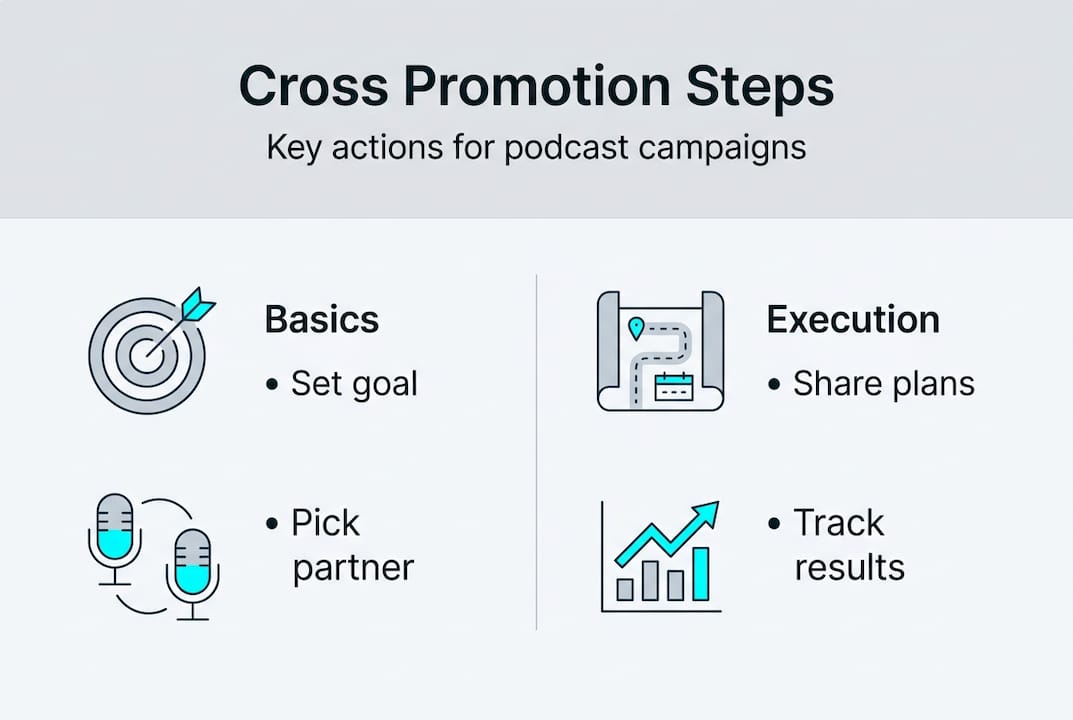
Step 2: Prepare your assets. This includes a clear, conversational ad script written in the style of your partner’s show, any audio files or clips they might need, promotional artwork, and unique tracking URLs or promo codes tied to this specific campaign.
Step 3: Write a host-read style script. Don’t give your partner a rigid script they have to read word for word. Give them talking points and let them riff. Authenticity is the entire point. Host-read promos used in cross promotion consistently achieve top recall and measurable sales impact precisely because they sound natural, not scripted.
“The best cross promotions don’t sound like ads. They sound like a friend telling you about something genuinely useful.” This is the bar you should be setting for every campaign.
Step 4: Agree on placement. Mid-roll placements tend to outperform pre-roll in terms of listener retention. If your partner can slot your mention in the first ten minutes of their episode while listeners are still fully engaged, that’s ideal.
Step 5: Set your timeline. Build in a review window for both parties to approve content before it goes live. Two weeks is usually enough lead time for most indie podcasts. Larger shows may need more runway.
Step 6: Publish and track. Once episodes go live, start collecting data immediately. Use your unique tracking links and promo codes to monitor traffic and conversions. Check your podcast hosting platform for listener spikes on the dates your partner’s episode publishes.
Pro Tip: Use commerce strategies for discovery to set up smart landing pages that capture new listeners coming in from your cross promo partners. These pages can be personalized to the referring show, which improves conversion significantly.
Step 7: Follow up with your partner. Share your results with them once you have data. This builds trust, opens the door to future campaigns, and helps both parties understand what worked.
A typical campaign runs four to six weeks from first outreach to episode publication. The more organized your assets and agreements are upfront, the smoother that timeline becomes.
Measuring outcomes and optimizing future podcast promotions
Executing a campaign is not the end. Analyzing and iterating on results is crucial if you want your cross promotion efforts to improve over time.
Start with the metrics that actually tell you something meaningful. Downloads are the most obvious signal, but they’re also the least specific. What you really want to track is behavior after the listen.
Key metrics to monitor:
- Unique listener spikes. Did your show gain new listeners in the days after your partner’s episode dropped?
- Promo code redemptions. How many people used the specific code tied to this campaign?
- Landing page conversions. What percentage of cross promo referral traffic completed a desired action?
- Episode completion rates. Are new listeners finishing your episodes, or bouncing after a few minutes?
- Subscriber retention. Of the new listeners you gained, how many are still around two weeks later?
Here’s a simple framework for evaluating campaign performance:
| Metric | What it tells you | How to track it |
|---|---|---|
| Listener spike | Immediate reach impact | Podcast hosting analytics |
| Promo code use | Direct conversions | Unique codes per campaign |
| Landing page visits | Traffic quality | UTM parameters |
| Episode completion | Content fit | Hosting platform data |
| Subscriber retention | Long-term audience quality | Listener growth trend |
Once you have a full campaign’s worth of data, the next step is comparison. Did this partner outperform a previous one? Did a mid-roll placement perform better than an intro mention? These comparisons are what let you scale the right things and stop doing the things that aren’t working.
Niche targeting via tools provides consumer insights across categories that are genuinely hard to find anywhere else. When you layer that kind of data on top of your cross promo results, you start to see patterns. Which topics drive the most engaged listeners? Which product categories are resonating right now? What language is moving audiences to action?
That’s where podcast metrics and engagement analytics become a serious strategic asset, not just a reporting checkbox.
Optimization is an ongoing loop. After each campaign, document what worked, adjust your partner criteria or script approach, and test something new on the next run. A/B testing two different scripts with two different partners in the same quarter is a smart way to accelerate learning without overcomplicating your process.
Don’t overlook qualitative signals either. Listener comments, social mentions, and direct messages following a cross promotion tell you things that numbers can’t. If people are reaching out to say they found your show through a specific partner, that’s a powerful signal worth documenting and building on.
Podcast cross promotion: What others miss (and how to get it right)
Here’s something we’ve noticed that most marketing playbooks skip entirely: the most important variable in a podcast cross promotion isn’t audience size, niche overlap, or even production quality. It’s trust transfer.
When a host mentions your show or product, their listeners don’t just hear a recommendation. They make a split-second decision about whether that host’s judgment is worth following. That decision is shaped by years of relationship-building between host and audience. If the mention feels forced or out of character, even a perfect niche match won’t save it.
Most marketers focus too much on the metrics side of partner selection and not enough on the feel of the partnership. Does this host talk about things the way your brand talks about things? Do they genuinely like what you’re promoting? An unenthusiastic endorsement from a technically perfect partner will underperform a heartfelt mention from a slightly off-category host who is genuinely excited.
The other thing people miss is the long game. A single cross promo episode generates a short-term listener spike. But an ongoing relationship with a compatible host, where you swap mentions across multiple episodes over time, compounds in ways that single campaigns never do. Audiences notice recurring endorsements. Familiarity builds credibility.
Track advertising trend insights across your niche to understand which cross promo formats are gaining traction. The data will often surprise you. And the brands that pay attention to those patterns early are the ones that build durable audience relationships instead of just chasing one-off spikes.
Supercharge your next podcast cross promotion
If you’ve made it this far, you already know that great cross promotion is built on smart partner matching, authentic host reads, and data that tells you what’s actually working. That’s exactly the kind of intelligence Prodcast was built to surface.

Prodcast’s AI analyzes thousands of podcast transcripts to reveal which brands, products, and topics are trending across specific niches right now. That means you can identify cross promo opportunities before they become obvious to everyone else. Want to scale that further? Explore the Mass Persuasion campaign to coordinate high-impact outreach across multiple shows at once. Or browse the Podcast Moments platform to see the exact conversations your target audience is already engaged with. The right partnership is already out there. Prodcast helps you find it faster.
Frequently asked questions
How do I track results from a podcast cross promotion?
Use tracking links, promo codes, and unique landing pages to measure new listeners or conversions resulting from each campaign. Combining all three gives you the clearest picture of real impact.
What types of podcasts are the best fit for cross promotion?
Podcasts with similar audience size, production quality, and niche alignment deliver the best results. Mismatches in any of these areas typically reduce effectiveness for both parties.
Are formal agreements required for podcast episode swaps?
Formal written agreements are strongly recommended to clarify roles, scheduling, and content quality in episode swaps. Even a brief written summary of agreed terms can prevent costly miscommunications.
What ROI can marketers expect from podcast cross promotion?
Host-read podcast cross promotions often deliver 3.4x to 5.1x return on ad spend with recall rates between 60 and 70 percent. Results vary by niche, partner quality, and how well the content is integrated.