CATEGORIES
TAGS
Podcast content discovery tools: find and analyze shows

Millions of podcasts exist today, yet finding the right show or episode remains surprisingly difficult. Podcast listeners face endless scrolling through generic recommendations, while marketers struggle to identify audience demographics and engagement metrics for campaign planning. Traditional podcast apps prioritize popularity over relevance, leaving niche content buried and valuable insights hidden. This guide explores the top podcast content discovery tools available in 2026, comparing their features, accuracy, and practical applications for both casual listeners seeking great content and marketers building data-driven campaigns.
Table of Contents
- Key takeaways
- The podcast discovery challenge: scope and listener habits
- Overview of top podcast content discovery tools
- Accuracy and reliability of audience data in discovery tools
- Choosing the right discovery tools for listeners and marketers
- Explore Prodcast’s podcast discovery and clip tools
- FAQ
Key Takeaways
| Point | Details |
|---|---|
| Tool variety matters | Discovery tools vary widely in features and accuracy, affecting how easily users find relevant shows. |
| AI excels in episodes | AI powered options excel at episode level search and topic based discovery beyond show titles. |
| Audience estimates have limits | Audience estimate tools provide useful campaign insights but have accuracy limits. |
| Blend AI and apps | Combining AI driven recommendations with traditional apps broadens content discovery for casual listeners and marketers. |
The podcast discovery challenge: scope and listener habits
The podcast landscape has exploded to include 3.6 million podcasts and over 181 million episodes, creating an overwhelming discovery environment for listeners and marketers alike. This massive content library means finding relevant shows requires more than casual browsing. The median podcast attracts about 1,425 downloads monthly, revealing a stark reality where most shows operate far below mainstream visibility thresholds.
Listeners currently discover new podcasts through several primary channels. Traditional podcast apps lead at 40%, followed by YouTube at 31% and Spotify at 24%. These percentages highlight how discovery remains fragmented across platforms, with no single dominant method emerging. Each platform applies its own algorithmic biases, often prioritizing established shows over emerging content that might better match listener interests.
Platform limitations create significant discovery friction:
- Search algorithms favor popularity metrics over content relevance, burying niche expertise
- Episode-level discovery remains rare in mainstream apps, forcing listeners to evaluate entire shows
- Transcript search capabilities exist in few tools, limiting keyword-based content discovery
- Recommendation engines rely heavily on listening history, creating filter bubbles that restrict exploration
These challenges explain why specialized discovery tools have emerged to address gaps in traditional podcast platforms. Understanding podcast search optimization becomes essential for both creators wanting visibility and listeners seeking quality content beyond algorithmic suggestions.
Overview of top podcast content discovery tools
Podcast discovery tools fall into distinct categories based on their primary features and target users. Rephonic leads the audience analytics space with a database covering 2 to 3 million podcasts, providing estimated listener numbers, demographic breakdowns, 3D audience visualization graphs, and contact information for outreach purposes. Marketers value these features for campaign planning and influencer identification, though accuracy limitations require careful interpretation.
Pod Seek by Castro represents the AI-powered discovery category, using machine learning recommendations and Apple’s foundation models to enable natural language queries across podcast trailers and episode content. This iOS app syncs subscriptions seamlessly and offers podcasting 2.0 features completely free, making sophisticated discovery accessible to casual listeners. The AI approach excels at surfacing relevant episodes based on specific topics or questions rather than just show titles.
Other AI-focused tools expand episode-level search capabilities:
- Fathom.fm analyzes transcripts for keyword searches within episode content, revealing discussions buried in long-form conversations
- PodRoll combines AI recommendations with social features, letting users share discoveries within communities
- Podcurator applies machine learning to match listener preferences with episode topics across its indexed database
- Listen Notes provides comprehensive podcast search with episode-level filtering and API access for developers
| Tool | Audience Data | AI Episode Search | Platform | Best For |
|---|---|---|---|---|
| Rephonic | Yes, with demographics | No | Web | Marketer outreach and campaign planning |
| Pod Seek | No | Yes, with natural language | iOS | Listeners seeking niche episode content |
| Fathom.fm | No | Yes, transcript-based | Web | Keyword-specific content discovery |
| Listen Notes | Basic | Limited | Web, API | Developers and broad search needs |
Pro Tip: Combine AI-powered episode search with traditional app browsing to discover content beyond popularity rankings, avoiding the algorithmic bias that keeps niche expertise hidden from mainstream recommendations.
These tools address different aspects of the discovery challenge, with some prioritizing audience insights for marketing while others focus on content relevance for listeners. The best podcast marketing platforms often integrate multiple discovery approaches, recognizing that effective podcast strategy requires both content understanding and audience analysis. As AI in podcasting continues advancing, expect discovery tools to become more sophisticated in matching specific listener needs with relevant episode moments.

Accuracy and reliability of audience data in discovery tools
Audience estimates provided by podcast discovery tools offer valuable directional insights but come with significant accuracy limitations. Rephonic’s listener estimates achieve approximately 52% accuracy on average, making them useful for prioritizing outreach opportunities but unreliable for precise advertising pricing or ROI calculations. This accuracy level means marketers should treat these numbers as rough indicators rather than definitive metrics.
Estimate reliability varies considerably based on podcast size and visibility. Very small shows with fewer than 500 downloads per episode often show the largest discrepancies, as limited public data makes modeling difficult. Conversely, extremely large shows may also present accuracy challenges when their distribution spans multiple platforms with inconsistent reporting. Mid-sized podcasts typically yield the most reliable estimates, as they generate enough public signals for modeling without the complexity of massive multi-platform distribution.
Audience data estimates serve best as prioritization tools for marketer outreach, helping identify promising opportunities while requiring content context and direct verification before major campaign commitments.
Marketers should apply these accuracy considerations when using discovery tools:
- Cross-reference audience estimates with content quality, topic relevance, and engagement signals before outreach decisions
- Request verification data directly from podcast hosts for significant advertising investments
- Use estimates to build target lists and prioritize research, not to calculate precise campaign budgets
- Combine quantitative audience data with qualitative content analysis for comprehensive evaluation
- Recognize that demographic breakdowns carry additional uncertainty beyond raw listener counts
The 50% accuracy threshold means discovery tools excel at identifying which podcasts deserve deeper investigation rather than providing campaign-ready metrics. Smart marketers treat audience estimates as the first filter in a multi-stage evaluation process. Understanding podcast advertising data and trends helps contextualize these limitations within broader industry measurement challenges.
Despite accuracy constraints, directional audience data remains valuable for discovery purposes. A show estimated at 10,000 listeners likely reaches more people than one estimated at 1,000, even if neither number proves exactly correct. This relative comparison capability makes discovery tools useful for initial screening, allowing marketers to focus detailed research on the most promising opportunities rather than manually evaluating thousands of potential podcast partners.
Choosing the right discovery tools for listeners and marketers
Selecting appropriate podcast discovery tools requires matching features to specific goals and use cases. Casual listeners seeking entertainment need different capabilities than marketers building targeted campaign lists or researchers analyzing industry trends. Understanding your primary discovery objective shapes which tools deliver the most value.
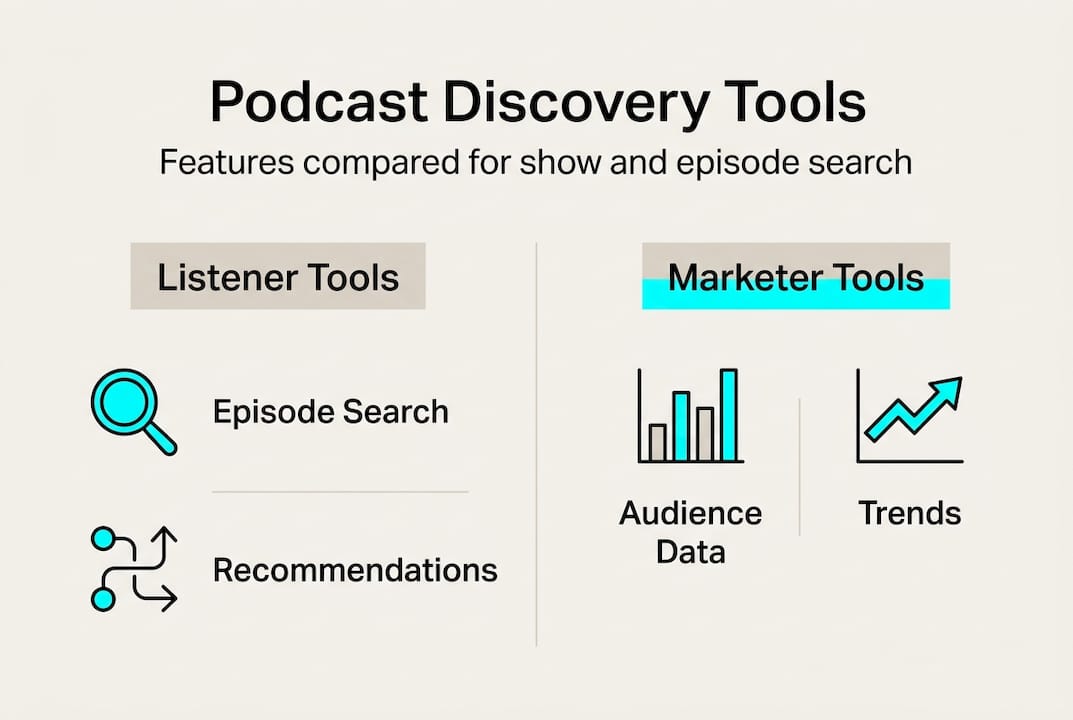
AI-powered apps like Pod Seek and Podcurator excel for listeners wanting episode-level discovery beyond popularity rankings. These tools surface relevant content based on topics, questions, or interests rather than just show titles, making them ideal for finding expert discussions within long-form episodes. The natural language search capabilities mean you can ask specific questions and receive episode recommendations that address those exact topics.
Tools like Rephonic serve marketers prioritizing audience demographics and contact information for outreach campaigns. The listener demographic data and contact details help build target lists efficiently, though remember the accuracy limitations discussed earlier. These platforms work best when combined with content evaluation to ensure audience alignment matches topical relevance.
Follow this selection process based on your primary needs:
- Identify your core discovery goal: casual browsing, niche expertise search, campaign planning, or industry research
- Evaluate budget constraints, as free options like Pod Seek offer solid features while paid tools provide deeper analytics
- Consider platform preferences, since some tools work exclusively on iOS, Android, or web browsers
- Test multiple tools simultaneously to compare results and find the best fit for your workflow
- Prioritize episode-level search if content relevance matters more than audience size
- Choose audience analytics tools if demographic targeting and outreach efficiency drive your strategy
Pro Tip: Regularly rotate between multiple discovery tools to avoid algorithmic filter bubbles and uncover diverse content that single-platform recommendations might miss.
Budget considerations play a significant role in tool selection. Free options provide substantial value for most listener needs, offering AI-powered search and personalized recommendations without cost barriers. Paid tools justify their expense primarily for marketers requiring audience analytics, demographic breakdowns, and contact databases that support campaign development. Marketing for podcasts often demands these premium features to identify optimal partnership opportunities efficiently.
The most effective discovery strategy combines multiple tools rather than relying on a single platform. Use AI-powered apps to find relevant content, traditional podcast apps to explore related shows, and analytics platforms to evaluate audience potential. This multi-tool approach compensates for individual platform limitations while providing comprehensive discovery coverage. Additional podcast outreach resources can supplement discovery tools when building targeted campaign lists.
Explore Prodcast’s podcast discovery and clip tools
While traditional discovery tools help you find podcasts and episodes, Prodcast takes discovery further by identifying the specific moments and product mentions that matter most. Our AI-powered platform analyzes thousands of podcast transcripts to surface compelling clips, trending products, and expert insights that drive real engagement and purchasing decisions.

Prodcast transforms podcast discovery from finding shows to finding actionable moments. Our moments discovery feature highlights the exact timestamps where hosts discuss products, share advice, or deliver key insights, saving you hours of manual listening. Marketers gain instant access to trending product mentions across industries, while listeners discover the specific recommendations and tools their favorite creators actually use.
Key benefits include:
- Instant access to curated podcast clips featuring product mentions and expert recommendations
- Real-time tracking of which brands, tools, and products are trending across podcast conversations
- Seamless integration between audio content discovery and product exploration
- Featured product pages like Mass Persuasion and BMW, Hyundai, Subaru, and Jeep showing exactly where and how products get discussed
Pro Tip: Use Prodcast’s clip discovery to complement broader podcast search tools, creating targeted campaigns around the specific product mentions and expert insights that resonate with your audience.
FAQ
What are podcast content discovery tools?
Podcast content discovery tools help listeners find relevant shows and episodes while providing marketers with audience insights and analytics. They range from AI-powered search apps that analyze episode transcripts to comprehensive databases offering demographic data and contact information. These tools address the challenge of navigating millions of podcasts by surfacing content based on topics, keywords, or audience characteristics rather than just popularity rankings.
How accurate are audience estimates from tools like Rephonic?
Audience estimates hover around 52% accuracy on average, making them useful for directional guidance but not precise metrics. Estimates work best for prioritizing which podcasts deserve deeper research rather than calculating exact advertising budgets. Accuracy varies by podcast size, with very small and extremely large shows typically showing larger discrepancies than mid-sized podcasts.
Which tools are best for discovering niche podcast episodes?
AI-based apps with transcript and keyword search capabilities excel at niche episode discovery. Pod Seek and Podcurator lead this category by using machine learning to match specific topics with relevant episode content, going beyond simple show-level recommendations. These tools let you search for exact questions or subjects, surfacing episodes where hosts discuss those topics even if the show title does not indicate that focus.
Are free podcast discovery tools as effective as paid ones?
Free tools like Pod Seek and Podurama offer solid episode discovery features that satisfy most listener needs, including AI-powered search and personalized recommendations. Paid tools justify their cost primarily for marketers requiring audience demographics, contact databases, and advanced analytics that support campaign planning. For casual listening and content exploration, free options provide substantial value without feature limitations that compromise discovery quality.
Recommended
- Comparison of Podcast Marketplaces – Expert Review 2025 | Prodcast
- Best Podcast Marketing Platforms – Expert Comparison 2025 | Prodcast
- Data-Driven Marketing Strategy for Podcast Product Discovery | Prodcast
- Marketing for Podcasts: Drive Real-World Product Discovery | Prodcast
- Podcast – The Lead Lab