CATEGORIES
TAGS
Podcast Commerce Explained: How Brands Drive Sales

TL;DR:
- Over half of podcast listeners are primed to purchase after hearing an ad.
- Host-read endorsements generate higher trust and conversion rates than traditional audio spots.
- Using targeted, niche podcasts and tracking codes improves advertising ROI.
Podcast listeners are not passive. That’s the insight most marketers still sleep on. A full 51% purchased something after hearing a podcast ad, which means more than half your audience is already primed to act. This isn’t background noise. Podcasts have quietly become one of the most direct pathways from brand message to consumer purchase. And yet, many advertisers still treat them like radio spots from 2005. This guide breaks down exactly how podcast commerce works, what the data says, and how you can build smarter campaigns that actually move product.
Table of Contents
- What is podcast commerce? The core definition and models
- The mechanics: Ads, integration, and what actually converts
- Why podcast commerce works: Data, outcomes, and emerging trends
- How marketers can win: Campaign planning and attribution tips
- Nuances and edge cases: B2B, non-endemic brands, and attribution hurdles
- A fresh perspective: Why marketers shouldn’t underestimate podcast commerce’s next wave
- Discover trending podcast merchandise and commerce opportunities
- Frequently asked questions
Key Takeaways
| Point | Details |
|---|---|
| Podcast commerce defined | It merges podcasting with direct purchase opportunities through ads, endorsements, and shoppable features. |
| Host-read ads ROI | Personalized, host-read ads in niche mid-roll slots consistently deliver the strongest engagement and sales lift. |
| Data-driven results | Data shows 78 percent of podcast listeners act on ads, with sustained revenue growth through 2026. |
| Attribution challenges | Promo codes and vanity URLs help marketers measure impact, though perfect attribution is still evolving. |
| Platform opportunity | Emerging shoppable podcasts and cross-platform tools offer marketers new ways to drive conversions. |
What is podcast commerce? The core definition and models
Let’s get grounded. Podcast commerce refers to the integration of commerce functionalities within podcasts, including advertising, sponsorships, host-read endorsements, shoppable integrations, and podcast merchandise sales. It’s the full ecosystem that turns a listening session into a buying moment.
Think of it as a spectrum. On one end, you have a simple promo code dropped by a host. On the other, you have a fully shoppable episode where listeners tap a link in the show notes and buy in two clicks. The infrastructure connecting those two ends has matured fast.
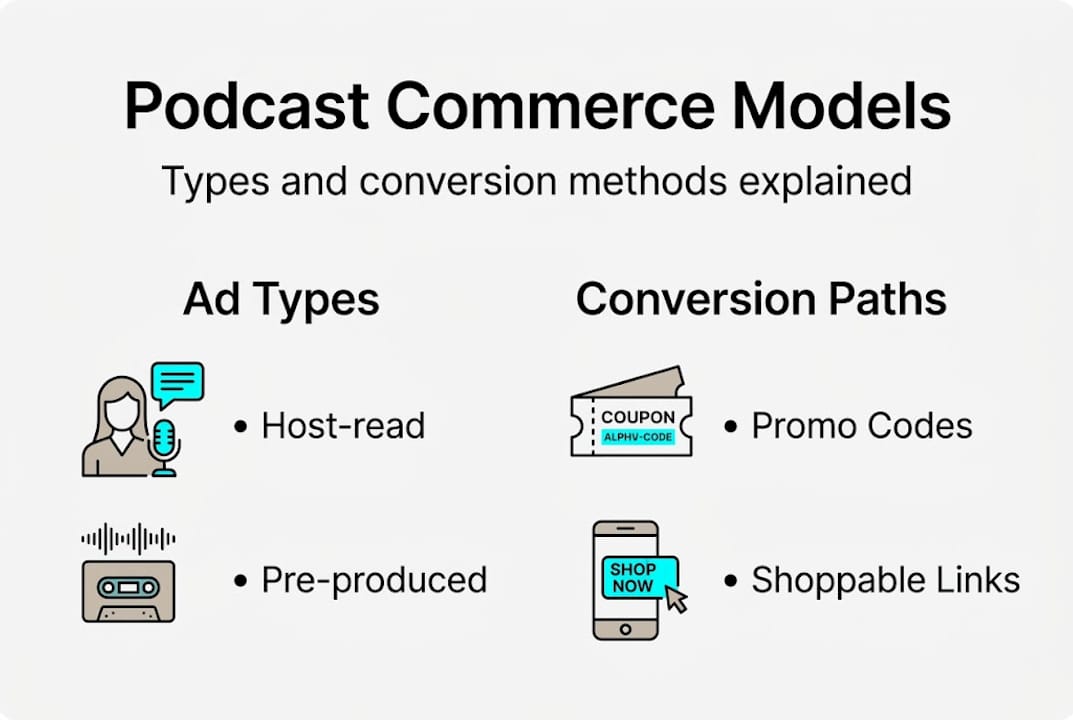
Here are the major models powering podcast commerce today:
- Host-read endorsements: The host personally recommends a product, often from lived experience. High trust, high conversion.
- Sponsorship segments: Branded blocks within an episode, sometimes scripted, sometimes improvised.
- Pre-produced ad spots: Polished audio ads inserted at specific timestamps, similar to traditional radio.
- Shoppable integrations: Clickable links in show notes, episode descriptions, or companion apps that let listeners buy instantly.
- Podcast merchandise: Branded products sold directly to a loyal listener base, often through creator storefronts.
As one Shopify podcast advertising guide notes, the infrastructure supporting these models now includes dynamic ad insertion technology, affiliate tracking, and direct creator storefronts. The buying journey from ear to cart has never been shorter.
If you want a deeper look at how these models connect, exploring podcast commerce strategies gives you a solid starting point for campaign planning.
The mechanics: Ads, integration, and what actually converts
Now let’s zoom into the engine room. Not all podcast ads are created equal, and the differences in performance are significant enough to change your entire budget allocation.
Host-read ads perform best at $25 to $50 CPM, pre-produced spots run $15 to $30 CPM, and programmatic dynamic insertion offers scale but lower trust. Mid-roll placements consistently outperform pre-roll and post-roll in conversion.

| Ad type | CPM range | Trust level | Best for |
|---|---|---|---|
| Host-read | $25 to $50 | Very high | DTC, premium brands |
| Pre-produced | $15 to $30 | Medium | Awareness campaigns |
| Programmatic | $10 to $20 | Lower | Scale and reach |
| Mid-roll placement | Varies | High | Conversion focus |
What actually drives conversion? Three things: trust, relevance, and placement. A host who genuinely uses your product and talks about it mid-episode is worth more than a polished spot at the top of the feed. Listeners feel the difference.
Here’s a simple process for selecting and optimizing your ad approach:
- Define your goal: awareness or direct conversion.
- Match ad type to goal. Host-read for conversion, programmatic for reach.
- Prioritize mid-roll placements on shows where your audience already lives.
- Build in a tracking mechanism before launch (more on that below).
- Review performance after three to four episodes, not one.
For a deeper breakdown of what the podcast ad effectiveness data actually shows, the numbers might surprise you. And if you want to understand the bigger picture, the latest podcast ecommerce trends reveal just how fast buying behavior is shifting.
Pro Tip: Don’t just buy the biggest show in your niche. A mid-tier podcast with a tight, loyal audience will often outperform a mega-show with passive listeners. Relevance beats raw reach almost every time.
Why podcast commerce works: Data, outcomes, and emerging trends
Here’s where the numbers get genuinely exciting. 78% of listeners act on podcast ads, brands see 3x incremental sales lifts, and US podcast ad revenue is projected to hit $2.56 billion in 2026. These aren’t soft engagement metrics. These are purchase signals.
DTC brands have led the charge here. Companies in supplements, apparel, software, and home goods have used podcast commerce to build loyal customer bases without relying entirely on social media algorithms. The trust transfer from host to brand is real and measurable.
| Metric | Benchmark |
|---|---|
| Listener action rate | 78% |
| Incremental sales lift | 3x average |
| US ad revenue (2026) | $2.56 billion |
| Mid-tier podcast revenue growth | 45% |
Several trends are reshaping outcomes right now:
- Video podcast growth: More shows are publishing video versions, enabling tappable product links and visual branding that audio alone can’t deliver.
- Shoppable podcast adoption: Platforms are building native buy buttons and affiliate integrations directly into the listening experience.
- Creator partnerships: Brands are moving beyond one-off sponsorships toward ongoing creator relationships that build familiarity over time.
- Cross-platform measurement: Marketers are connecting podcast exposure data with web analytics, CRM signals, and retail lift studies.
For a full picture of where the money is flowing, the podcast ad revenue growth data tells a compelling story. And retail impact case studies show exactly how brands are translating listens into shelf movement.
How marketers can win: Campaign planning and attribution tips
Okay, you’re sold on the opportunity. Now what? Let’s get practical.
The biggest mistake marketers make is jumping into podcast ads without a clear attribution plan. You spend the budget, see a bump in traffic, and have no idea which show drove it. That’s fixable.
Here’s a step-by-step approach that actually works:
- Identify your audience first. Find shows where your ideal buyer already spends time. Use category data, listener demographics, and topic alignment.
- Start small and test. Select niche podcasts matching your audience, use promo codes and vanity URLs for attribution, and test three to five shows with a $2,000 to $5,000 budget before scaling.
- Use promo codes and vanity URLs. These are your best attribution tools in a medium where pixel tracking doesn’t exist.
- Run lift analysis. Compare conversion rates among listeners versus non-listeners using survey panels or third-party measurement tools.
- Scale what works. Once you find a show that converts, increase frequency before expanding to new shows.
“The brands winning in podcast commerce aren’t the ones with the biggest budgets. They’re the ones who treat each show as a unique audience relationship and optimize accordingly.”
For a more detailed look at measuring podcast ad impact, the methodology matters as much as the metrics. And if you’re thinking about how to keep that audience engaged after the first click, strategies for boosting audience engagement are worth building into your plan from day one.
Pro Tip: Don’t rely on a single promo code per campaign. Use unique codes per show and per episode so you can isolate which placements are actually driving purchases.
For real-world examples of how brands have scaled through podcast channels, the ecommerce brand growth case studies are worth your time.
Nuances and edge cases: B2B, non-endemic brands, and attribution hurdles
Direct-to-consumer brands dominate the podcast commerce conversation, but the picture is more nuanced than that. Let’s talk about the edge cases.
B2B brands face longer cycles and should focus on awareness rather than direct conversion. Mid-tier podcasts with 10,000 to 100,000 downloads have grown revenue 45%, and non-endemic brands now account for 45% of podcast ad spend. That last number is worth sitting with.
Non-endemic brands are companies advertising in categories they don’t traditionally own. A financial services firm sponsoring a fitness podcast. A software company on a parenting show. It sounds counterintuitive, but it works when the audience alignment is right and the host integration feels genuine.
Here’s what makes edge cases tricky:
- B2B attribution: Sales cycles of six to eighteen months make it nearly impossible to draw a straight line from podcast ad to closed deal. Use brand recall surveys and pipeline influence metrics instead.
- Non-endemic fit: The host needs to find an authentic angle. Forced integrations backfire fast with loyal audiences.
- Cross-platform tracking: Listeners move between apps, devices, and platforms. No single tool captures the full journey yet.
- Mid-tier show discovery: Finding the right niche show at scale requires data, not guesswork.
“The brands that will win the next wave of podcast commerce are the ones investing in relationships with mid-tier creators now, before those shows become household names.”
For a full breakdown of podcast advertising ROI across different brand categories, the variance by vertical is significant. And for the latest podcast ad trends 2026, the data shows the space is still wide open for brands willing to move early.
A fresh perspective: Why marketers shouldn’t underestimate podcast commerce’s next wave
Here’s something worth saying out loud: a lot of brands are chasing programmatic podcast scale while leaving the most powerful format on the table. Host-read, content-driven integrations still lead in actual influence. The data backs this up, but the industry keeps funding the easier, more measurable option.
Shoppable podcast features and creator partnerships are building something that programmatic can’t replicate: genuine audience trust at the moment of purchase intent. That’s a moat. And right now, most brands aren’t building it.
The mid-tier podcast space is where the real opportunity lives. These creators have tight, passionate communities. They’re more accessible, more affordable, and often more willing to build authentic integrations that serve their audience first.
Most marketers look at a show with 25,000 downloads and see a small number. Smart marketers see 25,000 highly engaged humans who trust that host completely. That’s a different kind of asset.
If you’re serious about staying ahead, exploring advanced commerce strategies now, before the space gets crowded, is the move that separates leaders from followers.
Discover trending podcast merchandise and commerce opportunities
Ready to put all of this into practice? Prodcast is built for exactly this moment. Our AI-powered platform scans thousands of podcast transcripts to surface which products, brands, and tools are getting the most airtime right now.

For marketers, that means real-time intelligence on what audiences are actually hearing and caring about. You can explore trending podcast moments to find the conversations your audience is already in. Browse featured podcast merch to see which products are breaking through. And when you’re ready to go deeper, explore podcast solutions built to turn audio insights into actionable brand opportunities. The good stuff is already out there. Prodcast helps you find it first.
Frequently asked questions
What is podcast commerce in simple terms?
Podcast commerce means purchasing products or services directly from podcast ads, host endorsements, or shoppable episodes, turning listening into a buying action.
Why do host-read podcast ads perform better than programmatic spots?
Host-read ads perform better because listeners trust familiar voices and personalized endorsements. Host-read ads command $25 to $50 CPM versus $10 to $20 for programmatic, reflecting that trust premium in real dollars.
How can marketers track podcast ad effectiveness?
Marketers track podcast ads using promo codes, vanity URLs, and lift analysis. Attribution is challenging, so testing three to five shows with a defined budget before scaling helps isolate what’s actually working.
Are podcasts mostly effective for DTC brands or also for B2B?
Podcasts excel for DTC and premium consumer brands, but B2B brands can use them effectively for awareness. B2B longer cycles mean you should focus on brand recall and pipeline influence rather than direct conversion metrics.
What are shoppable podcasts and why are they trending?
Shoppable podcasts let listeners buy products directly from an episode through tappable links or show note integrations, driving measurable sales and closing the gap between audio content and commerce.
Recommended
- Unlock Podcast Commerce Strategies to Boost Discovery | Prodcast
- Unlock Podcast Commerce Strategies to Boost Discovery | Prodcast
- How podcasts drive sales: data-backed strategies for mark… | Prodcast
- How podcasts drive sales: data-backed strategies for mark… | Prodcast
- What Is Omnichannel Commerce? Complete Overview - Omnichannel payments at the Point Of Sale | Sensepass