CATEGORIES
TAGS
Podcast advertising growth: $2.43B and rising in 2026

TL;DR:
- Podcast advertising revenue surged to 2.43 billion dollars in 2024, with strong future growth expected.
- Advanced technology like Dynamic Ad Insertion and programmatic buying boosts targeting, measurement, and efficiency.
- Marketers should adopt data-driven, flexible strategies now to capitalize on this accelerating industry.
Podcast advertising isn’t creeping forward. It’s sprinting. US podcast ad revenue hit $2.43 billion in 2024, a 26.4% jump from the year before, and projections show no signs of slowing. If you’re still treating podcasts as an experimental line item in your budget, you’re already behind. This guide breaks down why podcast advertising is outpacing traditional channels, what technology is powering that shift, and how you can build campaigns that actually move the needle. We’ll cover Dynamic Ad Insertion, programmatic buying, data-driven targeting, and give you a practical playbook to act on all of it.
Table of Contents
- Why podcast advertising is gaining momentum
- The technology driving the new podcast ad era
- Data-driven targeting: Connecting with niche audiences
- Practical steps for marketers: Building future-proof podcast ad campaigns
- Looking ahead: What most marketers miss about podcast advertising
- Explore the future of podcast advertising with Prodcast
- Frequently asked questions
Key Takeaways
| Point | Details |
|---|---|
| Podcast ad market surging | Podcast advertising revenue is growing rapidly and projected to keep climbing through 2026. |
| Tech-driven targeting | Dynamic Ad Insertion and programmatic tools enable real-time, data-rich ad targeting for better results. |
| Niche audience engagement | Podcasts give brands direct access to loyal, highly segmented audiences for personalized messaging. |
| Actionable marketer strategies | Marketers should leverage modern tools and flexible frameworks to future-proof podcast ad campaigns. |
Why podcast advertising is gaining momentum
Let’s be clear: this isn’t a niche trend anymore. Podcast advertising has crossed into mainstream marketing strategy territory, and the numbers back that up.
Sustained annual growth of 8.6% to 9.6% is projected through 2026, which is the kind of steady climb that earns a permanent seat at the strategy table. Compare that to the flat or declining performance many brands are seeing from legacy broadcast channels, and the case for shifting budget becomes obvious.
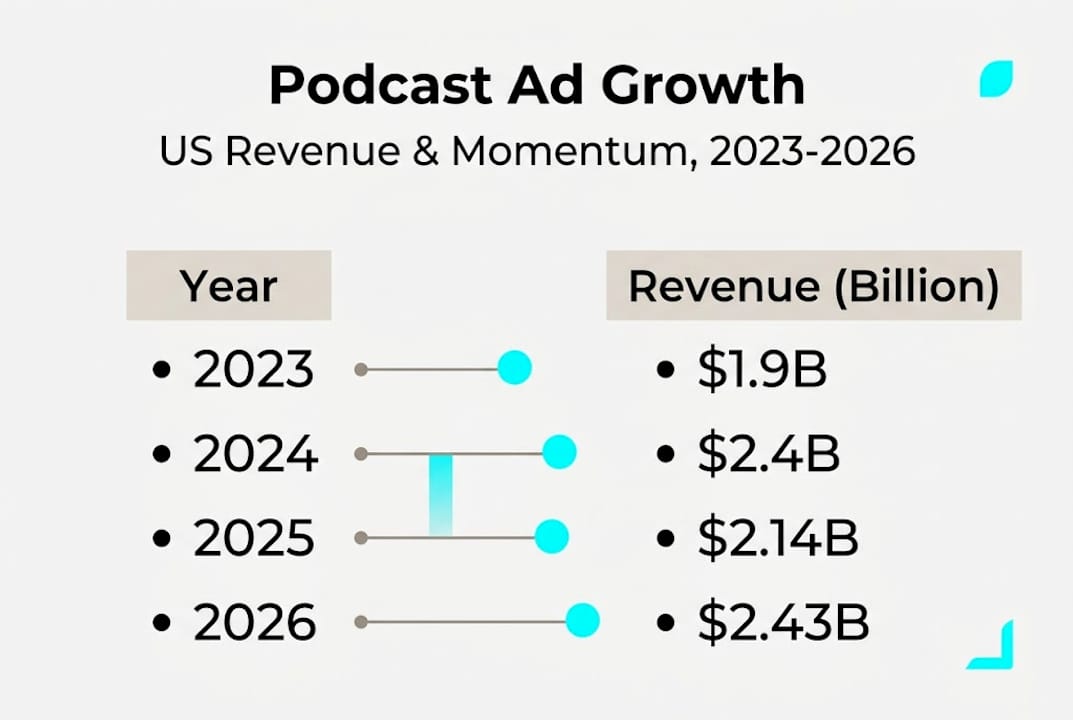
Here’s a quick snapshot of where things stand:
| Year | Estimated US podcast ad revenue | YOY growth |
|---|---|---|
| 2023 | $1.925 billion | Baseline |
| 2024 | $2.43 billion | +26.4% |
| 2026 (projected) | $2.56 billion | +8.6%–9.6% |
But revenue growth only tells part of the story. What’s really driving advertiser confidence is audience quality. Podcast listeners tend to be loyal, educated, and highly engaged. They follow specific hosts and genres closely. That means when a brand shows up in the right podcast, it’s not interrupting someone’s scroll. It’s entering a trusted conversation.
Major advertisers have noticed. Brands that once relied almost entirely on radio and TV are now reallocating meaningful portions of their budgets toward data-driven podcast trends to capture that attention more efficiently.
What makes podcast audiences especially valuable for marketers:
- Niche, intent-driven communities: Fitness, finance, tech, parenting. These listeners self-select into hyper-focused content.
- High completion rates: Podcast listeners often finish full episodes, meaning your ad gets heard, not skipped.
- Purchasing influence: Podcast audiences frequently act on product recommendations from hosts they trust.
- Cross-platform reach: Listeners tune in on mobile, desktop, smart speakers, and in-car systems.
Understanding podcast advertising effectiveness goes beyond just reach. It’s about connecting with audiences that are already in a receptive mindset. That’s a rare thing in digital advertising today.
With the stage set by explosive growth, it’s important to understand the specific innovations powering this trend.
The technology driving the new podcast ad era
If podcast advertising is the rocket, Dynamic Ad Insertion (DAI) and programmatic buying are the fuel. These two technologies have completely changed how ads are placed, measured, and optimized.

Dynamic Ad Insertion (DAI) works by inserting ads into podcast episodes at specific markers, in real time. Instead of baking an ad permanently into an episode file, DAI lets you swap ads in and out based on listener data, campaign dates, and targeting criteria. DAI now accounts for up to 92% of podcast ad revenue, which tells you everything about how fast the industry has moved away from static, baked-in ads.
Here’s how DAI stacks up against the old model:
| Feature | Static (baked-in) ads | Dynamic Ad Insertion |
|---|---|---|
| Targeting ability | None | Demographics, context, geography |
| Update flexibility | Fixed forever | Swappable in real time |
| Back-catalog use | Limited | Full catalog access |
| Measurement | Estimated downloads | Impression-level data |
| Campaign efficiency | Low | High |
Programmatic buying layers on top of DAI with automation. It uses real-time bidding (RTB) auctions to match your ad with the right podcast content and the right listener at the right moment. Think of it like display advertising’s precision, applied to audio.
“The shift to programmatic and DAI isn’t just about efficiency. It’s about accountability. Marketers can finally see what’s working and act on it fast.”
Pro Tip: When setting up dynamic ad insertion strategies, start with your back catalog. Older episodes still pull consistent listeners, and DAI lets you monetize that traffic with fresh, relevant ads without re-recording anything.
For brands exploring programmatic podcast buying, the entry barrier has dropped significantly. Platforms now offer self-serve options that don’t require a massive media team to manage.
Understanding the technology sets the foundation. Let’s dive into how brands can use these innovations to sharpen their strategy.
Data-driven targeting: Connecting with niche audiences
Having the technology is one thing. Knowing how to aim it is another.
Modern podcast platforms give marketers access to granular targeting options that didn’t exist even three years ago. You can now target by genre, episode topic, listener demographics, geographic location, and behavioral signals. That’s a far cry from the old “advertise on a popular show and hope” model.
Here’s a structured approach to building smarter targeting into your podcast campaigns:
- Start with genre alignment. Match your product category to the podcast genre your audience already listens to. A B2B software tool belongs in a business or tech podcast, not a true crime show.
- Layer in demographic targeting. Programmatic targeting lets you filter by age, income, household size, and interest categories. Use it.
- Use contextual signals. Some platforms now allow episode-level contextual targeting, meaning your ad only runs in episodes where relevant topics are discussed. Relevance drives results.
- Set up a feedback loop. Track completion rates, click-throughs, and attribution data weekly. Identify what’s working and shift budget toward it quickly.
- Test creative variations. Run two or three different ad scripts against similar audiences. Even small messaging changes can meaningfully shift performance metrics.
Pro Tip: Don’t ignore the long tail. Mid-size podcasts with 5,000 to 50,000 listeners per episode often deliver better ROAS (return on ad spend) than mega-shows because their audiences are more concentrated and loyal. Check out using podcasts in marketing for a deeper breakdown of how to identify those opportunities.
The brands winning right now aren’t just buying impressions. They’re using data to build feedback loops that get smarter with every campaign. Effective targeting leads to stronger ROAS and more meaningful brand-to-consumer interactions. That’s the shift from spray-and-pray to precision.
Now that targeting capabilities are clearer, how can marketers best leverage these insights for future-ready campaigns?
Practical steps for marketers: Building future-proof podcast ad campaigns
Knowing the trends is great. Having a playbook is better. Here’s how to put everything together.
Choosing the right podcasts and formats:
- Look for shows with consistent publishing schedules and strong listener retention data.
- Consider host-read mid-rolls for trust-heavy products and programmatic pre-rolls for broad awareness campaigns.
- Use DAI to appear in back-catalog episodes of established shows. Listeners binge, and those older episodes still drive volume.
- Prioritize shows in your exact niche over general interest podcasts, even if the audience size is smaller.
Creative testing and iteration:
- Write three versions of your ad script: one focused on the problem, one on the solution, and one on social proof.
- Rotate creatives every four to six weeks to prevent listener fatigue.
- Record both host-read and produced versions to test which format resonates better with your audience.
Programmatic tools now make it possible to automate much of this setup, freeing your team to focus on creative strategy rather than manual placement.
Pro Tip: Build campaign frameworks that are flexible by design. Markets shift, audiences evolve, and what worked in Q1 might underperform in Q3. A rigid campaign structure is your biggest enemy in podcast advertising.
Common mistakes to avoid:
- Relying exclusively on host-read legacy ads without testing dynamic alternatives.
- Ignoring attribution and measuring podcast ad results beyond download counts.
- Setting campaigns and forgetting them for months without optimization.
- Chasing the biggest shows instead of the most relevant ones.
Here’s the stat that should shape your priorities: programmatic podcast ads enable automated, scalable campaign setups that most teams simply can’t replicate manually. Efficiency matters, but it only pays off if you’re pointing that efficiency in the right direction.
With a clear blueprint in hand, it’s time to consider where the industry is heading and how marketers can move first.
Looking ahead: What most marketers miss about podcast advertising
Here’s the honest take. Most brands are still waiting for podcast advertising to “mature” before going all in. That’s exactly the wrong move.
The podcast ad space isn’t maturing. It’s accelerating. DAI, programmatic buying, contextual targeting, and impression-level measurement have already arrived. The brands treating this moment as experimental are handing market share to competitors who are actively running, learning, and optimizing.
What separates the winners is agility. The willingness to test a mid-tier show, analyze the data, adjust the creative, and go again. That’s not sophisticated. It’s just fast.
The next opportunity in podcast advertising isn’t just wider reach. It’s deeper accountability. Marketers who invest in measurement infrastructure now will have a compounding advantage. Every campaign teaches them something new, and that knowledge builds over time.
Exploring advanced programmatic approaches isn’t a bonus strategy. It’s quickly becoming table stakes. The brands that move now will look like geniuses in 18 months. The ones that wait will be playing catch-up.
Explore the future of podcast advertising with Prodcast
If everything in this guide has you thinking about how to actually find the right podcasts, track what’s being discussed, and connect your brand to the conversations your audience is already having, that’s exactly what Prodcast is built for.

Prodcast is an AI-powered platform that turns podcast transcripts into structured, searchable intelligence. You can discover trending products, track brand mentions, and identify which shows are driving real consumer interest right now. Whether you want to browse Podcast Moments clips for key discussion highlights or explore curated picks through Game Changers featured content, the data is already there. Explore Prodcast and start turning audio conversations into your next campaign advantage.
Frequently asked questions
How effective is podcast advertising compared to other digital channels?
Podcast advertising delivers high engagement with niche audiences, often outperforming traditional radio and some display ads for brand recall and purchase intent. Podcast ad revenue and engagement are growing faster than many other digital channels.
What is programmatic podcast advertising?
Programmatic podcast advertising uses automated auctions to match ads with targeted podcast content in real time for improved reach and efficiency. It relies on RTB auctions for automated buying without requiring manual placement.
How does Dynamic Ad Insertion benefit marketers?
Dynamic Ad Insertion lets marketers place and update ads mid-episode across an entire podcast catalog, optimizing reach and targeting for every listener. DAI enables real-time targeted ads in back catalogs via ad markers, making older content newly valuable.
Is podcast advertising suitable for small brands or only large companies?
Podcast advertising is becoming more accessible and scalable, so brands of all sizes can leverage programmatic tools and dynamic creative for targeted outreach. Programmatic enables automated scalable campaign setups that work even with modest budgets.
Recommended
- Unlock the power of podcast as marketing channel in 2026 | Prodcast
- Unlock the power of podcast as marketing channel in 2026 | Prodcast
- Podcast Advertising ROI: Complete Guide for 2025 | Prodcast
- Podcast content trends to boost engagement in 2026 | Prodcast
- Amazon Advertising nutzen 2026: Umsatz steigern, Kosten senken