CATEGORIES
TAGS
Increasing Podcast Visibility: Your 2026 Growth Guide
TL;DR:
- Consistent multi-channel efforts, including SEO, short-form video, and community building, are essential for podcast growth.
- Building a loyal community and optimizing episode discoverability are more effective than focusing solely on downloads or big guests.
You’ve got great content. You’ve put in the time, the research, the gear. But the downloads just aren’t moving. That’s the frustrating reality for thousands of podcasters right now. Increasing podcast visibility isn’t just about hitting “publish” and hoping the algorithm notices you. It’s a multi-layered effort that spans search optimization, social media, video, and community. This guide breaks down exactly what to do, in what order, so you can grow your podcast audience in a way that actually sticks.
Table of Contents
- Key takeaways
- Increasing podcast visibility starts with preparation
- Execution strategies across platforms
- Verifying and optimizing your growth efforts
- Building community and long-term loyalty
- My honest take on what actually drives growth
- How Prodcastapp helps you get discovered
- FAQ
Key takeaways
| Point | Details |
|---|---|
| SEO is your foundation | Optimize titles, descriptions, and episode names with searchable keywords before anything else. |
| Video content drives discovery | Short clips of 30 to 60 seconds on TikTok and Reels are the top method for gaining new listeners. |
| Consistency beats intensity | Podcast growth typically takes 6 to 12 months of sustained, multi-channel effort to show real results. |
| Community builds loyalty | Turning passive listeners into active community members accelerates organic sharing and referral growth. |
| Data guides improvement | Track completion rates and episode performance to adjust content and promotion for better results. |
Increasing podcast visibility starts with preparation
Before you spend a single dollar on ads or a single hour on social media, you need your foundation locked in. Think of it like building a house. Promotion is the paint. SEO and structure are the concrete. Without the concrete, the paint means nothing.
Here’s what to get right before you amplify anything:
- Show title and description: Use words your audience actually searches for. If your show is about personal finance for freelancers, that phrase needs to be in your title or description. Structured metadata is a compounding infrastructure effort, and the earlier you invest in it, the more it pays off.
- Episode titles: Every episode title is its own SEO asset. Name episodes the way your listener would search for that topic. “Episode 47: Taxes” tells nobody anything. “How Freelancers Can Avoid a Tax Bill Surprise in 2026” is a search magnet.
- Show notes and transcripts: Rich show notes with summaries, keywords, and full transcripts give search engines and podcast platforms a lot more to index. AI search engines increasingly prioritize structured content, including FAQ-rich episode pages, which means your website content matters just as much as your feed.
- Categories and tags: Choose the most specific and accurate categories available on each platform. Niche categories often have less competition and a more targeted listener base.
- Publishing schedule: Pick a cadence you can maintain and stick to it. One episode per week beats two per week for three weeks followed by nothing.
- Guest pipeline: Identify five to ten potential guests or collaborators and reach out before you need them. Having guests lined up keeps content flowing and opens doors to their audiences.
Pro Tip: Before you record your next episode, run your episode title through a free keyword research tool. See what related phrases people are already searching for and adjust the title to match.
Execution strategies across platforms
Getting your podcast out there means treating each platform as its own ecosystem, not just a place to drop a link. Here’s a step-by-step breakdown of where to focus your energy.
-
Distribute everywhere from day one. Get your show on Spotify, Apple Podcasts, Amazon Music, and YouTube at minimum. YouTube is the second-largest podcast platform after Spotify, and its recommendation algorithm is genuinely powerful for discovery. Don’t leave that on the table.
-
Create short-form video clips. This is the single highest-leverage thing you can do for new listener acquisition. Short-form clips of 30 to 60 seconds on TikTok, Instagram Reels, and YouTube Shorts consistently outperform every other format for reaching people who haven’t heard of you yet. Pull the moment that makes someone stop scrolling. The funny exchange. The surprising stat. The raw, honest confession.
-
Design platform-specific social content. Don’t just post the same clip everywhere. Social media requires unique content formats, not just redistribution. Turn a key quote into a graphic for Instagram. Write a thread breaking down your episode’s main argument for X. Turn your show notes into a LinkedIn post for a professional audience.
-
Build a newsletter list. Email is yours. Algorithms change. Platforms disappear. A newsletter keeps you in direct contact with your most loyal listeners and gives you somewhere to drive traffic that you actually control.
-
Cross-promote with other podcasters. Guest swaps, shout-outs, and co-hosted episodes expose you to audiences who already love podcasts. That’s the warmest possible cold audience you’ll ever find.
-
Use paid promotion selectively. Podcast ad networks and social media ads can work, but only once you know which episodes convert casual visitors into subscribers. Spend money amplifying what already performs well organically, not what you hope will work.
Pro Tip: Test a short-form video clip before releasing a full episode. Early engagement data tells you whether the topic will land, and you can use it to refine your framing before the full episode drops. This approach helps gauge audience interest and sharpen your content direction.
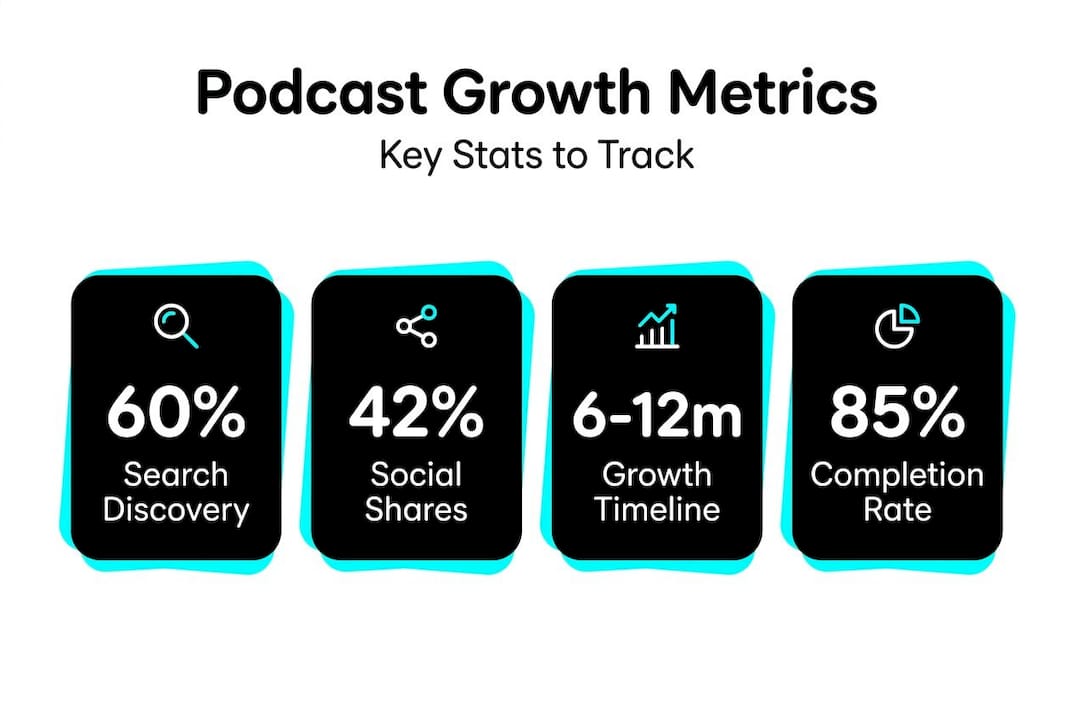
Over 60% of podcast discovery happens through search and browsing within apps, and 42% of listeners discover new shows weekly through social platforms. Both of those channels reward the work you put in before you hit publish.

Verifying and optimizing your growth efforts
Promotion without measurement is just guessing. Once your campaigns are running, you need to know what’s working and what’s wasting your time.
Here’s how to approach data-driven optimization:
- Track the right metrics. Downloads are a vanity metric if they’re not paired with episode completion rates and subscriber growth. A 200-download episode where 80% of people finish is more valuable than a 1,000-download episode with a 20% completion rate.
- Identify your best-performing content. Which guests drove the biggest spikes? Which topics got shared the most? Which episode titles pulled clicks from search? Your data tells you exactly what to do more of.
- Use platform analytics plus third-party tools. Spotify for Podcasters and Apple Podcasts Connect offer solid native dashboards. Pair those with tools that track web traffic and social referrals to get a fuller picture.
- Adjust and iterate. If a certain promotion cadence isn’t moving the needle after 30 days, change the format, the platform, or the content type. The goal is to find what compounds.
- Avoid shortcuts. Fake downloads and review manipulation might look good temporarily, but platforms detect them and penalize you. Beyond the risk, they tell you nothing useful about real audience behavior.
| Metric | What it tells you | How to act on it |
|---|---|---|
| Episode completion rate | Whether your content holds attention | Cut dead intros, tighten pacing |
| Subscriber growth per episode | Which topics attract new listeners | Produce more episodes in that direction |
| Social shares and referral traffic | Which clips or posts resonate | Double down on that format and platform |
| Search ranking for episode titles | Whether your SEO is working | Refine titles and show notes accordingly |
Building community and long-term loyalty
Downloads go up. Downloads go down. But a community? That stays. And it grows on its own terms through word of mouth, shares, and genuine enthusiasm that no paid ad can replicate.
Here’s the thing about audiences following authentic personalities rather than shows: it means the “brand” of your podcast is you. That’s actually great news, because personality is impossible to copy.
A few ways to build real community around your show:
- Create rituals your listeners look forward to. A weekly listener question segment. A monthly live Q&A. A recurring “what I’m reading” recommendation. Weekly rituals turn passive listeners into active participants, which accelerates referrals and shares organically.
- Give listeners somewhere to gather. A Discord server, a Facebook group, or even a dedicated Slack channel creates a space where fans talk to each other, not just to you. That peer-to-peer connection is sticky in a way that broadcast content can’t match.
- Ask for specific, low-friction actions. “Share this episode with one person” is more effective than “subscribe, rate, and review.” One clear ask beats three vague ones.
- Spotlight your listeners. Feature their questions, stories, or wins on your show. People who feel seen become your loudest ambassadors.
- Use your mailing list as a two-way channel. Reply to people who respond to your emails. Ask questions. Run polls. The listeners you engage directly become the ones most likely to recommend your show unprompted.
Pro Tip: Don’t underestimate the power of Spotify’s editorial playlists for niche shows. Spotify editorial actively prioritizes diverse and emerging creators in curated playlists. Fill out your Spotify for Podcasters profile completely and pitch your show for playlist consideration when relevant episodes release.
Learning how to grow my podcast audience isn’t a one-time exercise. It’s an ongoing practice of showing up, listening to what your community tells you, and refining as you go.
My honest take on what actually drives growth
I’ve watched a lot of podcasters chase the wrong things. They obsess over getting on big media lists, or landing one massive guest who will supposedly unlock everything. It rarely works that way.
What I’ve seen actually move the needle is almost boring in how basic it sounds. Consistency. Specificity. And treating social media like a separate creative output, not an afterthought.
The hardest truth? Podcast growth takes 6 to 12 months of consistent, multi-pronged effort before most shows see real traction. That’s not discouraging. It’s clarifying. It means the people who stick around long enough to build real systems will win by default, because most competitors give up in month three.
I also think the video conversation is under-appreciated. Young podcasts without video previews struggle significantly more to convert casual browsers into listeners. Video isn’t optional anymore if you’re serious about building a podcast audience in 2026.
My biggest advice: stop optimizing for downloads and start optimizing for genuine connections. The downloads follow the community, not the other way around. Every time I see a show grow fast, it’s because someone built something people felt part of, not just something people consumed.
That’s the influencer marketing insight that often gets missed. The most effective podcast promoters are often the listeners themselves, when you give them something worth sharing.
— Jason
How Prodcastapp helps you get discovered
If you’re putting out great content and want to make sure the right moments actually reach people, Prodcastapp was built for exactly that.

Prodcastapp uses AI to analyze podcast transcripts and surface the key moments, product mentions, and insights that make people stop and listen. Instead of a listener scrubbing through a 90-minute episode hoping to find the good stuff, Prodcastapp turns those conversations into structured, searchable highlights. For creators, that means your best clips are easier to find, share, and promote across every platform. You can explore compelling podcast moments that Prodcastapp already surfaces across thousands of shows, and use it as a model for how your own content can show up in front of the right people.
Want to learn more about proven discoverability steps? Prodcastapp’s resources go deep on exactly that.
FAQ
What is the fastest way to grow a podcast audience?
Short-form video clips of 30 to 60 seconds on TikTok, Instagram Reels, and YouTube Shorts consistently drive the fastest new listener acquisition. Pair that with distribution on all major platforms and a consistent publishing schedule for compounding results.
How long does it take to grow a podcast audience?
Most shows need 6 to 12 months of consistent, multi-channel promotion before seeing significant growth. Patience combined with regular SEO updates, social media engagement, and community building accelerates the timeline.
Does podcast SEO really make a difference?
Yes. Over 60% of podcast discovery happens through search and browsing within apps. Optimized episode titles, descriptions, and transcripts dramatically improve how often your show appears when listeners search for topics you cover.
How do I turn listeners into loyal fans?
Create recurring rituals like weekly Q&As or listener spotlights, give your community somewhere to gather like a Discord server, and engage directly with email replies and social comments. Authentic personality builds loyalty faster than polished content without connection.
Should I use paid ads to grow my podcast?
Paid promotion works best once you’ve identified which episodes convert casual visitors into subscribers organically. Amplify content that already performs well rather than spending budget on untested episodes.