CATEGORIES
TAGS
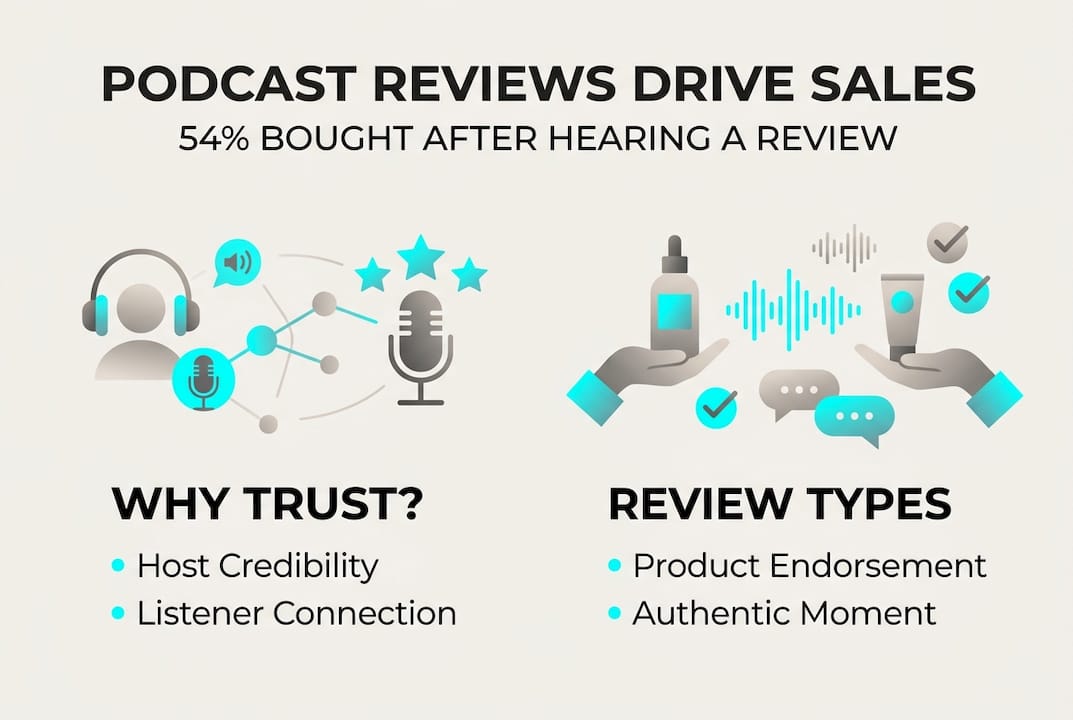
How to get product reviews from podcasts: 54% buy

TL;DR:
- Podcast recommendations significantly influence purchasing decisions by building parasocial trust with engaged audiences.
- AI tools now enable brands to automatically detect, verify, and leverage podcast mentions for targeted marketing assets.
- Focusing on niche, authentic endorsements from trusted hosts yields higher ROI than volume-based podcast promotion efforts.
Podcast recommendations are quietly driving purchase decisions at a scale most brands haven’t caught up to yet. 54% of listeners are more likely to buy a product after hearing it mentioned on a podcast, and that’s not a soft metric. That’s real intent, real trust, and real revenue sitting inside audio files your marketing team may never have touched. The problem is that most brands have no systematic way to surface those endorsements, let alone turn them into repeatable marketing assets. This guide changes that. We’ll walk you through exactly how to capture, verify, and amplify podcast-driven product reviews for measurable sales impact.
Table of Contents
- Why podcast reviews matter for brands
- Essential tools and workflows for extracting podcast reviews
- Turning extracted podcast reviews into marketing assets
- Overcoming common challenges and ensuring review authenticity
- What most brands get wrong about podcast-driven reviews
- Unlock more revenue from podcast-driven product reviews
- Frequently asked questions
Key Takeaways
| Point | Details |
|---|---|
| Podcast reviews drive sales | Authentic listener and host recommendations generate measurable purchasing intent and retail lift for brands. |
| AI unlocks at-scale extraction | AI-powered tools now make it possible to monitor, transcribe, and extract product mentions and reviews from thousands of podcast episodes efficiently. |
| Amplification boosts engagement | Repurposing and sharing podcast-sourced reviews multiplies their influence across social media, email, and beyond. |
| Quality beats quantity | Focusing on niche alignment and trusted hosts delivers greater ROI than chasing the most mentions. |
Why podcast reviews matter for brands
Let’s be honest: not all reviews are created equal. A three-star rating on a retail site carries a very different weight than a host you’ve followed for two years saying, “I’ve been using this every single morning.” That’s the core difference with podcast reviews. They’re built on parasocial trust, which means the listener already feels a personal connection with the host before any product is mentioned.
The numbers back this up. 58% of podcast listeners have bought a product directly because a host recommended it. That’s not a passive audience scrolling past an ad. That’s an engaged listener pausing an episode to pull out their phone.
Here’s a quick look at what makes podcast-driven reviews uniquely powerful:
- Contextual trust: Hosts weave product mentions into real conversations, making them feel organic rather than scripted.
- Longer attention spans: Podcast listeners are typically engaged for 30 to 60 minutes per episode, giving recommendations time to land.
- Niche alignment: Podcast audiences self-select by interest, so a mention on a fitness show reaches people who are already primed to care about health products.
- Measurable lift: The olive oil brand Graza saw a 15% retail lift and 3x higher incremental sales after podcast ad campaigns.
“Podcast listeners don’t just hear recommendations. They act on them. The parasocial bond between host and audience is the most underutilized asset in modern marketing.”
Understanding podcast purchasing data shows that this behavior isn’t a fluke. It’s a consistent pattern across categories from tech to beauty to food. And endorsement-driven shopping habits are only getting stronger as podcast listenership grows. The brands winning right now are the ones treating podcast mentions as a review channel, not just an advertising placement.
For marketers, the strategic shift is simple but significant: stop thinking of podcasts as a broadcast medium and start treating them as a review generation engine. Every episode where your product gets mentioned is a potential asset. The question is whether you have the tools to find it.
A solid podcast media monitoring strategy is the foundation. Without it, you’re essentially hoping someone on your team happens to hear the right episode at the right time. That’s not a strategy. That’s luck.
Essential tools and workflows for extracting podcast reviews
So how do you actually pull reviews out of audio content at scale? The good news is that the tooling has gotten really good. AI-powered podcast transcript analysis now makes it possible to automatically detect product mentions, brand names, and endorsements across thousands of episodes without anyone having to sit through hours of audio.
Here’s a comparison of key tools you’ll want to know about:
| Tool | Primary function | Best for |
|---|---|---|
| Podscan | Real-time podcast monitoring | Brand mention tracking at scale |
| Mentionlytics | Sentiment analysis and alerts | Reputation and review discovery |
| Trigify | Audience signal detection | Identifying high-trust hosts |
| Transkriptor | AI audio transcription | Accurate text extraction from episodes |
Once you have your tools selected, the workflow looks like this:
- Ingest audio from target podcasts using your monitoring platform.
- Auto-transcribe each episode. AI transcription tools now hit 95 to 98% accuracy, which is more than enough for reliable extraction.
- Identify product mentions using keyword and entity detection.
- Evaluate sentiment around each mention. Is it enthusiastic? Neutral? Critical?
- Export reviews that meet your quality threshold into a usable format.
This process can run largely on autopilot once it’s set up. Platforms built for AI for podcast analysis can handle the heavy lifting, flagging the moments that actually matter so you’re not wading through hours of content manually.
Pro Tip: Don’t just monitor for your own brand name. Track competitor mentions and category keywords too. If a host is raving about a product in your space, that’s competitive intelligence and a potential outreach opportunity.
The goal at this stage is a clean, organized library of podcast moments where your product (or your category) gets genuine, positive airtime. Think of it as raw material. What you do with it next is where the real marketing magic happens. Content recommendation tools can also help you identify which extracted moments are most likely to resonate with your target audience before you invest in amplification.

Also worth noting: an AI recommendations extractor can help you cross-reference podcast mentions with video content, giving you a fuller picture of where your product is generating organic buzz.
Turning extracted podcast reviews into marketing assets
You’ve got the clips. You’ve got the quotes. Now what? This is where a lot of brands drop the ball. They find a great mention and then… do nothing with it. Don’t be that brand.
Here’s how to turn extracted podcast reviews into actual marketing fuel:
- Social media clips: Pull the audio moment, add captions and branding, and post it as a short-form video. Repurposing podcast insights into social clips boosts engagement 3x compared to standard brand content.
- Email campaigns: Quote the host directly in a subject line or body copy. “[Host name] called this ‘the best productivity tool I’ve used this year’” is a compelling hook.
- Landing pages: Dedicated pages that feature podcast endorsements as social proof convert better than generic testimonial pages because the source is credible and traceable.
- PR and press kits: A collection of podcast mentions from credible hosts is a powerful third-party validation tool for retail buyers and media contacts.
“The most effective review isn’t the one you asked for. It’s the one that happened organically, in front of an audience that already trusts the source.”
A quick note on compliance: always attribute quotes accurately and, when possible, reach out to the host or show for permission before using audio clips commercially. Most hosts are happy to collaborate, especially if you’re amplifying their content. Fair use covers some scenarios, but getting explicit consent protects you and opens the door to a genuine partnership.
Pro Tip: Run A/B tests with different review formats. A direct quote might outperform a paraphrased summary, or vice versa, depending on your audience. Test email subject lines, landing page headlines, and social captions to find what actually moves the needle.
For deeper strategy, content recommendations from podcast data can guide which formats and channels to prioritize. And if you want to build a full system around this, a data-driven marketing strategy rooted in podcast discovery is the most sustainable approach.
Overcoming common challenges and ensuring review authenticity
Not every podcast mention is a gift. Some are neutral. Some are negative. Some are about a competitor. And some transcripts are just too garbled to be useful. Here’s how to handle the messy reality.
| Challenge | Recommended solution |
|---|---|
| Negative sentiment | Set real-time alerts for crisis detection; respond proactively |
| Competitor mentions | Log as competitive intelligence; identify gaps in positioning |
| Non-English episodes | Use multilingual transcription tools; prioritize accuracy review |
| Low audio quality | Apply noise-reduction preprocessing before transcription |
| Unverifiable hosts | Cross-check host credibility via listener counts and engagement metrics |
Handling edge cases like negative sentiment and competitor mentions is part of any mature monitoring program. The brands that do this well treat every mention, good or bad, as useful signal.
Here’s a simple process for verifying review authenticity before you use it in marketing:
- Check host credibility. Does this person have a genuine audience? Look at download numbers, listener reviews, and social engagement.
- Confirm the mention is organic. Was this a paid placement or a spontaneous recommendation? Organic mentions carry more weight.
- Trace the listener response. Did the episode generate comments, social posts, or purchase spikes? Real impact is traceable.
- Verify transcript accuracy. Always read the extracted quote in context. AI is accurate, but context matters.
- Document the source. Keep a record of the episode, timestamp, and host for every review you plan to use.
Understanding why podcasts are trusted helps you evaluate which sources are worth prioritizing. Not all podcasts carry the same credibility, and your review library should reflect that. For a comprehensive look at podcast edge case handling, the full monitoring guide is worth bookmarking.
What most brands get wrong about podcast-driven reviews
Here’s the uncomfortable truth: most brands approach podcast reviews the same way they approach influencer marketing. More mentions, more reach, more volume. And they miss the point entirely.
The brands seeing the highest ROI aren’t the ones with the most podcast mentions. They’re the ones with the right mentions, from hosts whose audiences are deeply aligned with their product category. A single enthusiastic recommendation from a niche podcast with 8,000 loyal listeners can outperform a casual mention on a show with 500,000 downloads.
Niche podcast alignment is where the real competitive advantage lives. AI tools can now quantify your share of voice versus competitors across specific podcast categories, which means you can stop guessing and start targeting with precision.
The other thing brands consistently underestimate is the relationship layer. Hosts who genuinely love your product and feel seen by your brand will mention you again, recommend you to other hosts, and become long-term advocates. That’s not something you can buy with a one-off ad placement. It comes from treating podcast creators as partners, not just distribution channels.
Why trust drives ROI in podcast marketing comes down to this: listeners have already opted in to a relationship with the host. When you earn the host’s genuine endorsement, you inherit that trust. Volume without alignment is just noise.
Unlock more revenue from podcast-driven product reviews
With the right strategy and tools in place, you’re ready to maximize the payoff from every listener endorsement. Prodcast makes the entire process faster and smarter, from spotting the moments that matter to turning them into ready-to-use marketing assets.

You can discover top podcast moments that are already driving conversation in your category, or tap into curated mass persuasion recommendations built from real listener data. Whether you’re tracking brand mentions, finding new product trends, or building a review-driven content strategy, explore all podcast review tools to see how Prodcast turns podcast conversations into your next competitive edge.
Frequently asked questions
How accurate are AI tools for extracting podcast reviews?
Advanced AI tools can transcribe podcast audio with 95 to 98% accuracy, allowing you to reliably extract listener and host recommendations with minimal errors.
What’s the fastest way to process multiple podcast episodes for potential product reviews?
AI-powered monitoring platforms can analyze and surface relevant product mentions from 35,000+ daily episodes, with each episode processed in under 15 minutes.
How do I ensure the authenticity of extracted podcast reviews?
Prioritize sources with strong host credibility, transparent attribution, and evidence of real listener engagement. Host expertise and parasocial trust are the clearest indicators of an authentic, high-value endorsement.
How effective are podcast reviews compared to traditional online product reviews?
Podcast reviews can increase purchase intent by 54%, outperforming many traditional review platforms in terms of trust and direct sales impact.