CATEGORIES
TAGS
How to buy products from podcasts with confidence

TL;DR:
- Podcast recommendations build trust through personal stories, authenticity, and repeated mentions.
- Verify product details via show notes, brand websites, independent reviews, and comparison shopping.
- Use a discovery approach: consider host insights as ideas, not final decisions, and conduct independent research before buying.
How to buy products from podcasts with confidence
Over 67% of podcast listeners have made a purchase directly because of something a host recommended on air. That number probably surprises you, but it makes sense once you think about it. Podcasts feel intimate. You’re listening to someone talk for an hour while you cook dinner or hit the gym. By episode ten, you trust them like a friend. This article breaks down exactly why podcast product recommendations carry so much weight, how to find those products after the episode ends, how to separate genuine picks from paid placements, and how to buy confidently without second-guessing yourself.
Table of Contents
- Why podcasts drive product purchases
- Finding product recommendations in podcasts
- Evaluating credibility: What makes a podcast product recommendation trustworthy?
- Taking action: Steps to buy products confidently from podcasts
- What most listeners overlook about podcast product recommendations
- Discover trending podcast products with Prodcast
- Frequently asked questions
Key Takeaways
| Point | Details |
|---|---|
| Podcast trust signals | Trusted hosts and tested reviews make podcast product recommendations highly credible. |
| Where to find links | Show notes and podcast platforms are the main sources for product links and further details. |
| Evaluate before buying | Look for transparency, repeatable reviews, and independently verify any podcast recommendation. |
| Practical buying steps | Follow sequence—find links, check authenticity, review ratings—to buy confidently from podcasts. |
Why podcasts drive product purchases
Building on the widespread influence podcasts have, let’s examine the factors that drive listeners to purchase.
Podcast hosts earn trust slowly and consistently. Unlike a social media influencer dropping a quick sponsored post, a podcast host spends hours with their audience every week. Listeners learn their opinions, laugh at their stories, and absorb their worldview. By the time a host says, “I’ve been using this protein powder for three months and it actually works,” you believe them. That’s not an accident. It’s the result of dozens of episodes building a real relationship.
Product recommendations on podcasts also land differently because they’re woven into real stories. A host doesn’t just announce a product. They talk about the problem they were trying to solve, the products they tried that failed, and then the one that finally clicked. That narrative structure makes the recommendation feel earned, not manufactured. You’re not watching a commercial. You’re hearing someone work through the same frustrations you might have.
There’s something else at play here too. Listeners genuinely care about creator authenticity. When a host has been on your playlist for two years talking about minimalist living, and they recommend a specific backpack brand, that endorsement carries context. It fits the world they’ve built. Compare that to a banner ad from a brand you’ve never heard of, and the difference is obvious.
Here’s what makes podcast recommendations different from traditional advertising:
- Personal experience: Hosts usually share how they actually use the product, not just what it does
- Emotional context: Recommendations arrive inside a story, which makes them more memorable
- Earned credibility: Listeners have already decided they trust the host before the recommendation appears
- Conversational tone: The informal delivery feels like a tip from a friend, not a pitch
- Repetition: Many hosts revisit products across multiple episodes, which signals genuine satisfaction
The data consistently backs this up. More than two-thirds of global listeners have acted on a podcast recommendation and made a purchase. That’s not a niche behavior. That’s mainstream consumer influence.
“Podcasts have become one of the most trusted channels for product discovery because listeners self-select into a host’s world. They already align with that person’s taste before a product is ever mentioned.”
Understanding why podcasts influence buying behavior helps you become a smarter shopper. Once you recognize the emotional mechanics at work, you can appreciate the recommendation while still applying your own judgment. That’s the balance every good podcast listener learns to strike.
For a deeper look at the numbers behind this trend, the data-driven guide to podcast purchases breaks it all down by category, genre, and listener behavior.
Finding product recommendations in podcasts
Now that you know why recommendations are trusted, here’s how to actually find the products discussed in your favorite shows.
The most reliable place to start is the show notes. Every podcast episode should have them, and for product-focused shows, they’re basically a shopping list. Show notes typically include direct purchase links, discount codes, affiliate URLs, and sometimes brief descriptions of why the host chose each product. If you’re listening on Spotify, Apple Podcasts, or any major platform, the show notes are usually one tap away from the episode page.

During the episode itself, hosts tend to flag product moments clearly. Phrases like “I’ll link this in the show notes” or “use code [hostname] for ten percent off” are your cue to bookmark the moment or jot down the product name. Some hosts dedicate specific segments to product reviews, especially in consumer, tech, or lifestyle shows.
Not all recommendations carry the same weight, though. Here’s a useful comparison:
| Type of mention | What it signals | Trust level |
|---|---|---|
| Long-form review with personal use | Host tested it over time | High |
| Brief mention in conversation | Casual awareness, not deep experience | Moderate |
| Sponsored segment with discount code | Paid placement, may be genuine | Mixed |
| Guest recommendation | Depends on guest credibility | Variable |
| Repeated mentions across episodes | Sustained satisfaction | Very high |
You can also take practical steps to track down products more efficiently:
- Go to the episode page on the podcast platform and read the full show notes before searching anywhere else
- Visit the host’s website or link-in-bio where many creators maintain curated product pages for their most recommended items
- Search the podcast name plus the product name in a search engine to find blog posts or roundup articles that reference the same recommendation
- Check community spaces like subreddits or Discord servers dedicated to your favorite shows, where listeners often compile product lists
- Use a discovery platform like Prodcast to surface product mentions across entire podcast catalogs without scrubbing through every episode
Pro Tip: Start with show notes every time. They’re the fastest and most accurate source for product details, codes, and links. If notes are missing or sparse, that’s actually useful information about how seriously the creator takes their product recommendations.
For context on how podcast commerce actually works behind the scenes, it helps to understand the relationship between creators, brands, and listeners. Shows like Wirecutter’s podcast bring their tested product reviews directly into audio format, setting a high bar for what credible podcast product content looks like.
Some creators, like the team at Lizard’s Lunch, have taken this further by building dedicated shopping destinations tied directly to their podcast content. That kind of integration is the gold standard for podcast-driven commerce.
The podcast product sales strategies that work best for brands also reveal a lot about how listeners can spot the most authentic picks.
Evaluating credibility: What makes a podcast product recommendation trustworthy?
Locating product links is just the start. Let’s look at how to decide which recommendations you can actually trust.
The most reliable signal is repetition. When a host mentions the same product across three separate episodes, spanning months or even seasons, that’s not a scripted talking point. That’s someone who keeps reaching for the same tool and finding value in it. One mention might be a paid placement. Five mentions over a year is a habit.
Transparency is the second filter. Reputable hosts disclose when something is sponsored or when they’re using an affiliate link. In fact, affiliate marketing in podcasting specifically emphasizes relevance, natural integration, trust, and transparency as the pillars of ethical promotion. If a host is openly saying “I earn a commission if you use this link,” that’s actually a point in their favor. They’re not hiding the relationship. That honesty usually signals they care about their credibility more than a one-time payout.
Here’s what credible podcast product recommendations typically include:
- Specific use case: The host explains exactly how and when they use the product
- Clear rationale: They give real reasons beyond “it’s great” or “I love it”
- Honest drawbacks: Credible reviewers acknowledge what the product doesn’t do well
- Verification paths: They point you to show notes, landing pages, or independent reviews
- Disclosure statements: Affiliate links and sponsorships are clearly labeled
| Credibility factor | Weak signal | Strong signal |
|---|---|---|
| Duration of use | “Just tried it” | “Been using for 6 months” |
| Specificity | “It works great” | “Helped me sleep 45 minutes faster” |
| Disclosure | None mentioned | Clearly states affiliate relationship |
| Verification | No links provided | Show notes, landing page, and reviews linked |
| Consistency | One mention | Referenced repeatedly across episodes |
Pro Tip: Before buying, search the host’s name alongside the product name. Look for any past mentions in older episodes or social posts. A pattern of genuine use is the clearest indicator that the recommendation is real.
For a framework on how to evaluate these moments in context, the podcast commerce strategies guide covers how both listeners and brands approach the credibility question.
If you’re curious how curated, high-quality product lists look in practice, the Lizard’s Lunch gift guide is a solid real-world example of a creator organizing their tested picks for easy discovery.
Taking action: Steps to buy products confidently from podcasts
With the credibility checks in place, here’s your step-by-step approach to buying responsibly from podcasts.
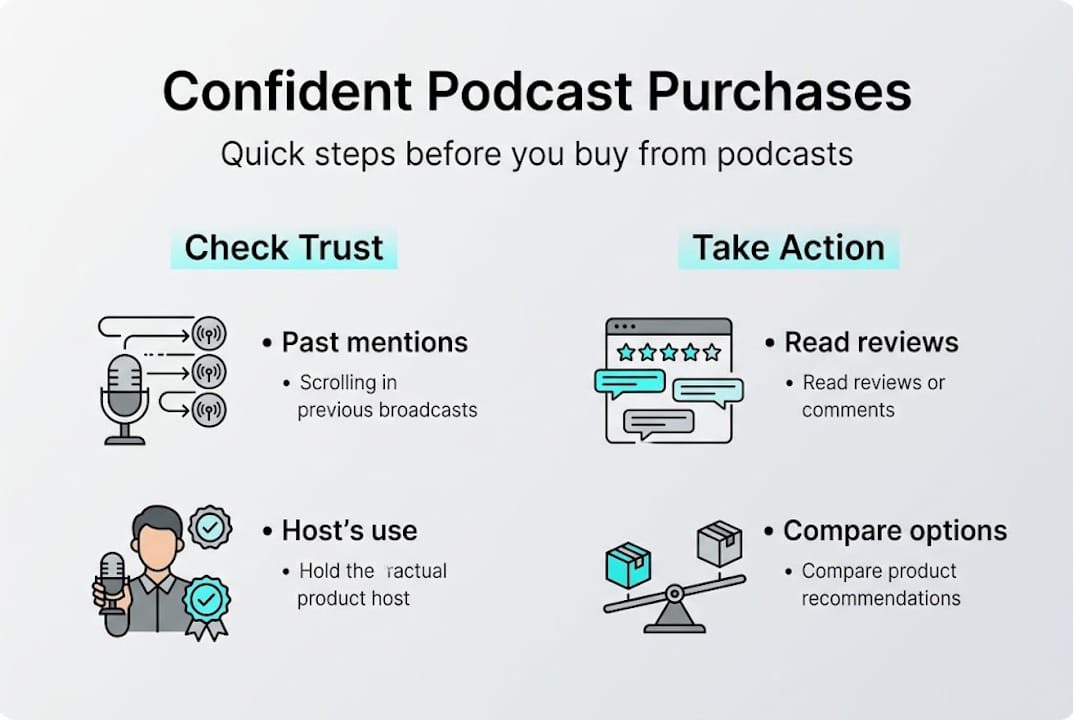
The good news is that podcast-to-product recommendations are credible enough to genuinely move purchase decisions when you apply a basic verification process. The process doesn’t take long. It just takes intention.
Here’s how to do it:
- Start with show notes. Before you Google anything, pull up the episode’s show notes. This gives you the exact product name, the host’s description, and any discount code or affiliate link they’ve provided.
- Confirm the product exists on the brand’s official website. Don’t rely on a third-party seller right away. Visit the brand directly to verify the product is real, in stock, and accurately described.
- Check for affiliate disclosures. If the host has an affiliate arrangement, the link in show notes will usually redirect through a tracking URL. That’s normal and fine, but knowing it exists helps you understand the full picture.
- Read independent reviews. Head to a site that has no relationship with the host or brand. Look for patterns in verified reviews across multiple platforms. A product that’s genuinely good will have consistent praise from people who found it on their own.
- Compare against similar products. Spend ten minutes checking alternatives in the same category. Sometimes the host’s pick is the best option. Sometimes it’s just the one that fit their sponsorship deal. Comparison shopping reveals which is which.
- Make the purchase through a secure channel. Use the official website, a well-known retailer, or the host’s affiliate link if you want to support them. Avoid unfamiliar third-party marketplaces for products you haven’t verified.
- Save the episode timestamp. If you ever need to return the product or recall specific details the host mentioned, having the exact moment bookmarked saves real time.
Pro Tip: Use independent review sites like Wirecutter, Consumer Reports, or Reddit threads as your second opinion layer. They have nothing to gain from your purchase and everything to gain from maintaining accuracy.
Understanding how brands drive podcast sales also helps you spot when a recommendation is organic versus strategically placed. That context makes you a sharper buyer without making you cynical about the whole process.
What most listeners overlook about podcast product recommendations
Here’s the honest take that most podcast shopping guides skip: treating a host recommendation as the final word is where a lot of listeners go wrong.
Podcast hosts can be genuinely passionate and paid at the same time. Those two things aren’t mutually exclusive. A host might truly love a mattress brand AND receive a flat fee for every mention. That doesn’t automatically make the recommendation bad. But it does mean you shouldn’t stop your research at “my favorite host said so.”
The smartest podcast listeners we’ve seen use shows as a discovery layer, not a decision engine. A host surfaces something interesting. That sparks curiosity. Then the listener goes and verifies it independently, checks how podcast listeners shop for patterns across multiple shows, and reads tested reviews from sources that have no skin in the game.
That two-step approach, podcast as discovery plus independent verification, is what separates confident buyers from people who feel burned after a purchase. The podcast gives you the lead. You close the case yourself.
Discover trending podcast products with Prodcast
When you’re ready to explore product picks from podcasts, here’s where Prodcast can help.
Prodcast is built exactly for this moment in your listening journey. It analyzes thousands of podcast transcripts to surface the products, tools, books, and brands that creators are actually talking about right now. No more scrubbing through a 90-minute episode hoping to catch the product name before it disappears.

With Prodcast, you can browse podcast moments where specific products are mentioned, compare how often something comes up across different shows, and find the authentic recommendations that align with your interests. Whether you’re into fitness, tech, business, or beauty, the product signals are already there. Prodcast just makes them easy to find and act on.
Frequently asked questions
Are podcast product recommendations really trustworthy?
Most recommendations are credible, especially when hosts show clear rationale and a history of tested, reviewed picks, but verifying independently before you buy is always the smarter move.
Where can I find links to the products discussed in a podcast?
The show notes are your first stop; podcast hosts and platforms usually place product links there directly, and discovery tools like Prodcast also collect and organize these mentions across shows.
Should I check if a podcast host is an affiliate or sponsor?
Absolutely. Hosts should disclose those relationships, and transparency around affiliate links is one of the clearest signs that a creator values your trust over a quick commission.
What if I can’t find the product in show notes?
Search the podcast’s website directly, or use a discovery platform like Prodcast, which collects and highlights product recommendations from thousands of episodes so you don’t have to track them down manually.
How do I avoid buying the wrong product from a podcast?
Compare the recommendation against similar products, check tested sources and independent reviews before purchasing, and look for hosts who revisit the same product across multiple episodes as a sign of genuine satisfaction.