CATEGORIES
TAGS
How podcasts shape what you buy and why you trust

TL;DR:
- Listeners trust podcast hosts 64% more than influencers due to long-term, genuine relationships built through consistent content. The intimate and voluntary nature of podcasts enhances audience engagement, trust, and the effectiveness of host-read ads, leading to higher recall and conversion rates. Platform features and tools that facilitate discovery and tracking amplify this trust, creating a powerful environment for authentic marketing collaborations.
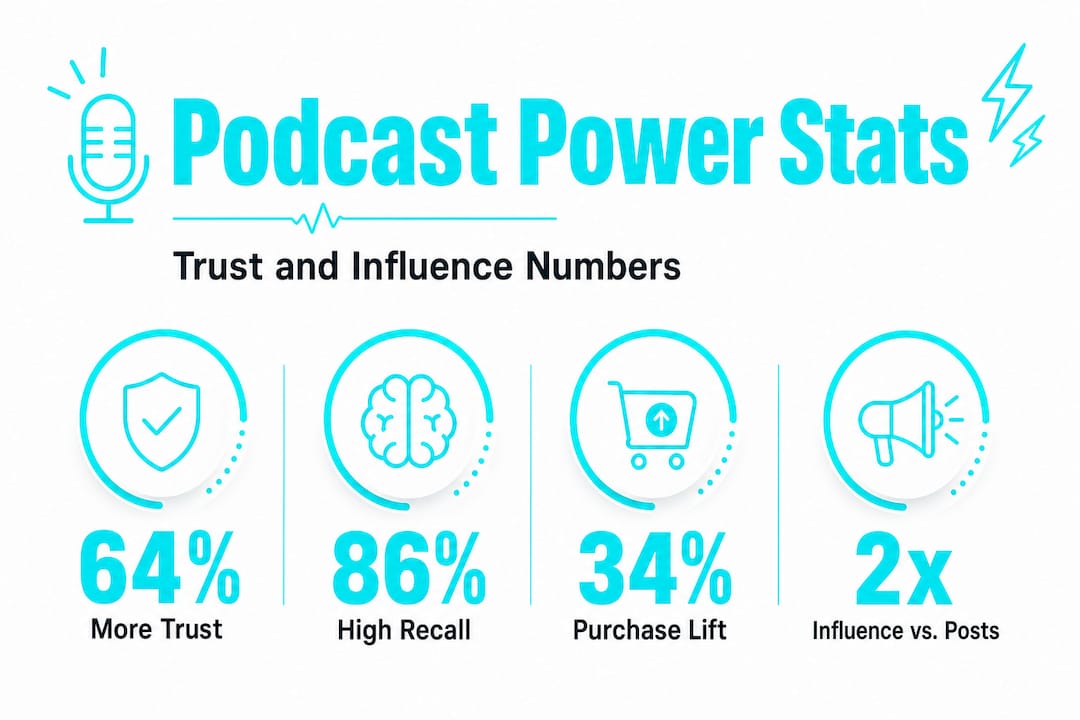
Forget the Instagram influencer with the perfectly lit product shot. The most persuasive voice in marketing right now might be the one coming through your earbuds on your morning commute. Podcast listeners trust hosts 64% more than influencers, and ad recall for host-read content sits between 60% and 86%, with purchase intent jumping 28% to 34%. Those are numbers most social media campaigns would dream of. So what’s actually happening inside podcast platforms that creates this kind of pull? Let’s get into it.
Table of Contents
- What drives user behavior on podcast platforms?
- How platform features amplify engagement and trust
- From trusted voices to purchases: The path to action
- Practical strategies for listeners and marketers
- The real reasons podcast behavior beats other channels
- Ready to act on what you hear? Discover and track podcast moments
- Frequently asked questions
Key Takeaways
| Point | Details |
|---|---|
| Host trust drives action | Podcast listeners trust their favorite hosts and are more likely to recall and act on endorsements than with influencer content. |
| Platform design shapes choices | Features like recommendations and sharing heavily influence what listeners discover and how they engage. |
| Authenticity boosts purchasing | Host-read ads that sound genuine lead to much higher purchase intent and recall. |
| Success needs strategy | Both listeners and marketers get the most value by approaching recommendations and ads with clear strategies. |
What drives user behavior on podcast platforms?
To move from the big picture into what actually drives these behaviors, let’s look at the key motivations and engagement triggers unique to podcast platforms.
Podcast listening is different from scrolling a feed or watching a video. It’s intentional. You chose to show up. You pressed play. That single act of choice creates a very different mental state than passively watching a video auto-play. Listeners are often doing something else, running, cooking, driving, but their ears are fully engaged. The host’s voice becomes almost companionable.
This is why podcast engagement metrics look so different from those of other media. People listen to the whole episode. They come back week after week. They feel like they actually know the host, even if they’ve never met.
Here’s what makes podcast audiences tick:
- Entertainment and escape. People want content that holds their attention during otherwise mundane tasks.
- Learning and skill-building. Business, health, technology, personal finance — listeners tune in to level up in areas they care about.
- Discovery. Finding new tools, books, brands, or ideas they wouldn’t encounter elsewhere.
- Community and belonging. Following a podcast is a bit like joining a club. Listeners share episodes, debate topics, and bond over shared interests.
- Trust in a familiar voice. Repeated exposure over months or years makes hosts feel credible and reliable.
That last point is the big one. We’re not talking about a celebrity endorsement from someone you’ve never heard speak candidly. We’re talking about a person who has shared their struggles, failures, and opinions across dozens of hours of audio. When that host says “I actually use this product,” the listener believes it.
“The intimacy of audio is unlike any other format. A host’s voice becomes a part of your daily routine, and that routine builds the kind of trust advertisers spend years trying to earn elsewhere.”
Pro Tip: If you’re a marketer wondering which hosts actually build this kind of trust with their audiences, look at shows with consistent episode release schedules and high listener retention rates, not just download numbers. Consistency is the foundation of that bond.
How platform features amplify engagement and trust
Now that we know what motivates listeners, it’s critical to see how the design and features of podcast platforms further shape their actions.

The platform you use to listen isn’t neutral. Every design choice, from how episodes are surfaced to how ads are displayed, influences what you hear, how long you listen, and whether you act on a recommendation. These aren’t small nudges. They’re the difference between a listener discovering a product that changes their life and scrolling right past it.
Let’s look at how the major platforms stack up across key features that influence behavior:
| Feature | Spotify | Apple Podcasts | Amazon Music |
|---|---|---|---|
| Personalized recommendations | Strong algorithm | Curated editorial | Growing AI tools |
| Social sharing tools | Built-in | Limited | Minimal |
| In-app purchases or links | Available | Limited | Growing |
| Ad format transparency | Clear labels | Varies | Moderate |
| Discovery interface | Visual and rich | Category-based | Search-heavy |
There’s something important buried in that table. Spotify’s recommendation engine surfaces new shows based on listening history, which is useful for discovery. But here’s the thing: listeners trust hosts far more than they trust algorithmic suggestions. An algorithm might introduce you to a show. But it’s the host who makes you buy something.
Here’s how platform features create what you could call a trust loop:
- The algorithm recommends a new show based on your listening habits.
- You try a few episodes and enjoy the host’s perspective.
- You subscribe and develop a routine around the show.
- The host reads an ad or makes an organic recommendation.
- Because you already trust the host, you recall the product and consider it.
- You search, click, or buy, often directly from a promo code mentioned in the episode.
The design of platforms like Spotify also allows for podcast ads trends to evolve quickly. Dynamic ad insertion, for example, means brands can reach listeners of older episodes with current offers. This extends the lifespan of a campaign well beyond its original air date.
Producers and marketers also need to think about the technical side of audio delivery. Poorly edited or low-quality audio breaks the intimacy effect instantly. Tools that support audio version control help creators maintain consistency across episodes, which matters more than most people realize for listener retention.
From trusted voices to purchases: The path to action
Understanding the platform mechanics, let’s follow the listener journey from hearing a trusted host to actually buying or trying something new.
It rarely happens in one step. A listener doesn’t hear a product mentioned once and immediately pull out their credit card. Usually, it takes a few exposures, some reflection, and a moment of felt need. But the seed gets planted the first time.
Here’s the typical path a listener takes from awareness to action:
- First mention. The host references a product in passing or as part of an ad read. The listener files it away mentally.
- Repeated exposure. The host mentions the product again, maybe shares a personal story about using it. The specifics make it memorable.
- Emotional connection. The listener relates to the problem the product solves. “That’s exactly what I’ve been dealing with.”
- Active consideration. The listener searches for the product, often using the promo code mentioned on the show.
- Purchase or trial. The listener buys, downloads, or tries the product, often crediting the podcast as the reason.
What makes this work so well is the intimacy we talked about earlier. A purchase intent lift of 28-34% for host-read ads isn’t an accident. It’s the result of a relationship that’s been built over time.
Let’s look at how host-read ads compare to other formats in terms of recall and intent:
| Ad format | Recall rate | Purchase intent lift |
|---|---|---|
| Host-read podcast ad | 60% to 86% | 28% to 34% |
| Pre-roll video ad | 20% to 35% | 8% to 12% |
| Social media influencer post | 25% to 40% | 10% to 18% |
| Display/banner ad | 5% to 10% | 2% to 5% |
Those gaps are significant. And understanding podcast ad effectiveness means recognizing that the format alone doesn’t guarantee results.
“A host can recite an ad script perfectly and still fall flat if it doesn’t feel like them. Authenticity isn’t optional in podcast advertising — it’s the whole game.”
Pro Tip: For a host-read ad to actually convert, it should sound like a natural extension of the conversation, not a commercial break. The best-performing ads are the ones where listeners aren’t entirely sure where the content ends and the ad begins.
The most effective recommendations aren’t just product pitches. They’re stories. A host explaining how a supplement helped them sleep better, or how a project management tool saved their business, is telling a story listeners can see themselves in. That narrative element is what drives recall and action.
Practical strategies for listeners and marketers
With a clear look at trust and conversion pathways, here are tangible strategies for both those listening and those marketing on podcast platforms.
Let’s split this into two clear camps.
For listeners who want to shop smarter:
Before acting on a podcast recommendation, ask yourself these questions:
- Has this host mentioned the product more than once, and does it fit naturally with their content?
- Are they using a promo code, or does this feel like a genuine organic mention?
- Do other trusted sources back up the product’s claims?
- Are you reacting to the excitement of the moment, or do you actually need this?
- Can you find independent reviews that don’t come from the podcast ecosystem?
Taking five minutes to evaluate a recommendation honestly can save a lot of buyer’s remorse. Not every mention is a gold star endorsement. Some are paid placements that a host agreed to without ever touching the product. It’s okay to be a critical listener.
Digging into audience engagement insights also helps you understand which shows have highly loyal audiences where organic recommendations tend to be more genuine, versus shows that run heavy ad loads where most mentions are paid.
For marketers who want to see real results:
Getting podcast advertising right takes more than writing a script and handing it to a host. Here’s a practical process that actually moves the needle:
- Identify shows where your product fits organically. A fitness supplement on a business strategy podcast is a mismatch. Audience alignment matters as much as audience size.
- Brief the host but let them use their voice. Give them talking points, key benefits, and a promo code. Then step back. Over-scripted ads kill authenticity fast.
- Use unique promo codes per show. This is the simplest way to track conversions back to specific episodes and hosts.
- Commit to a multi-episode run. One mention rarely converts. Three to five episodes of consistent exposure builds the recall effect.
- Monitor what listeners are saying. Social media, reviews, and community forums often light up after a popular host mentions a product. Watch for that signal and respond to it.
- Analyze beyond downloads. Site traffic spikes, promo code redemptions, and search volume for your brand name after an episode drops all tell a richer story than downloads alone.
Good audio quality also signals professionalism and builds trust. Marketers who partner with shows that follow remote audio collaboration tips tend to see better ad performance simply because the listening experience is clean and distraction-free.
The high recall rates of 60-86% for host-read content are achievable, but not guaranteed. Strategy and execution matter.
The real reasons podcast behavior beats other channels
We’ve covered the strategies, and it’s worth stepping back now to question what really makes podcast-driven behavior special. Especially for those of us who’ve spent years in other digital marketing channels.
Here’s an uncomfortable truth most marketers don’t want to admit: we’ve been optimizing for the wrong thing. Clicks, impressions, reach, views. Metrics that are easy to measure but rarely reflect actual behavior change. Podcasts force a different question: did this message actually land?
When listeners trust hosts 64% more than influencers, it signals something much bigger than a format preference. It tells us that consumers have gotten very good at detecting performance. They know when someone is just being paid to hold up a product. They know when a post is staged. And they’re tuning it out.
Podcasts work because they’re rooted in long-form, voluntary connection. Nobody is forced to listen to a two-hour episode. You choose it. You make space for it. That voluntary attention is the rarest, most valuable thing in all of media right now. And it can’t be faked or bought in bulk.
Conventional marketers who approach podcast advertising the same way they approach banner ads or sponsored posts will consistently underperform. The mindset has to shift from interrupting an audience to earning a place in their routine. That’s a fundamentally different kind of relationship.
What we’ve found is that the most successful podcast campaigns treat podcast engagement strategies not as a funnel but as a relationship. You’re not pushing someone through a journey. You’re respecting the journey they’re already on and asking if you can be part of it.
The listeners who act on recommendations aren’t being tricked. They’re responding to genuine connection and perceived value. And the marketers who understand that will keep winning.
Ready to act on what you hear? Discover and track podcast moments
If you’ve ever heard a product mentioned on a podcast and then immediately forgotten which episode it was, you know the frustration. You know something interesting was just recommended, but it’s gone. Searching through transcript-less audio to find it again is like looking for a needle in a haystack.

That’s exactly what Prodcast was built to solve. Our AI-powered platform analyzes podcast transcripts at scale, surfacing every product mention, tool, book, and brand being talked about across thousands of shows. Whether you want to discover podcast moments from your favorite creators or find out which fitness brands are being recommended this week, Prodcast makes it searchable and actionable. You can even find health product recommendations from the most trusted voices in the wellness space. For listeners, it means never missing a trusted tip again. For marketers, it’s a real-time signal of what audiences are actually hearing and responding to.
Frequently asked questions
Why do listeners trust podcast hosts more than influencers?
Podcast hosts build long-term relationships through consistent, candid, long-form content, leading to 64% greater trust compared to social media influencers. It’s the depth of exposure, not just frequency, that drives that trust.
What makes host-read podcast ads so effective?
Host-read ads generate recall rates of 60-86% and a purchase intent lift of 28-34% because audiences perceive them as genuine personal endorsements rather than scripted commercials.
How can marketers make podcast ads convert better?
Ads perform best when hosts sound completely natural and the product fits the show’s content organically. A host-read ad that sounds like a conversation converts far better than one that sounds like a script.
What platform features matter most for listener engagement?
Personalized recommendations, easy episode sharing, and transparent ad labeling keep listeners engaged and returning. These features work best when paired with content quality and host consistency.
Can you really track product mentions across all podcasts?
Yes. Tools like Prodcast use AI to scan transcripts and surface product mentions, brand references, and key moments across thousands of shows, making it easy for listeners and marketers to find and act on insights.