CATEGORIES
TAGS
How podcasts drive sales: data-backed strategies for marketers

TL;DR:
- Podcasts build trust and influence buyer decisions through authentic, long-form conversations.
- Metrics like purchase intent and promo code redemptions directly correlate with sales success.
- Effective content integrates storytelling, clear CTAs, and multi-channel strategies to drive revenue.
Podcasts have quietly grown into one of the most powerful sales tools in a marketer’s kit. Most people still think of them as a branding play, a way to get your name out there. But the numbers tell a different story. Podcast ads increase purchase intent by 6 points, according to Nielsen, which means listeners aren’t just hearing your message. They’re moving closer to buying. This guide breaks down the data, the mechanics, and the practical strategies that turn podcast content into measurable revenue.
Table of Contents
- Why podcasts influence buyer decisions
- Podcast advertising: Metrics that matter
- Storytelling that converts: Crafting podcast content for sales
- Maximizing the sales lift: Integration and ongoing optimization
- Why most brands underutilize podcast sales power
- Drive higher sales with podcast-optimized strategies
- Frequently asked questions
Key Takeaways
| Point | Details |
|---|---|
| Podcasts build trust | Long-form, authentic content positions brands as authorities, driving real purchase actions. |
| Metrics prove results | Podcast advertising reliably lifts brand awareness and purchase intent according to major benchmarks. |
| Storytelling drives sales | Strategic podcast content aligns business goals with customer engagement for higher conversions. |
| Integration multiplies impact | Combining podcasts with other marketing channels amplifies and attributes sales outcomes. |
Why podcasts influence buyer decisions
With that purchase intent stat in mind, let’s break down exactly why podcasts move listeners from passive to purchase-ready.
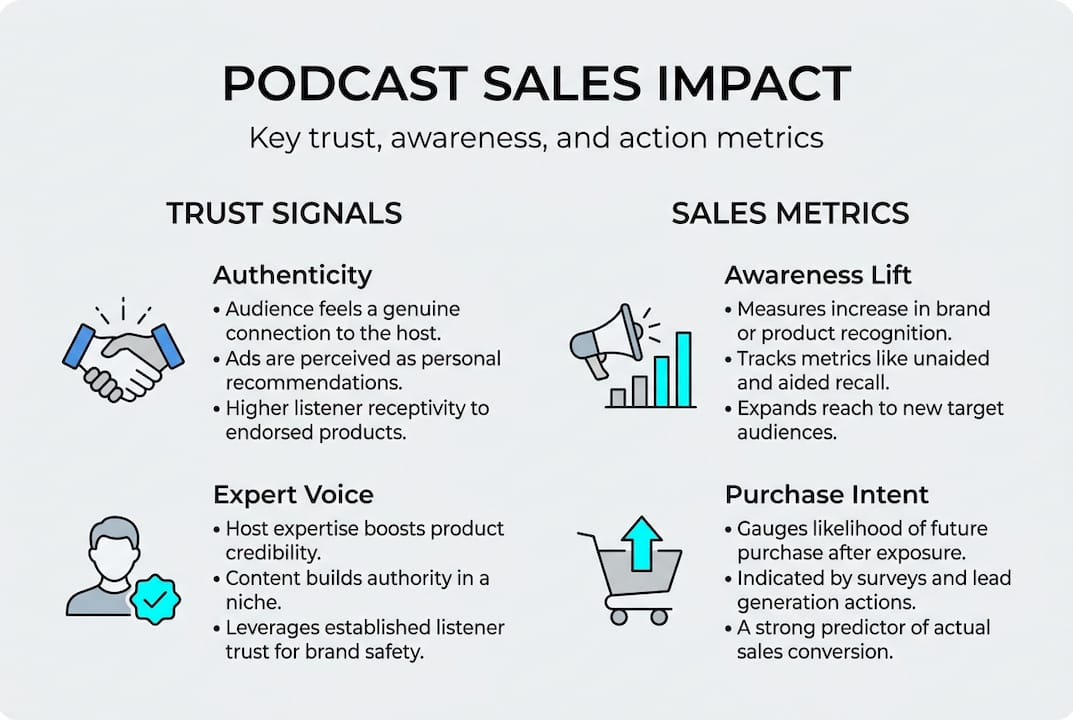
The short answer? Trust. Podcasts are long-form, conversational, and deeply personal. A host who spends 45 minutes sharing real experiences with a product isn’t running a banner ad. They’re having a conversation with someone who chose to listen. That’s a fundamentally different kind of influence.
When a host recommends something, it lands more like advice from a friend than a pitch from a brand. Listeners build genuine relationships with podcast hosts over weeks, months, and sometimes years. That relationship is the engine behind podcast-driven sales.
“Podcasts drive sales through building authority, generating warm leads, and shortening sales cycles” according to real case study data from brands that have used podcast content strategically.
This isn’t just a feel-good theory. The mechanics are real. Here’s what makes podcast listeners more likely to convert:
- Authority transfer: When a respected host endorses a product, their credibility attaches to the brand. Listeners who trust the host extend that trust to what the host recommends.
- Warm lead generation: Podcast listeners are already interested in the topic. A fitness brand on a health podcast isn’t interrupting anyone. It’s showing up exactly where its ideal customer already is.
- Reduced sales friction: A listener who has heard a product discussed in depth arrives at your website already informed. They need less convincing. The sales cycle shortens.
- Emotional resonance: Stories stick. An episode that follows a real customer’s transformation creates an emotional connection that a product description never could.
Nielsen data backs this up too. Podcast ads yield significant lifts in brand awareness, information seeking, and purchase intent across categories. These aren’t soft vanity metrics. They map directly to buyer behavior.
Understanding podcast advertising effectiveness helps you connect these trust signals to actual revenue outcomes. And if you want to go deeper on how to structure content for conversion, e-commerce content best practices offer a useful framework for thinking about how audio fits into a broader content strategy.
The bottom line here is simple. Podcasts earn attention in a way most channels can’t. And earned attention converts.
Podcast advertising: Metrics that matter
Understanding podcast influence as a trust builder sets up our next focus: the metrics proving real-world impact.
Not all metrics are created equal. Downloads and listener counts tell you about reach. But if you’re a marketer focused on sales, you need metrics that trace the path from listen to purchase.
Nielsen’s benchmarks give us a solid baseline. Podcast ads generate measurable lifts across three critical dimensions:
| Metric | Typical lift (Nielsen benchmark) | Buyer journey stage |
|---|---|---|
| Brand awareness | +10 points | Top of funnel |
| Information seeking | +8 points | Middle of funnel |
| Purchase intent | +6 points | Bottom of funnel |
Those numbers matter because they map to where your listener is in the buying process. A 10-point jump in brand awareness means more people know you exist. An 8-point lift in information seeking means they’re actively researching. And a 6-point bump in purchase intent means they’re getting ready to buy.

That’s a full funnel story in three data points.
A 6-point lift in purchase intent from a single ad placement is a significant commercial signal. Most digital ad formats struggle to move that needle at all.
For deeper analysis of which metrics for podcast ads actually predict revenue, it’s worth going beyond the standard dashboard. And if you’re exploring programmatic podcast ads, understanding these benchmarks helps you evaluate placements more precisely.
Pro Tip: Don’t just track downloads. Set up a dedicated landing page or promo code tied to each podcast placement. Post-listen web traffic spikes and promo code redemption rates give you direct, attributable evidence of sales impact. These are the numbers that make the business case for continued podcast investment.
The goal is to connect every ad placement to a measurable outcome. When you can show that a podcast mention drove a 15% spike in traffic to a product page, that’s a conversation worth having in your next budget review.
Storytelling that converts: Crafting podcast content for sales
Podcast ad measurement is vital, but your show’s actual content can be even more powerful for driving conversions.
Ads get attention. Stories create action. The most effective podcast content for sales doesn’t feel like a sales pitch at all. It feels like a conversation that happens to solve a problem your listener has right now.
Intentional, business-aligned content shortens sales cycles significantly, and the structure of your episodes matters more than most marketers realize.
Here’s a practical framework for aligning your podcast format with your sales goals:
- Start with the customer’s problem. Open every episode by naming a pain point your ideal buyer actually has. This signals immediately that the content is relevant to them.
- Use real transformation stories. Feature customers, case studies, or your own journey. Concrete before-and-after narratives build emotional investment and make your solution feel tangible.
- Introduce your solution in context. Don’t drop a product mention out of nowhere. Weave it into the story naturally, at the moment when the listener is already thinking “I need something that does that.”
- Address objections inside the episode. Think about what holds your listener back from buying and answer those objections directly within the content. This pre-handles resistance before they hit your sales page.
- End with a clear, specific CTA. Vague endings lose sales. Tell listeners exactly what to do next, whether that’s visiting a URL, using a promo code, or downloading a resource.
Pro Tip: Always end episodes with a single, clear call-to-action. Multiple CTAs dilute attention. One action, stated twice (once mid-episode and once at the close), consistently outperforms a list of options.
Episodic arcs work especially well for high-consideration purchases. A three-part series that follows a customer from problem to solution to outcome gives listeners time to build trust and arrive at the final episode ready to act. For more on how to position podcasting as a podcast marketing channel, there are strategies worth exploring that go well beyond the basics.
The key insight here is that your content is doing sales work whether you design it that way or not. You might as well be intentional about it.
Maximizing the sales lift: Integration and ongoing optimization
Once you know how to tell compelling, sales-driven stories, you can multiply those results with smart integration and data-driven improvements.
A podcast that lives in isolation leaves a lot of value on the table. The real gains come when you connect your audio content to the rest of your marketing ecosystem.
SEO from 250 episodes drove client acquisition in one documented case, proving that podcast archives aren’t just content libraries. They’re long-term lead generation assets.
| Campaign type | Typical reach | Sales attribution | Longevity |
|---|---|---|---|
| Podcast only | Niche, loyal | Moderate, measurable | Long (archive value) |
| Multi-channel | Broad, varied | Higher, multi-touch | Compounding over time |
Here’s how to build that multi-channel lift:
- Repurpose episode clips for social. Short audio or video clips from high-performing episodes extend reach to audiences who don’t listen to podcasts. Social video integration turns your best moments into shareable content.
- Embed episodes in email sequences. A nurture email that links to a relevant episode keeps leads warm between touchpoints and deepens the relationship.
- Transcribe episodes for SEO. Full transcripts indexed by search engines turn spoken content into discoverable text. This is how podcast archives become organic traffic machines.
- Link episodes from product pages. A customer on your product page who can hear a real conversation about that product is more likely to convert than one who only reads a description.
- Review listener data regularly. Drop-off points in episode playback reveal where content loses momentum. Use that data to sharpen future episodes.
For a full breakdown of podcast ROI optimization and how to measure compounding returns, there’s a lot more to unpack. And if you want to stay ahead of what’s working across the industry, tracking data-driven podcast trends keeps your strategy current.
Integration isn’t optional if you’re serious about sales. It’s the difference between a podcast that builds an audience and one that builds a business.
Why most brands underutilize podcast sales power
Here’s a perspective that rarely shows up in the typical marketing guide.
Most brands measure podcast success by downloads. That’s the wrong scoreboard. Downloads tell you how many people pressed play. They tell you nothing about how many people bought something.
The brands that actually convert podcast listeners into customers are tracking a different set of signals. They’re watching which episodes drive traffic spikes to specific product pages. They’re monitoring promo code redemption by episode. They’re mapping listener behavior through the funnel, not just at the top of it.
The uncomfortable truth is that podcast sales potential is almost always underutilized because marketers treat it like a branding channel and then wonder why it doesn’t produce revenue. Understanding data-driven podcast effectiveness means committing to the full picture, from first listen to final purchase. The brands winning with podcasts aren’t the ones with the most listeners. They’re the ones with the sharpest content strategy and the clearest conversion path.
Drive higher sales with podcast-optimized strategies
Ready to put these strategies to work? Here’s where to get support, tools, and examples to drive your podcast sales further.
Prodcast gives marketers the data layer that most podcast strategies are missing. You can see which products are being mentioned across thousands of shows, track brand visibility in real time, and identify the exact moments that move listeners to action.

If you want to see how top brands are using podcast content to drive real sales, the Mass Persuasion platform is built for exactly that. Or explore the Game Changers series to see how leading voices are shaping buyer decisions through audio. Start turning podcast conversations into commercial results at Prodcast.
Frequently asked questions
What sales metrics should I track for my podcast campaign?
Track brand awareness lifts, website traffic from podcast mentions, promo code redemptions, and direct sales tied to listener conversions. Nielsen benchmarks confirm that podcast ads generate measurable lifts in both brand lift and purchase intent, giving you a clear framework for attribution.
How fast can I expect to see sales results from podcasting?
Some brands see qualified leads after just a few episodes, but most results build over several months of consistent, targeted content. In one documented case, three episodes produced a high-ticket sale, showing that speed depends heavily on content quality and audience alignment.
Is podcast advertising better for awareness or direct sales?
Podcast ads are strong at both. They deliver a 10-point lift in brand awareness and a 6-point lift in purchase intent, meaning they work across the full funnel. Nielsen data shows the medium drives measurable commercial outcomes, not just recognition.
How do I craft podcast content that sells?
Focus on customer transformation stories, build in clear calls-to-action, and align every episode with a specific stage of your sales funnel. Business-aligned podcast content consistently shortens sales cycles when the structure is intentional from the start.
Recommended
- How podcasts influence purchases: a data-driven guide | Prodcast
- Podcast shopping trends: data-driven insights for marketers | Prodcast
- Podcast shopping trends: data-driven insights for marketers | Prodcast
- Podcast Data Analytics: Boost Shopping and Brand Sales in… | Prodcast
- YouTube for brands: boost engagement and drive sales