CATEGORIES
TAGS
How podcasts drive e-commerce discovery and real sales
TL;DR:
- Podcast advertising is outperforming traditional channels by leveraging trusted host relationships and narrative storytelling for effective product discovery and measurable sales. Brands like Graza and Quince demonstrate how targeted, authentic, and long-term strategies in podcasts drive incremental revenue and brand loyalty across niche shows and genres. Using unique promo codes, vanity URLs, and rigorous attribution methods, e-commerce brands can unlock significant ROI from podcast moments within a full-funnel digital approach.
Most e-commerce brands are still treating social ads and paid search as their only real growth levers. That’s a mistake. Podcast advertising is quietly outperforming channels most marketers consider “proven,” and the numbers are starting to be impossible to ignore. Take Graza, the olive oil brand that found 5.66% of new Shopify customers cited podcast ads as their discovery source in 2025. This article breaks down exactly why podcasts are driving product discovery and measurable sales, and what you can do to capture that momentum for your own brand.
Table of Contents
- Why podcasts matter for e-commerce growth
- Tactics: Making podcasts drive discovery and measurable sales
- Storytelling that sells: How narrative drives memorability and revenue
- What successful brands do: Case studies and industry shifts
- Why most e-commerce brands underestimate podcast ROI
- Activate podcast moments to boost your e-commerce discovery
- Frequently asked questions
Key Takeaways
| Point | Details |
|---|---|
| Podcasts convert listeners | Podcast ads consistently drive measurable e-commerce discovery and incremental sales. |
| Attribution is achievable | You can track podcast-driven sales using promo codes, lift studies, and surveys. |
| Narrative boosts recall | Story-driven podcast mentions make products up to 42% more memorable and increase revenue. |
| Industry leaders invest heavily | Top brands like Graza, Amazon, and Quince devote growing budgets to podcast campaigns. |
| Pair with other channels | Mix podcasts with digital marketing for best results and ongoing growth. |
Why podcasts matter for e-commerce growth
Let’s be honest. The average consumer is drowning in digital noise. Banner ads get ignored. Instagram stories get skipped. Even paid search is getting more expensive and more competitive every quarter. So how do you actually cut through?
Podcasts work differently. When someone puts in their earbuds and hits play, they’ve made an intentional choice to spend time with a host they trust. That relationship is gold for e-commerce brands.
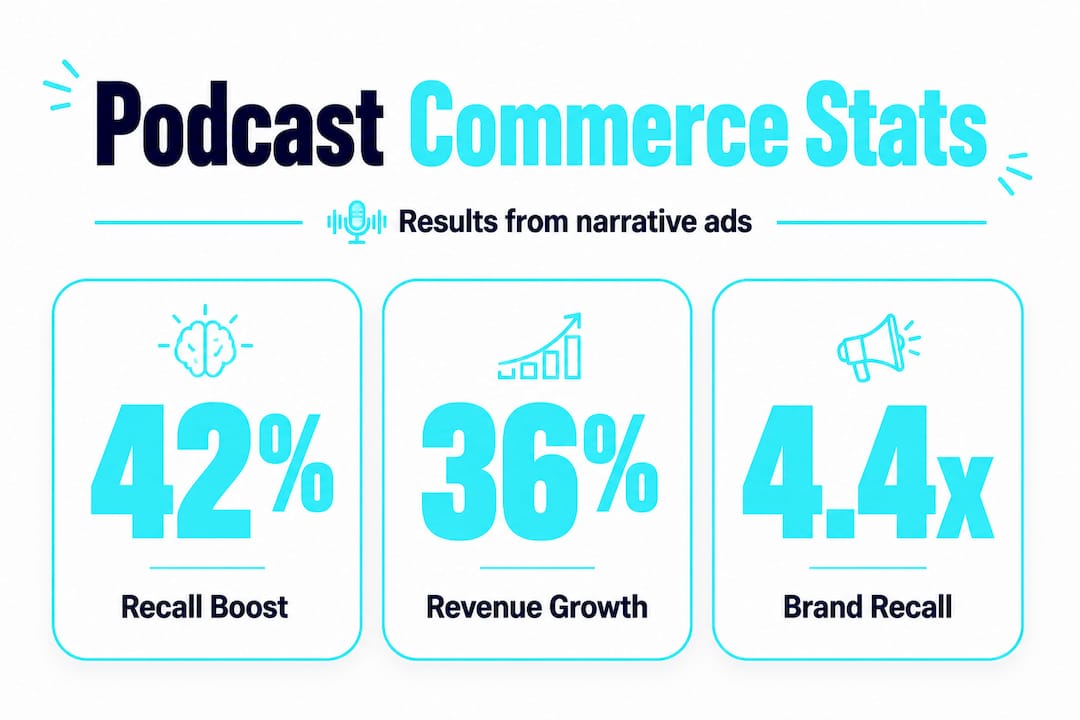
The data backs this up hard. Host-read podcast ads generate 4.4x higher brand recall than display ads, and listeners are 54% more likely to consider brands they hear about on podcasts. That’s not a rounding error. That’s a completely different league of engagement.
There’s a reason for this. When a podcast host tells their audience, “I’ve been using this for three months and it genuinely changed how I cook,” that’s not an ad. It’s a personal recommendation wrapped in a format people actually enjoy. Listeners are primed to receive and remember it.
“The trust listeners place in their favorite hosts is something brands spend years trying to build through traditional advertising. Podcast ads inherit that trust immediately.”
Graza’s results illustrate this perfectly. The olive oil brand didn’t just see brand awareness bumps. They saw 3X incremental sales and a 15% retail lift from podcast exposure, outperforming every other channel while also delivering their lowest customer acquisition cost. That’s the kind of result that makes a CFO take notice.
Here’s what sets podcast listeners apart from the typical social media scroller:
- They’re highly educated and tend to have above-average income, making them strong e-commerce buyers.
- They listen to episodes in full, meaning your ad message isn’t competing with a three-second scroll window.
- They’re in an engaged, receptive mental state during daily routines like commuting, working out, or cooking.
- They trust their hosts. It’s not parasocial fluff. It translates into actual purchasing behavior.
We’ve seen this pattern across podcast ecommerce trends repeatedly. The brands winning on podcasts aren’t necessarily the biggest spenders. They’re the ones who align their product story with the right show and let the host do what they do best. If you want to go deeper on the mechanics, our breakdown of podcast commerce strategies lays out the full framework.
Tactics: Making podcasts drive discovery and measurable sales
Understanding the “why” is one thing. Getting your money’s worth is another. Let’s talk about the mechanics.
The biggest hesitation most e-commerce brands have with podcast advertising is measurement. You can’t pixel a listener’s ear. But attribution is absolutely possible with the right setup.
Here’s the tested playbook:
- Use unique promo codes. Give each podcast its own discount code. Track redemptions directly in Shopify. This is simple, cheap, and immediately reveals which shows are converting.
- Set up vanity URLs. A custom landing page (like yourbrand.com/podcastname) gives you clean traffic data without relying on listener memory.
- Run post-purchase surveys. Ask buyers how they found you. “I heard about you on a podcast” is a surprisingly common answer, and it surfaces organic word-of-mouth lifts you’d otherwise miss.
- Run geo-targeted lift studies. This is the most rigorous method. Run your campaign in select markets only, then compare sales velocity against control markets. Graza’s team used a 21-day exposure window with a 7-day cooldown period to isolate the podcast effect. The results were unambiguous.
- Request mid-roll placement. Mid-roll ads, delivered by the host in their own voice, consistently outperform pre-roll and post-roll. Listeners are locked in at the midpoint of an episode and haven’t started thinking about what’s next.
Budget guidance for getting started:
Podcast ad CPMs range from $18 to $50 for mid-roll placements. A smart entry point for most e-commerce brands is a $2,000 to $5,000 test across three to five niche podcasts. Don’t try to win at scale before you know what works.
| Metric | Typical Range | Best Practice |
|---|---|---|
| Mid-roll CPM | $18 to $50 | Target $25-35 for niche DTC audiences |
| Test budget | $2,000 to $5,000 | Spread across 3-5 shows |
| Attribution method | Promo codes, vanity URLs | Layer with post-purchase survey |
| Campaign duration | 4 to 8 weeks | Minimum 4 weeks for meaningful data |
| Conversion rate (podcast) | 1% to 4% | Higher for lifestyle and DTC fits |
Pro Tip: Don’t just track redemptions. Compare your Shopify new customer rate during the campaign period against your baseline. If it spikes in zip codes where podcast listeners cluster, that’s signal, not coincidence.
Quince, the fashion and lifestyle DTC brand, topped podcast ad spending in March 2026 with a focused investment in comedy and lifestyle shows. That’s not accidental. Comedy audiences are loyal, engaged, and conditioned to trust their hosts’ recommendations. Quince recognized this pattern before most competitors.

For a fuller breakdown of what this looks like in practice, our guide on how podcasts boost sales walks through actual Shopify attribution setups. And if you want current podcast shopping trends, we track those in real time across thousands of shows.
Storytelling that sells: How narrative drives memorability and revenue
Here’s something most e-commerce marketers haven’t thought about. The reason podcast ads work isn’t just placement or audience quality. It’s narrative structure.
There’s a concept called narrative binding, and it’s worth understanding. When a story connects product features, benefits, and real customer outcomes together in a meaningful arc, the listener’s brain processes it differently than a product pitch. It moves from information into memory. That’s the whole game in e-commerce.
The data is striking. Narrative binding in product storytelling boosts memorability by 42% and revenue per visitor by 36.7%. These numbers came from product description testing, but the mechanism applies directly to podcast content. A host who tells a story about how a product fit into their life isn’t just reciting ad copy. They’re creating a memory anchor.
Think about how this plays out in a real episode. The host mentions struggling with meal prep, then describes how a particular olive oil changed their whole cooking routine, then laughs about the compliments they got at a dinner party. That arc, problem to product to outcome, is narrative binding in action. The listener remembers the product because they remember the story.
Compare this to a standard 30-second pre-roll read:
| Ad type | Recall rate | Emotional engagement | Purchase intent lift |
|---|---|---|---|
| Pre-roll, scripted ad | Low | Minimal | Baseline |
| Mid-roll, host-read, no narrative | Medium | Moderate | +15% to +20% |
| Mid-roll, host-read, story arc | High | Strong | +35% to +45% |
| Integrated brand episode | Very high | Very strong | +50%+ |
The difference between a forgettable mention and one that makes someone pause the episode and search for the product is almost always storytelling quality.
Brands like Cox & Cox, a home lifestyle retailer, have applied narrative-driven approaches to their product content and seen meaningful lifts in session value and conversion. The same principle works on-air. When a host weaves your product into a genuine story from their life, you’re not buying ad space. You’re buying a memory.
Pro Tip: When briefing podcast hosts, don’t hand them a bullet-point script. Give them a story prompt instead. Share a customer outcome, an unexpected use case, or a behind-the-scenes moment about your product. Hosts are storytellers. Give them material that fits their format.
For more on how brands drive sales through podcast storytelling, we’ve put together a complete breakdown with real campaign examples.
What successful brands do: Case studies and industry shifts
Let’s get concrete. The brands leading in podcast-driven e-commerce aren’t waiting for perfect attribution models. They’re testing, learning, and scaling what works.
Graza is the clearest proof of concept right now. Their olive oil brand was built in part on podcast advertising, and the results speak for themselves. A 15% retail lift and 3X incremental sales from podcast exposure, with their lowest CAC of any channel. They ran geo-targeted lift studies to prove the effect, not assume it. The discipline in their measurement is what makes their results credible and repeatable.
Quince is playing the volume game strategically. By topping podcast ad spending in March 2026, particularly in comedy and sports, they’re reaching audiences who are primed to buy lifestyle and fashion products from hosts they find funny and relatable. Comedy is an underrated genre for DTC brands because the emotional warmth of laughter transfers to brands mentioned in that context.
Amazon is making the biggest structural bet. They’re restructuring their podcast strategy through Audible and Creator Services to directly integrate storytelling with commerce. In practice, this means turning creator-hosted podcasts into lifestyle brand storefronts where discovery and purchase happen in the same content experience. When the world’s largest e-commerce company starts building this infrastructure, it’s worth paying attention.
| Brand | Investment approach | Key result | Attribution method |
|---|---|---|---|
| Graza | Geo-targeted niche shows | 3X incremental sales, 15% retail lift | Geo lift study, promo codes |
| Quince | High-volume, comedy focus | #1 podcast ad spender, March 2026 | Channel mix tracking |
| Amazon | Platform-level integration | Commerce embedded in creator content | Native platform data |
A few things these brands have in common:
- They let hosts tell the story in their own voice rather than enforcing rigid scripts.
- They measure rigorously instead of relying on brand sentiment alone.
- They treat podcast spending as an investment in audience trust, not just reach.
- They connect podcast exposure to full-funnel digital touchpoints, including retargeting and email.
For broader context on how this fits with home office tech trends and lifestyle product discovery, the podcast channel is showing up across every category where people care about how a product fits into their real life.
Why most e-commerce brands underestimate podcast ROI
Here’s the honest take, and it might sting a little.
Most brands look at podcast advertising through a last-click lens and dismiss it. They run a campaign, see that promo code redemptions represent 2% of their usual sales volume, and conclude it isn’t working. That’s the wrong read entirely.
Podcast ROI compounds. It doesn’t spike. A listener hears your product mentioned on episode 47 of their favorite show. They don’t buy that day. Three weeks later, they see your Instagram ad and recognize the name. Two weeks after that, a friend mentions it. They buy. That last click is Instagram. But the trust that made the purchase possible was planted by the podcast mention.
Podcasts excel at awareness and retail lift but need to be paired with digital for a full-funnel approach. That’s not a knock on podcasts. That’s how they’re designed to work. Podcast exposure primes audiences for conversion elsewhere. Brands that understand this build omnichannel funnels where podcast advertising feeds the top and digital retargeting closes the loop.
The other mistake is fixating on short-term CAC while ignoring serial ad exposure. A listener who hears your product mentioned three times across different shows they trust isn’t just aware of you. They’re being conditioned to see your brand as part of their world. That’s brand equity in audio form, and you can’t buy it on Facebook.
The unsung lever here is the combination of branded podcasting and paid placements. Brands that run their own podcast build authority and discoverability over time. Brands that pay for placements on established shows get fast audience access. Doing both creates a compounding loop. When a listener hears your brand on someone else’s show and then discovers you have your own podcast, the trust multiplication is real.
Dig into deeper podcast trends and you’ll see that the brands treating podcasts as a long-game channel are building something that short-term CAC chasers simply can’t buy their way into.
Activate podcast moments to boost your e-commerce discovery
If this article made one thing clear, it’s that podcast moments are product discovery gold. The challenge has always been finding them, tracking them, and turning them into something actionable.

That’s exactly what Prodcast was built for. Prodcast is an AI-powered platform that analyzes podcast transcripts across thousands of shows to surface product mentions, trending brands, and key discussion moments in real time. Instead of scrubbing through hours of audio, you get structured, searchable data showing you exactly which products are being talked about, where, and how often.
For e-commerce marketers, this means you can track your brand’s podcast presence, identify influencer opportunities before competitors notice, and build content strategies around what audiences are actually hearing. Whether you’re monitoring a DTC food brand like Graza or tracking emerging AI tools across tech shows, Prodcast turns spoken-word conversations into a discovery engine you can act on. Explore what’s trending on Prodcast and start turning podcast mentions into revenue.
Frequently asked questions
How do you track podcast-driven sales for e-commerce?
Use promo codes, vanity URLs, geo-targeted lift studies, and post-purchase surveys layered together for the most accurate attribution. Running a 21-day exposure window against a control market is the most rigorous way to isolate the podcast effect.
What budget is ideal to start podcast advertising as an e-commerce brand?
Start with $2,000 to $5,000 across three to five niche podcasts to gather real data before scaling. This range gives you enough exposure to measure promo code redemptions and Shopify traffic shifts without overcommitting.
Are host-read ads really more effective for e-commerce sales?
Yes. Host-read ads deliver 4.4x greater brand recall than display ads, and listeners are 54% more likely to consider brands mentioned by hosts they trust. The personal endorsement format is what makes the recall and conversion difference.
What types of products perform best in podcast commerce?
Products that naturally fit into authentic host storytelling and daily routines see the strongest lift. Lifestyle, food and beverage, DTC wellness, and tech products tend to perform best because hosts can genuinely integrate them into their personal narrative rather than reading a generic pitch.