CATEGORIES
TAGS
How Podcasts Boost Product Sales: Data-Driven Strategies

TL;DR:
- Podcast ads, especially host-read formats, deliver significantly higher conversions and brand recall.
- Trust and authenticity make podcast audiences highly receptive to product recommendations.
- Effective podcast advertising requires strategic host selection, message fit, and comprehensive attribution methods.
Most marketers still treat podcasts as a brand awareness play. A nice-to-have. Something you do when the budget has a little breathing room. But the numbers tell a very different story. Host-read podcast ads deliver 3x higher conversions, 60-80% higher brand recall, and a ROAS of 3.4x to 5.1x compared to standard programmatic ads. That is not a niche channel. That is one of the highest-performing sales drivers in your media mix, hiding in plain sight. This guide breaks down exactly why podcast audiences convert, which ad formats perform best, and what the data says about turning audio mentions into real revenue.
Table of Contents
- Why podcast audiences drive higher conversions
- How podcast ad formats influence product sales
- Psychological factors: Why podcast mentions drive buying intent
- Real-world ROI: Case studies and performance data
- What most marketers miss about podcast-driven sales
- Level up your podcast advertising strategy
- Frequently asked questions
Key Takeaways
| Point | Details |
|---|---|
| Host trust drives action | Podcast listeners trust hosts, making product mentions highly influential for brand recall and sales. |
| Host-read ads outperform | Host-read podcast ads deliver 2-3x better results than programmatic ads on conversions and ROI. |
| Fit and authenticity matter | Product success in podcasts depends on authentic endorsements and strong match with the host’s audience. |
| Data proves ROI | Case studies show brands can achieve up to 500% return on ad spend through strategic podcast campaigns. |
Why podcast audiences drive higher conversions
Now that you know podcast ads outperform the norm, let’s explore why their audiences are so uniquely receptive.
The short answer? Trust. Podcast listeners do not stumble onto their favorite shows by accident. They actively seek them out, subscribe, and return week after week. That kind of intentional listening is rare in media. Compare it to a scroll through a social feed or background TV noise, and you start to see why the attention quality is so different.
There is also a psychological layer that makes podcast audiences particularly valuable. Listeners develop what researchers call parasocial relationships with hosts. That means they feel genuinely connected to the person talking in their earbuds, even though that person does not know they exist. It sounds strange, but it is incredibly powerful for brands. When a host recommends a product, it does not feel like an ad. It feels like a tip from a friend.
This is backed up by authenticity and branded content research showing that perceived authenticity directly shapes consumer attitudes and purchase behavior. The more a host genuinely uses or believes in a product, the more effective the mention becomes.
Here is what makes podcast audiences stand out from other digital audiences:
- They choose to listen, which means their attention is voluntary and sustained
- They trust the host’s judgment on recommendations, often more than editorial reviews
- They listen during activities where they are relaxed and receptive, like commuting or working out
- Host-read ads are woven into the episode, not easily skipped or blocked
- They are more likely to act on a recommendation because it feels personal
The numbers back this up. According to podcast advertising effectiveness benchmarks, host-read ads generate up to 80% higher brand recall compared to programmatic alternatives.
“Podcast audiences are among the most conversion-ready in digital media. The combination of trust, habit, and intentional listening creates a rare environment where brand messages actually land.”
For a deeper look at listener behavior and what drives purchase decisions, the data-driven podcast purchase guide is worth exploring.
How podcast ad formats influence product sales
Understanding the makeup of the podcast audience, the next step is to choose the right ad format for your brand.

There are two main formats you will encounter: host-read ads and programmatic ads. They are not interchangeable, and picking the wrong one for your goal can cost you significantly.
Host-read ads are recorded by the host themselves, often in their natural voice and style. They blend into the episode. Listeners barely register them as ads, which is exactly the point. Programmatic ads are pre-produced spots inserted dynamically into episodes. They scale easily and cost less upfront, but they also feel more like traditional radio spots. Listeners recognize them immediately.
| Ad format | ROAS | Conversion rate | Brand recall |
|---|---|---|---|
| Host-read | 3.4x to 5.1x | Up to 3x higher | 60 to 80% higher |
| Programmatic | 1.8x to 2.4x | Baseline | Baseline |
The ROAS difference is stark. Host-read ads deliver up to 5.1x return versus 2.4x for programmatic. That gap compounds quickly over a campaign. For full context on how to measure and maximize returns, the podcast advertising ROI guide lays it out clearly.
So when should you use each format? Here is a practical framework:
- Use host-read ads when you are selling a considered purchase (think supplements, software, or financial products) where trust matters most
- Use host-read ads when your product has a good story and benefits from a conversational, natural explanation
- Use programmatic ads when you need wide reach at low cost and the product has simple messaging that does not require endorsement
- Use programmatic ads for retargeting audiences who already know your brand and just need a reminder
- Use host-read ads if you are launching and need to build credibility fast in a new category
For brands experimenting with both, dynamic podcast ad tips can help you layer formats strategically without wasting spend.
Pro Tip: For considered purchases, host-read placements offer far higher ROI. If your product requires any explanation or builds on trust, do not cut corners with a programmatic-only approach.
Psychological factors: Why podcast mentions drive buying intent
Selecting the right ad format is only half the battle. Let’s see why some podcast mentions outperform others at driving intent.
Not all podcast ads are created equal, even within the same format. Two host-read ads in the same show can produce wildly different results depending on how well the message fits the host’s voice, values, and audience expectations. That is not intuition talking. That is psychology.
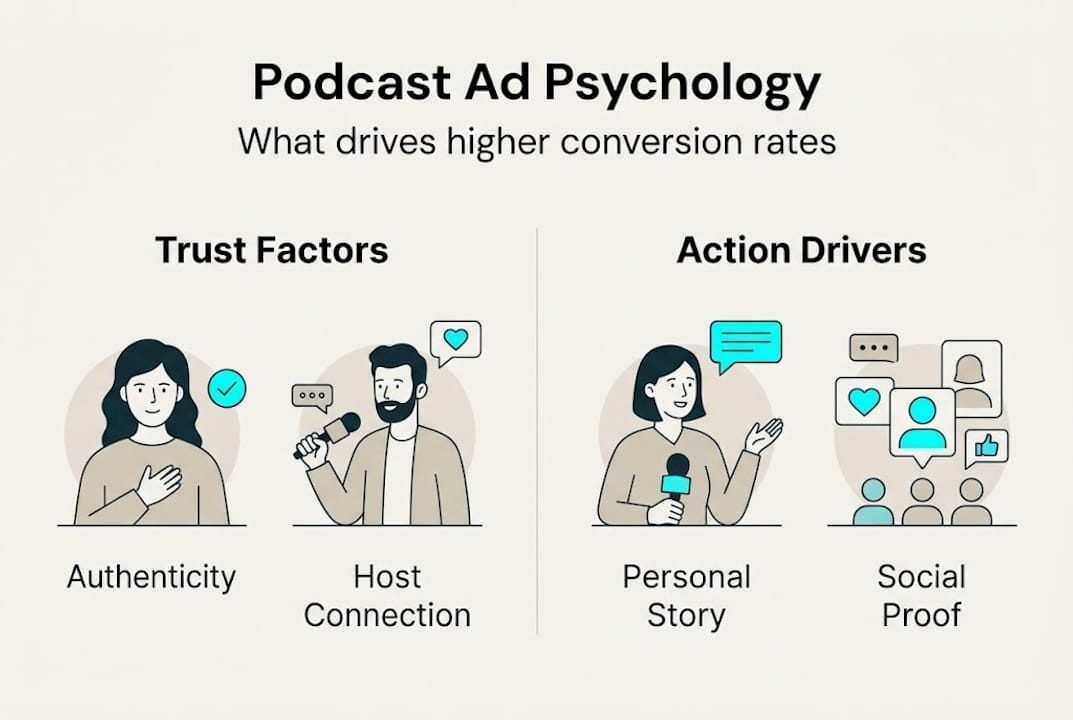
Research shows that podcaster authenticity and brand congruence are the strongest predictors of brand attitude, recall, and purchase intentions. When a fitness host recommends a protein powder they actually use, it lands. When a personal finance host reads an ad for a product that has nothing to do with their content, listeners notice the disconnect.
Here are the factors that elevate podcast-driven purchase intent:
- Authenticity: The host genuinely uses or endorses the product rather than reading a script
- Congruence: The product fits naturally within the podcast’s topic, tone, and audience lifestyle
- Host enthusiasm: Genuine excitement is contagious and creates emotional resonance with listeners
- Relevance: The product solves a real problem the audience is already thinking about
- Explicit integration: The mention is woven into conversation, not just a tagged-on ad read
| Psychological factor | Impact on brand recall | Impact on purchase intent |
|---|---|---|
| High authenticity | Significantly higher | Strong uplift |
| Strong brand-host congruence | Moderate to high | High |
| Low congruence (mismatched) | Minimal | Negligible or negative |
| Parasocial relationship strength | High | Moderate to strong |
Understanding the psychological impact of podcast ads helps marketers go beyond just booking a slot and actually engineering a message that resonates.
Pro Tip: Do not send hosts a rigid script. Share the product story, your key benefits, and let them translate it into their own language. The ad will feel more real because it is.
Real-world ROI: Case studies and performance data
Psychology aside, what happens in the real world? These case studies and performance numbers bring the impact to life.
The data from controlled campaigns confirms what the psychology suggests. Brands that treat podcast advertising as a genuine channel, with the right host, the right message, and the right attribution setup, see results that are hard to replicate elsewhere.
Here are the standout findings from real campaigns:
- Go Ape achieved a nearly 500% ROAS from host-read sponsorships placed in parent-focused podcasts, a category perfectly aligned with their outdoor adventure products
- Direct-to-consumer brands consistently report higher customer lifetime value from podcast-acquired customers compared to social media channels
- Brands using promo codes for attribution found that podcast listeners converted at higher rates and with larger average order values
- Multi-episode sponsorships outperformed one-off placements because repeated exposure builds familiarity and credibility
- Campaigns tracked with a combination of pixel data, surveys, and unique promo codes showed more accurate attribution and consistently positive returns
“The long-tail effect of podcast mentions is often underestimated. A listener hears a product mentioned on Tuesday, searches for it on Friday, and converts the following week. Single-touch attribution models miss all of that.”
For a deeper look at how brands have connected podcast mentions to measurable revenue, podcast ROI case studies offer detailed breakdowns worth studying.
Of course, not every product is a fit. Impulse buys and commodity items rarely benefit from the high-trust, high-effort environment that podcasts create. Winning partnerships tend to share a few traits: the product has a genuine story, the host has real affinity for it, and the brand commits to a multi-touch tracking setup. A performance marketer’s podcast ad guide lays out the conditions that separate winning campaigns from wasted spend.
For brands ready to act on this, data-backed podcast sales strategies covers what good execution actually looks like.
What most marketers miss about podcast-driven sales
Here is something we have noticed after working through the research, the case studies, and the real campaign data. Most marketers either overestimate or underestimate podcasting. Both mistakes are costly.
The overestimators go in expecting magic. They book one host-read slot, use a single promo code, and then declare the channel dead when they cannot tie every sale back to the episode. The underestimators never try at all, assuming podcasts are too niche or too hard to track.
The truth sits in the middle. Podcast ROI is frequently under-attributed. Listeners hear a mention, research the product later, and convert through a channel that looks like organic search. If you are only using promo codes, you are missing a chunk of the picture. You need pixels, post-purchase surveys, and lift studies working together.
Not every product belongs here either. Brands with strong stories, considered purchase cycles, or lifestyle alignment with specific audiences see the biggest effect. If your product has no story and no emotional hook, podcasting is probably not your best channel.
The marketers who win long-term are the ones who treat host selection and message fit as critical campaign levers, not afterthoughts. They use podcasting ROI insights to guide decisions rather than guessing.
Pro Tip: Treat host selection and message fit as critical campaign levers, not afterthoughts. The wrong host with a great product still underperforms.
Level up your podcast advertising strategy
Ready to apply these insights? Here is how to transform knowledge into results.
Knowing that podcasts drive conversions is one thing. Knowing which episodes, moments, and hosts are actually moving products in your category is something else entirely. That is where Prodcast comes in.

Prodcast analyzes thousands of podcast transcripts to surface the exact moments where products get mentioned, endorsed, and discussed. You can discover top podcast moments relevant to your brand or category in real time, without scrubbing through hours of audio. Want to see how other brands are doing it? See real campaign examples to understand what high-performing podcast strategies actually look like. The good stuff is already out there. Prodcast just helps you find it faster.
Frequently asked questions
What makes host-read podcast ads so effective for product sales?
Host-read ads build on listener trust and feel like a personal recommendation rather than a commercial, which drives up to 3x more conversions compared to programmatic formats.
How do you attribute sales from podcast advertising?
Accurate podcast ROI tracking requires layering promo codes, post-purchase surveys, and tracking pixels together, since single-method attribution consistently underestimates actual impact.
Is podcast advertising suited for all types of products?
No. Podcast ads work best for considered purchases and lifestyle products with clear stories and strong calls-to-action. Commodity or impulse-buy products rarely see the same returns.
What ROI can brands expect from top-performing podcast campaigns?
Top campaigns have documented extraordinary returns, with brands like Go Ape reporting nearly 500% ROAS from well-matched, host-read sponsorships in relevant podcast categories.
Recommended
- How podcasts drive sales: data-backed strategies for mark… | Prodcast
- How podcasts drive sales: data-backed strategies for mark… | Prodcast
- How podcasts influence purchases: a data-driven guide | Prodcast
- Unlock podcast product discovery with data-driven strategies | Prodcast
- Academy - Public Speaking & Communication Tips | Pavone