CATEGORIES
TAGS
Curate podcast content for actionable marketing insights

Most marketers are sitting on a goldmine and don’t even know it. Podcast listeners are some of the most engaged, purchase-ready audiences on the internet, and the product mentions woven into their favorite shows carry serious weight. In fact, 40-60% of listeners report making a purchase after hearing a podcast ad, with host-read mentions outperforming nearly every traditional format. Yet most brands still aren’t tracking what’s being said about them, or their competitors, across millions of episodes every week. That’s a massive blind spot. And fixing it starts with smart podcast content curation.
Table of Contents
- Why podcast content curation matters for marketers
- How podcast content curation works: Tools and workflow
- Comparing podcast curation tools: What matters most
- Turning podcast insights into marketing wins
- Unlock deeper podcast insights with Prodcast
- Frequently asked questions
Key Takeaways
| Point | Details |
|---|---|
| Podcast mentions drive action | Brand mentions in podcasts correlate with real-world sales lifts and influence consumer decisions. |
| AI makes curation scalable | Modern tools can transcribe and monitor millions of shows daily for actionable marketing insights. |
| Feature selection matters | Choose curation tools with precise transcription, robust alerts, and analytics integration for best results. |
| Turn insights into strategy | Use podcast data to improve ad placements, spot trends, and optimize content marketing. |
Why podcast content curation matters for marketers
Podcast listeners are different from your average social media scroller. They’re tuned in, often for 30 to 60 minutes at a stretch, and they genuinely trust the hosts they follow. When a host casually mentions a product they love, it doesn’t feel like an ad. It feels like a recommendation from a friend. That’s the magic of podcast influence, and it’s why podcast ad effectiveness is such a hot topic right now.
The numbers back this up. Olive oil brand Graza saw a 15% retail lift and three times the incremental sales from podcast-driven discovery compared to standard digital ads. That’s not a fluke. That’s what happens when the right product gets mentioned in the right context, in front of the right audience.
“Podcast content curation isn’t just about tracking mentions. It’s about understanding the conversations your customers are already having, and finding your place in them.”
The challenge is scale. There are now 4.2 million podcasts transcribed and monitored daily by AI-powered tools. No human team can manually scrub through that volume. That’s exactly why systematic curation has become a non-negotiable for serious marketing teams.
Here’s what you gain when you get curation right:
- Real consumer language: Hear exactly how your audience describes products and pain points.
- Competitive intelligence: Spot when rival brands get mentioned and in what context.
- Trend detection: Catch emerging product categories before they hit mainstream media.
- Campaign alignment: Match your ad placements to shows where your category already resonates.
- Authentic creative fuel: Pull real host language to inspire ad copy that actually sounds human.
How podcast content curation works: Tools and workflow
So how does this actually work under the hood? Let’s break it down without the tech jargon.
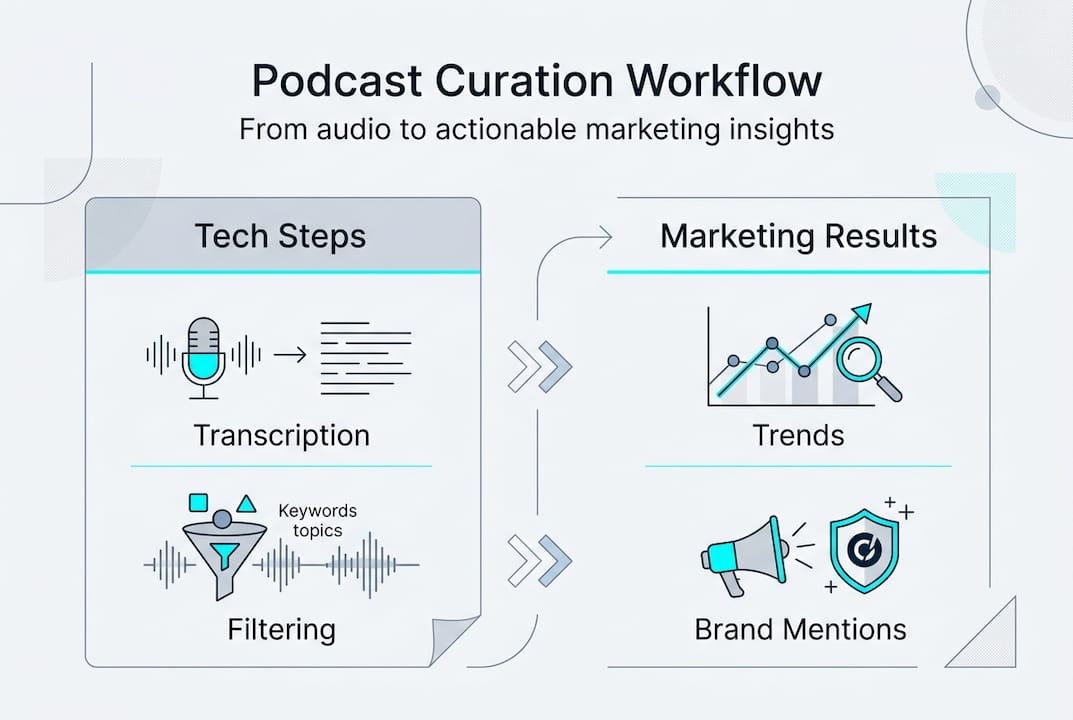
First, AI transcription converts raw audio into searchable text. Every word spoken across millions of episodes becomes a data point. Then natural language processing, or NLP, scans that text for product mentions, brand names, and relevant keywords. The smart part? It catches real-time alerts, misspellings, and slang too. So if a host says “Graza” or mispronounces a brand name, the system still flags it.
After detection, sentiment analysis reads the tone around each mention. Was it enthusiastic? Skeptical? Neutral? That context matters enormously for how you interpret and act on the data.
Here’s a simple workflow most marketing teams can follow:
- Define your keywords: Brand names, product categories, competitor names, and relevant slang.
- Set up monitoring: Connect your keyword list to an AI-powered podcast monitoring tool.
- Configure alerts: Get notified in real time when relevant mentions appear.
- Review sentiment scores: Prioritize mentions with strong positive or negative signals.
- Export and analyze: Pull data into your analytics stack to spot patterns over time.
- Act on insights: Adjust ad placements, creative messaging, or influencer outreach based on findings.
The table below shows how key workflow steps map to the tools and outcomes involved:
| Workflow step | Technology used | Marketing outcome |
|---|---|---|
| Audio transcription | AI speech-to-text | Searchable episode database |
| Keyword detection | NLP algorithms | Brand and product mention tracking |
| Sentiment analysis | Machine learning models | Tone and context scoring |
| Real-time alerts | Automated notification systems | Instant team awareness |
| Analytics integration | API connections | Campaign optimization data |
Pro Tip: When curating podcast content with data, start narrow. Pick your top five competitor brands and your own brand name as your first keyword set. You’ll get clean, actionable data fast before expanding your scope.
Once you’re comfortable with the basics, you can layer in more advanced tactics like programmatic podcast advertising triggers based on mention frequency or sentiment spikes.
Comparing podcast curation tools: What matters most
Not all podcast monitoring tools are built the same. Major tools transcribe and filter millions of episodes daily, but they differ significantly in alert precision and how well they connect to your existing marketing stack.
Here’s a comparison of the features that actually move the needle:
| Feature | Why it matters | What to look for |
|---|---|---|
| Transcription accuracy | Garbage in, garbage out | 90%+ accuracy across accents and audio quality |
| Language and show coverage | Reach global audiences | Multilingual support, broad podcast index |
| Alert customization | Reduce noise, increase signal | Boolean logic, keyword exclusions |
| Sentiment scoring | Context beyond the mention | Positive, negative, neutral tagging |
| Analytics integration | Connect to your existing workflow | Native CRM, Slack, or data warehouse connections |
| Reporting granularity | Prove ROI to stakeholders | Episode-level, show-level, and trend reporting |
When evaluating tools, keep this checklist handy:
- Does it cover the podcast categories most relevant to your industry?
- Can you filter by audience size or show demographics?
- How quickly does it surface new mentions after an episode drops?
- Does it offer product discovery in podcasts beyond just brand name tracking?
- Can your team access data-driven ad trends without needing a data scientist?
The answers to these questions will tell you a lot about whether a tool will actually get used by your team or just collect dust in your tech stack.
Turning podcast insights into marketing wins
Okay, you’ve got the data. Now what? This is where most teams drop the ball. They collect mentions but never close the loop between insight and action. Here’s how to actually turn podcast intelligence into results.
“The brands winning with podcast data aren’t just listening. They’re responding, adapting, and showing up in the right conversations at the right time.”
Start with placement. Surface the podcast moments where your category is already being discussed organically. Those shows are warm territory for your ads. Audiences there are already primed for your message.

Next, adjust your creative. If hosts in your category consistently use casual, story-driven language, your ad copy should match that energy. Stiff, corporate messaging will stick out like a sore thumb. Mirror the tone of the conversations your audience is already having.
Here’s a practical action plan:
- Identify high-mention shows: Prioritize ad buys on shows where your category gets frequent organic mentions.
- Analyze host language: Pull recurring phrases and vocabulary from transcripts to inform your ad scripts.
- Track emerging trends: Flag new product categories getting buzz before they peak, then create content around them.
- Measure post-mention lift: Compare sales data before and after significant podcast mentions to build your ROI case.
- Document and iterate: Keep a running log of what worked, what didn’t, and why, so each campaign gets smarter.
The payoff is real. Up to 81% of listeners pay attention to podcast ads, with host-read formats driving the most action. When your creative sounds like it belongs in the show, those numbers work in your favor.
Pro Tip: Use your podcast ad ROI guide benchmarks to set realistic lift expectations before your campaign launches. It makes stakeholder conversations a lot easier when you walk in with a clear measurement framework.
Unlock deeper podcast insights with Prodcast
If manually piecing together a curation workflow sounds like a lot of work, that’s because it is. Prodcast was built to take that grind off your plate. It surfaces brand and product mentions from over 4.2 million podcasts, giving your team instant access to the conversations that matter most to your category.

With Prodcast, you get real-time alerts, advanced sentiment analytics, and ready-to-use consumer insights, all in one place. Want to see how it works with a real brand? Check out the mass persuasion insights feature or explore the Monster Energy Drink podcast case to see exactly how mention tracking translates into campaign intelligence. Stop guessing what your audience is hearing. Start knowing.
Frequently asked questions
How do AI tools detect product mentions in podcasts?
AI-powered transcription converts audio into searchable text, then NLP algorithms find and interpret product mentions, including phonetic variations and informal references. This means even mispronounced or slang versions of a brand name get caught.
What results can I expect from podcast content curation for marketing?
Marketers can discover actionable trends, measure consumer sentiment, and link podcast exposure to real sales lifts. Graza, for example, achieved a 15% retail lift and triple incremental sales directly from podcast-driven discovery.
Which podcast curation features are most important for brands?
Prioritize accurate transcription, real-time alerts, sentiment analysis, and strong analytics integration. Tools differ widely in transcription coverage, alert options, and reporting depth, so match features to your specific campaign goals.
Is analyzing organic mentions more valuable than paid podcast ads?
Both serve different purposes, but organic mentions often signal genuine brand affinity and can surface emerging trends before they peak. Host-read and organic mentions tend to drive stronger listener trust and more sustained attention than standard ad formats.