CATEGORIES
TAGS
Boost podcast discoverability: proven steps for more listeners

72% of podcasters cite discoverability as their top challenge, and that number has barely budged in years. You can produce a flawless episode, nail the audio quality, and still watch it disappear into a directory of over 4 million active shows. The good news is that discoverability is not random luck. It follows a set of mechanics you can learn, apply, and measure. This guide walks you through every step, from foundational setup to advanced optimization tactics, so your podcast reaches the audience it deserves.
Table of Contents
- Understanding the podcast discoverability challenge
- What you need: Prerequisites for discoverability
- Step-by-step: Optimize your podcast for search
- Strategies from top-performing and niche podcasts
- Emerging trends and helpful tools for 2026
- Summary: Your podcast discoverability checklist
- Discover trending podcast moments and brands
- Frequently asked questions
Key Takeaways
| Point | Details |
|---|---|
| Focus on metadata optimization | Keyword-rich titles, descriptions, and show notes are critical for being found in-app. |
| Engage listeners consistently | Regular publishing and encouraging interaction drives rankings on major platforms. |
| Embrace AI and new tools | Leverage emerging technology and discovery apps to stay ahead and reach broader audiences. |
| Niche topics win with SEO | Niche podcasts can outperform broader ones by optimizing old episodes and capitalizing on less competition. |
Understanding the podcast discoverability challenge
Most new listeners never open a browser to find their next favorite show. 54-70% of podcast discovery happens via in-app search on platforms like Apple Podcasts and Spotify. That means your show lives or dies by how well it performs inside those apps, not just on Google.
Each major platform uses its own ranking logic. Apple Podcasts ranks shows using metadata quality, engagement signals like follows and saves, and episode recency. Spotify leans heavily on listening behavior and personalization data. Neither platform publishes a transparent algorithm, but the patterns are clear enough to act on.
Here is how the two biggest platforms compare on key ranking factors:
| Ranking factor | Apple Podcasts | Spotify |
|---|---|---|
| Keyword metadata | High importance | Moderate importance |
| Listener engagement | Follows, saves, reviews | Streams, saves, playlist adds |
| Episode recency | Strong signal | Moderate signal |
| Transcripts | Not indexed natively | Not indexed natively |
| External search (Google) | Indirect benefit | Indirect benefit |
A few things stand out from podcast industry statistics. Engagement signals matter far more than most creators realize. A show with 500 loyal followers who save every episode will often outrank a show with 5,000 passive subscribers.
Key discoverability signals to focus on:
- Episode title keyword relevance
- Show description quality and keyword density
- Listener follow and save rates
- Review volume and average rating
- Publishing consistency
Understanding podcast SEO best practices and podcast search optimization gives you a real edge before you even record your next episode.
What you need: Prerequisites for discoverability
Before you optimize anything, you need the right foundation. Think of this as your pre-flight checklist. Missing even one item can cap your growth regardless of how good your content is.
Podcast SEO (PSO) is the primary mechanic for improving discoverability, involving keyword optimization across titles, descriptions, show notes, and metadata. That means every field in your hosting dashboard is a ranking opportunity.

Here is what you need in place before optimizing:
| Element | Why it matters | Quick check |
|---|---|---|
| Hosting platform | Must support RSS and major directories | Submitted to Apple, Spotify, Google |
| Cover art | First impression in search results | 3000x3000px, readable at small size |
| Show title | Primary keyword placement | Includes core topic keyword |
| Show description | Crawled by platforms and Google | 150-500 words, keyword-rich |
| Author field | Searchable on Apple Podcasts | Real name or brand name |
| Episode titles | Highest-weight metadata field | Descriptive, not clever |
Using content discovery tools helps you identify what keywords and topics are already driving traffic in your niche. Pair that with data-driven insights for podcasts to validate your keyword choices before committing to a show direction.
A solid podcast SEO guide will also walk you through the technical side of RSS feed optimization, which most creators overlook entirely.
Essential prerequisites at a glance:
- Verified submission to Apple Podcasts, Spotify, and Google Podcasts
- High-resolution cover art with legible text
- Keyword research completed for show and episode level
- Consistent author and show name across all platforms
- Show description written with primary and secondary keywords
Pro Tip: Run your show title and description through a free keyword tool before publishing. Even small adjustments, like adding “for beginners” or a specific topic phrase, can dramatically shift your ranking position.
With these essentials in place, you can begin the process of boosting your podcast’s discoverability using proven methods.
Step-by-step: Optimize your podcast for search
Now comes the part most podcasters skip. Optimization is not a one-time task. It is an ongoing process that compounds over time.
- Research keywords before every episode. Use tools like Google Keyword Planner or Ubersuggest to find phrases your target audience actually searches. Apply those phrases to your episode title, description, and show notes.
- Write episode titles that describe, not tease. “Episode 47” tells a platform nothing. “How to start a podcast on a $200 budget” tells it everything. Descriptive titles rank. Clever titles do not.
- Optimize your show notes for Google. Write 300-500 word show notes per episode with your target keyword in the first sentence. Google indexes these pages and can send organic traffic directly to your episode.
- Publish full transcripts. Transcripts boost Google indexing significantly, and video podcasts reach even broader audiences since 39% of listeners find shows through YouTube and Google video search.
- Encourage engagement actively. Ask listeners to follow, save, and leave a review. These signals directly influence how platforms rank your show in search results.
- Create a video version. Even a simple static image with your audio uploaded to YouTube can capture search traffic that never touches a podcast app.
“The podcasters who grow fastest are not always the best storytellers. They are the ones who treat every metadata field like a marketing asset.”
To maximize podcast engagement, focus on the listener experience inside the episode too. Strong retention signals, like listeners finishing 80% or more of an episode, send powerful ranking data back to platforms.
For a broader look at audience growth tactics, growing your podcast covers distribution strategies that complement your SEO work.
Pro Tip: Batch-optimize your back catalog. Go back to your 10 most popular old episodes and rewrite their titles and descriptions using current keyword research. This alone can generate a measurable traffic lift within 30 days.
Armed with these optimization tactics, let’s look at what works for top-performing and niche podcasts.
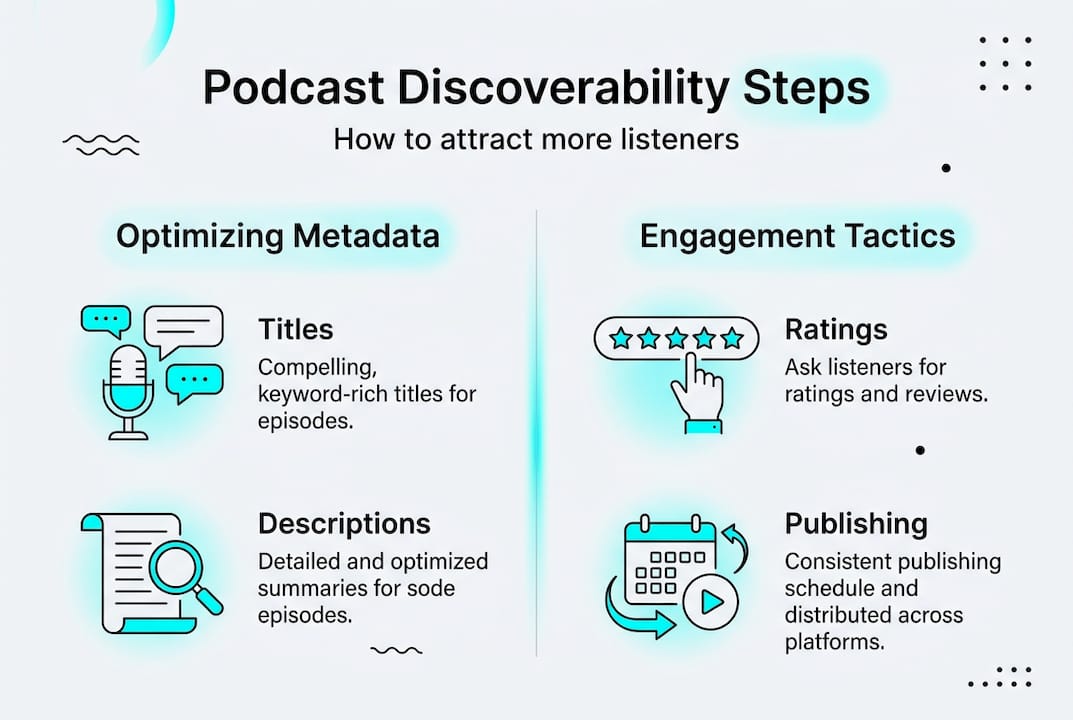
Strategies from top-performing and niche podcasts
The most successful shows do not just produce great content. They operate with a discipline that most creators underestimate.
Top podcasts publish consistently, often on a Monday/Thursday schedule, and maintain average ratings of 4.6 stars or higher with high review volumes and keyword-rich metadata across every episode. Consistency is not just about audience habit. It is a ranking signal. Platforms reward shows that publish on schedule.
Niche podcasts have a structural advantage that broad shows cannot replicate. Niche shows outperform broad ones in PSO because they face lower competition for specific keyword phrases. A show about “sourdough baking for beginners” will rank faster and more reliably than a general food podcast.
| Show type | Competition level | Ranking speed | Audience loyalty |
|---|---|---|---|
| Broad topic (e.g., health) | Very high | Slow | Moderate |
| Mid-niche (e.g., fitness for women) | Moderate | Medium | Higher |
| Deep niche (e.g., postpartum fitness) | Low | Fast | Very high |
Here are the habits that separate growing shows from stagnant ones:
- Publish on a fixed schedule, at minimum weekly
- Revisit and update old episode metadata every quarter
- Monitor which episodes drive the most follows and replicate their format
- Build internal linking between related episodes in show notes
- Engage with listener reviews publicly to boost community signals
“Evergreen episodes are your best long-term asset. One well-optimized episode from two years ago can still drive 30% of your monthly downloads.”
Explore niche podcast strategies to see how data can reveal untapped topic opportunities in your category. For a deeper look at platform-specific tactics, podcast SEO for niches breaks down what actually moves the needle.
Emerging trends and helpful tools for 2026
The podcast landscape is shifting fast, and the tools available to creators in 2026 are genuinely powerful.
AI tools like Podbotz and discovery platforms like Pod Seek are rising in popularity, offering personalized recommendations that match listeners to shows based on behavior rather than just keywords. Trending genres right now are Comedy, News, and True Crime, which means adjacent niches in those categories carry strong discovery momentum.
What to watch and act on in 2026:
- AI-powered recommendation engines are replacing manual browsing for many listeners
- Video podcasting on YouTube is now a primary discovery channel, not a secondary one
- Short-form audio clips shared on social media drive significant app installs
- Listener data from hosting platforms is becoming more granular and actionable
- Cross-promotion between complementary niche shows is outperforming paid ads for growth
Using podcast discovery tools that analyze what topics and products are trending across thousands of shows gives you a real-time edge. Instead of guessing what your audience wants to hear next, you can see what they are already engaging with.
The smartest move right now is to treat your podcast like a content brand. That means tracking performance data, adapting your format based on listener behavior, and staying ahead of platform changes before they affect your rankings.
Summary: Your podcast discoverability checklist
Before you publish your next episode, run through this checklist. Each item maps directly to a ranking or discovery signal covered in this guide.
- Episode title includes a researched keyword phrase
- Show description is 150-500 words with primary and secondary keywords
- Show notes are 300-500 words with the target keyword in the first sentence
- Full transcript is published or linked on the episode page
- Cover art is high-resolution and readable at thumbnail size
- A call-to-action inside the episode asks listeners to follow and save
- Video version is uploaded to YouTube with matching title and description
- Back catalog episodes have been reviewed and updated in the last 90 days
- Publishing schedule is consistent, at minimum weekly
- Listener engagement data has been reviewed to inform the next episode topic
| Action | Impact level | Time to complete |
|---|---|---|
| Keyword-optimize episode title | High | 10 minutes |
| Write keyword-rich show notes | High | 30 minutes |
| Publish transcript | High | 20-60 minutes |
| Update back catalog metadata | Medium | 1-2 hours |
| Upload video version to YouTube | Medium | 30-60 minutes |
| Ask for follows inside episode | High | 30 seconds |
Take these final steps to confirm your discoverability improvements before launching your next episode. Even one or two changes from this list can produce measurable results within a few weeks.
Discover trending podcast moments and brands
Optimizing your podcast for search is only half the equation. The other half is understanding what listeners are already responding to across the broader podcast landscape. That is where Prodcast comes in.

Prodcast analyzes thousands of podcast transcripts in real time to surface the products, brands, and moments that audiences are actually engaging with. Whether you are a creator looking for content angles or a marketer tracking what your target audience is hearing, Prodcast turns audio conversations into structured, searchable intelligence. Discover podcast moments that are driving listener action right now, or explore featured podcast products to see which brands are getting the most airtime across leading shows. It is the fastest way to turn podcast data into a real competitive advantage.
Frequently asked questions
What is the fastest way to improve podcast discoverability?
Optimizing your metadata with relevant keywords and publishing full transcripts are the fastest, highest-impact steps you can take. PSO is the primary mechanic for improving discoverability across all major platforms.
Does publishing frequency really affect podcast rankings?
Yes, consistent publishing directly boosts engagement and visibility on Apple Podcasts and Spotify. Top podcasts publish consistently and show measurably higher engagement metrics as a result.
Are reviews or ratings important for getting discovered?
High ratings and engagement signals help algorithms surface your show, though reviews alone have limited direct ranking impact. Apple Podcasts ranks by metadata and engagement, with reviews playing a supporting rather than primary role.
How can niche podcasts stand out in crowded directories?
Niche shows benefit from lower keyword competition, so optimizing your metadata and updating old episodes can drive long-term, evergreen discovery. Niche podcasts outperform broad ones in PSO precisely because the competition for specific phrases is much lower.
What new technologies are changing podcast discoverability in 2026?
AI-driven personalized recommendations and new discovery apps are reshaping how listeners find shows, alongside the rise of video podcasting. AI tools like Podbotz and platforms like Pod Seek are leading this shift toward behavior-based discovery.