CATEGORIES
TAGS
Boost podcast audience engagement with proven data insights

Most marketers are chasing the wrong number. Downloads feel satisfying, like a scoreboard everyone can see. But 80% of podcast listeners finish most or all of an episode, which tells a completely different story than raw download counts ever could. The real question isn’t how many people clicked play. It’s how many stayed, acted, and came back. If your podcast strategy is built around downloads, you’re optimizing for a metric that can’t tell you whether anyone actually cared. This article breaks down what genuine podcast audience engagement looks like, how to measure it, and what the data says about turning listeners into loyal fans and buyers.
Table of Contents
- What does podcast audience engagement really mean?
- Benchmark data: What does strong engagement look like?
- How to measure podcast engagement that matters
- Proven tactics to improve podcast audience engagement
- Handling drop-offs and platform shifts: Nuances that matter
- Why true podcast engagement is a marketer’s unfair advantage
- Take your podcast engagement to the next level with Prodcast
- Frequently asked questions
Key Takeaways
| Point | Details |
|---|---|
| Engagement beats downloads | Measuring completion and retention is far more valuable than tracking raw download numbers. |
| Data-driven action wins | Use benchmarks and platform tools to target the right engagement metrics for your audience. |
| Tactics drive retention | Adopt hooks, community building, and repurposing to keep listeners coming back. |
| Genre and medium matter | Fiction, True Crime, and video podcasts see the highest engagement, but attention spans still vary. |
| Prodcast boosts results | Specialized tools like Prodcast help marketers turn insights into long-term audience loyalty. |
What does podcast audience engagement really mean?
With the misconception about downloads clear, let’s define what true audience engagement looks like for podcasts.
Engagement isn’t a single number. It’s a cluster of behaviors that signal whether your audience is genuinely connecting with your content. Think of it as the difference between someone walking past a billboard and someone stopping to photograph it and share it with friends.
Here’s what real engagement looks like in podcast terms:
- Episode completion rate: Did listeners finish the episode, or bail at minute three?
- Retention curves: Where exactly do people drop off, and does it happen at the same moment every time?
- Social sharing: Are listeners clipping and posting moments that made them pause?
- Call-to-action responses: Did they visit the link, use the promo code, or leave a review?
- Subscription and follow behavior: Are they opting in for more, or treating it as a one-time listen?
Here’s a stat worth sitting with: 13% of podcast downloads are never actually played. That’s a meaningful chunk of your “audience” that never heard a single word. Downloads count the file transfer, not the human experience.
“Completion rates and listener actions are the gold standard for podcast engagement. Everything else is context.”
The good news? Average completion rates range from 60% to 85%, with top performers hitting 90% or above. That benchmark gives you something real to aim for. And when you tie those completion rates to engagement metrics for podcasts like ad response and community activity, you get a picture of audience loyalty that downloads simply can’t provide.
For marketers, this matters because engaged listeners drive brand lift, purchase intent, and word-of-mouth. A podcast with 5,000 highly engaged listeners will outperform one with 50,000 passive downloaders every single time.
Benchmark data: What does strong engagement look like?
Now that you know what engagement really means, let’s look at the industry benchmarks and what top performers achieve.
Numbers only matter when you have something to compare them to. Here’s a breakdown of engagement benchmarks across key metrics and genres.
| Genre | Avg. completion rate | Ad recall lift | Listener action rate |
|---|---|---|---|
| True Crime | 87%+ | High | 70%+ |
| Fiction | 85%+ | High | 68%+ |
| Business | 78% | Moderate | 65% |
| Health & Wellness | 75% | Moderate | 62% |
| News & Politics | 65% | Lower | 55% |
True Crime and Fiction consistently exceed 85% completion rates, while host-read ads in these genres see recall rates 2.5x higher than other ad types. That’s not a coincidence. These genres create emotional investment, and emotional investment drives action.
Speaking of action: 61% of listeners say they’re likely to buy after hearing a podcast ad, and 78% take some form of action. Those numbers would make most display ad managers weep.
The average listener consumes 7 to 8 episodes per week and prefers episodes in the 20 to 40 minute range. That’s a sweet spot worth noting for your own content planning.
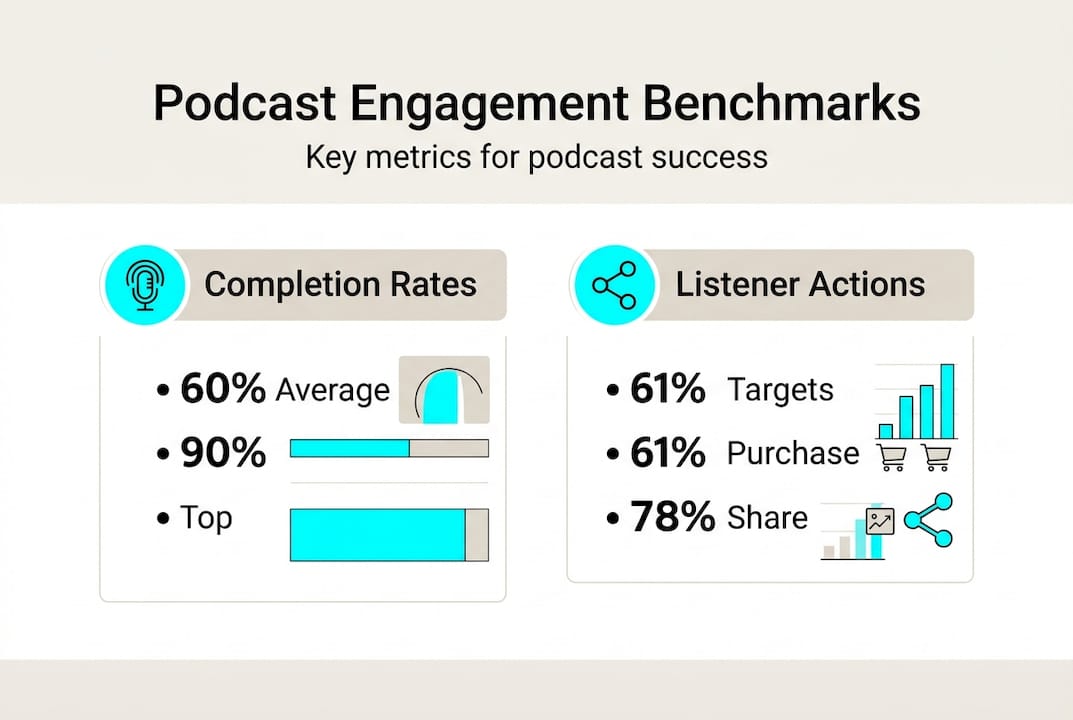
Statistic callout: The top 10% of podcasts see 90%+ episode completion, which separates truly sticky content from everything else in a crowded feed.
What separates high-engagement shows from average ones? It’s rarely production quality alone. It’s format consistency, host authenticity, and content that delivers on its promise every episode. If you want to optimize for engagement at a structural level, start with your genre benchmarks and work backward from there. Understanding where you sit relative to your category is the first step toward data-driven podcast growth that actually compounds over time.

How to measure podcast engagement that matters
Benchmarks set a target, but how do you actually gather and interpret the numbers that matter most?
Most platforms give you data. Not all of it is equally useful. Here’s how to extract what actually counts.
Step-by-step engagement measurement:
- Pull completion and retention data from Apple Podcasts Connect. Apple shows you average consumption percentage and a retention curve. Look for consistent drop-off points.
- Check Spotify for Podcasters. Spotify provides streaming starts, listeners, and follower data. Cross-reference with Apple to spot platform-specific behavior.
- Track unique listeners vs. total plays. Unique listeners tell you audience size; total plays tell you loyalty. A high ratio of plays to listeners means people are coming back.
- Monitor call-to-action conversion. Use unique URLs or promo codes per episode to tie listener behavior to real outcomes.
- Triangulate with social shares and mentions. Shares are a proxy for emotional resonance. If nobody’s clipping your content, something isn’t landing.
Here’s a comparison that puts it in perspective:
| Metric | What it tells you | Reliability |
|---|---|---|
| Downloads | File transfers | Low (13% unplayed) |
| Completion rate | Actual listening behavior | High |
| Retention curve | Drop-off moments | High |
| Social shares | Emotional resonance | Moderate |
| Unique listeners | True audience size | High |
Pro Tip: Don’t obsess over total download numbers in your weekly reporting. Replace that slot with average completion rate and retention curve shape. A flat retention curve that holds above 70% through the full episode is worth more than a spike in downloads that evaporates by minute five.
For a deeper look at key podcast metrics and how to interpret them across platforms, it’s worth mapping your measurement approach before you start optimizing. Knowing what you’re measuring is half the battle when growing your podcast audience with intention.
Proven tactics to improve podcast audience engagement
Just measuring engagement is not enough. What specific steps will actually move listeners to act and return?
Here’s what the data and real-world practice consistently support:
- Nail the first 60 seconds. Your opening is everything. Skip the lengthy intros and get to the value immediately. Listeners decide whether to stay or bounce within the first minute.
- Use pattern interrupts. Change the pace, tone, or format mid-episode. A sudden question, a quick story, or a shift in energy resets attention and keeps people listening.
- Add binge hooks. End each episode with a teaser for the next one. “Next week, we’re talking to someone who built a $10M business from a single podcast appearance” works. Vague “stay tuned” does not.
- Promote older episodes internally. Reference relevant past episodes during the show. It drives replays and deepens listener investment in your catalog.
- Build community around the show. Discord servers, Slack groups, and online forums create stickiness that no algorithm can replicate. Listeners who talk to each other don’t churn.
- Repurpose clips and highlights. Short-form video clips and audiograms extend your reach and pull new listeners into full episodes.
Pro Tip: Guest-driven growth loops are underused. When a guest shares your episode with their audience, you get warm introductions to people who already trust that guest. Structure your guest strategy around audience overlap, not just name recognition. It’s one of the fastest ways to increase podcast discoverability without paid promotion.
Keep episodes in the 20 to 40 minute range for optimal consumption. Longer isn’t always better. Tight, focused episodes with strong hooks consistently outperform sprawling conversations in retention data. Pair that with smart podcast commerce strategies and you’ve got a flywheel that builds on itself.
Handling drop-offs and platform shifts: Nuances that matter
Strategies are critical, but not all audiences or platforms behave the same way. Let’s dig into the nuances that affect engagement rates.
Not every drop-off is a crisis. But understanding when and why listeners leave is what separates reactive creators from strategic ones.
10 to 25% of listeners drop off in the first five minutes. That number climbs to 35% by minute five for shows with weak openings. If your retention curve shows a cliff in that window, your hook isn’t working.
Here are the nuances worth tracking:
- B2B podcasts play by different rules. Smaller audiences are normal and expected. A B2B show with 2,000 highly engaged decision-makers is more valuable to a marketer than a consumer show with 20,000 passive listeners.
- Video podcasting changes the game. 32% of listeners prefer video formats, and video podcasts drive higher engagement overall. But they also fragment your audience across YouTube, Spotify, and social platforms, which complicates measurement.
- Playback speed is a real variable. Between 25% and 45% of listeners speed up audio playback. This affects how you interpret time-based retention data. A listener who finishes at 1.5x speed is still an engaged listener.
“The most dangerous assumption in podcast analytics is treating all listeners as identical. Segment by platform, format, and episode type before drawing conclusions.”
For advanced optimization, consider testing different episode formats (solo vs. interview vs. panel) and measuring completion rates separately for each. You might find your audience loves your solo episodes but drops off your roundtables at minute eight. That’s actionable. Explore using podcast data effectively to build a segmentation approach that reflects how your real audience actually listens.
Why true podcast engagement is a marketer’s unfair advantage
Putting all this into perspective, here’s why the smartest podcast marketers think differently about engagement.
Here’s the uncomfortable truth: most podcast marketing budgets are allocated based on reach, not resonance. Brands chase shows with big download numbers because big numbers feel safe to justify in a meeting. But downloads don’t buy products. Engaged listeners do.
The marketers winning right now are the ones who’ve stopped asking “how many people heard this?” and started asking “how many people acted on this?” That shift sounds small. It isn’t. It changes which shows you partner with, how you structure your ad reads, and how you measure success.
Completion rates and retention curves reveal something downloads never can: whether your message landed in a moment of genuine attention. A listener who finishes 90% of an episode and then visits your URL is worth ten passive downloaders who never pressed play.
The other thing most marketers miss? Community. Shows that build real communities around their content create compounding loyalty. Those listeners don’t just buy once. They advocate, share, and return. That’s not a media buy. That’s a relationship. And data-driven strategies are how you find and nurture those relationships at scale.
Take your podcast engagement to the next level with Prodcast
Ready to put these engagement insights to work? Here’s where Prodcast can help marketers scale real podcast loyalty.
Knowing what drives engagement is one thing. Having the tools to act on it is another. Prodcast is built for marketers who want to go beyond guesswork and find the moments that actually move audiences.

With Prodcast, you can surface the exact product mentions, expert insights, and high-impact moments happening across thousands of podcasts right now. Whether you’re tracking brand sentiment, scouting partnership opportunities, or building content around what listeners are genuinely responding to, Podcast Moments gives you the clips and context you need. For deeper influence mapping, Mass Persuasion shows you which voices are driving real audience action. Explore the full Prodcast platform and start turning podcast conversations into your next marketing advantage.
Frequently asked questions
What is considered a good podcast engagement rate?
A strong podcast engagement rate means 80% or more of your listeners finish each episode, with top shows consistently exceeding 90% completion.
How do you measure true podcast engagement?
Track completion rates, retention curves, and listener actions like shares or ad responses. 13% of downloads are never played, so downloads alone are not a reliable measure.
Which genres have the highest podcast engagement?
True Crime and Fiction podcasts typically achieve the highest engagement and completion rates, often exceeding 85% per episode.
Do podcast ads really lead to action?
Yes. 61% of listeners say they are likely to buy after hearing a podcast ad, and 78% take some form of action after exposure.
How can I reduce podcast drop-off rates?
Start with a strong opening minute, keep episodes in the 20 to 40 minute range, and use pattern interrupts. First-minute drop-offs account for 10 to 25% of exits, so your hook is your most important asset.