CATEGORIES
TAGS
Boost engagement with podcast loyalty programs in 2026

Podcast listeners who join loyalty programs stick around 30% longer than those who don’t. Yet most podcasters and marketers miss this opportunity, treating product mentions as mere content rather than commercial touchpoints. Data from thousands of podcast transcripts reveals trending products listeners care about, and integrating these insights into loyalty programs transforms passive audiences into engaged buyers.
Table of Contents
- Introduction To Podcast Loyalty Programs And Their Importance
- How Ai And Transcript Analysis Reveal Trending Products In Podcasts
- Understanding Audience Behavior And Product Mention Mechanisms
- Common Misconceptions About Podcast Loyalty Programs
- Frameworks And Models To Design Effective Podcast Loyalty Programs
- Case Studies And Practical Applications From Leading Podcasts
- Implementing Your Podcast Loyalty Program: Step-By-Step Guide
- Conclusion: Future Trends And Opportunities In Podcast Loyalty Ecosystems
- Explore Prodcast Solutions For Podcast Loyalty Programs
Key takeaways
| Point | Details |
|---|---|
| Data-driven loyalty programs significantly boost listener retention | Podcast listeners who participate in loyalty programs show a 25-30% higher retention rate over six months compared to non-participants. |
| Product mentions directly increase purchase conversions | Integrating product recommendations into loyalty rewards increases purchase conversions by 18% when aligned with listener interests. |
| Personalized rewards outperform generic discount strategies | Personalized product-based incentives lead to 40% higher engagement than blanket promotional codes. |
| Effective programs require transcript analysis for targeting | AI platforms analyze podcast transcripts to identify popular product mentions in real-time across niches. |
| Structured frameworks guide successful loyalty design | Reward-based, content-access-based, and product-integrated loyalty programs address different engagement and revenue objectives. |
Introduction to podcast loyalty programs and their importance
Podcast loyalty programs are strategic frameworks that reward listeners for engagement actions like subscribing, sharing episodes, or purchasing mentioned products. These programs bridge the gap between content consumption and commercial activity, turning casual listeners into brand advocates.
Podcasters face persistent engagement challenges. Retention drops sharply after the first few episodes. Converting listeners into customers requires more than product mentions alone. Traditional advertising models fail to capture the trust built through podcast conversations.
The podcast commerce landscape is shifting. Listeners trust creator recommendations more than traditional ads, but monetizing this trust demands structured approaches. Loyalty programs capitalize on this dynamic by rewarding the behaviors that drive both engagement and revenue.
Product mentions in podcasts create natural commercial opportunities. When fitness podcasters discuss supplements or tech hosts recommend software tools, these moments represent high-intent signals. Podcast engagement powered by AI transforms these mentions into loyalty rewards, creating a feedback loop where listening drives purchasing and purchasing reinforces listening.
Key strategic benefits include:
- Enhanced listener retention through personalized reward structures
- Direct revenue streams from product partnerships and affiliate relationships
- Deeper audience insights revealing purchasing patterns and preferences
- Competitive differentiation in crowded podcast markets
- Scalable engagement mechanisms that grow with audience size
How AI and transcript analysis reveal trending products in podcasts
AI-powered transcript analysis transforms unstructured audio content into searchable, actionable product data. Natural language processing models parse conversations, identifying brand names, product categories, and sentiment indicators that signal genuine endorsements versus casual mentions.
Fitness podcasts frequently mention supplements, workout equipment, and recovery tools. Business shows highlight productivity software, books, and consulting services. Tech podcasts showcase emerging AI platforms, hardware, and development tools. Podcast product discovery with AI reveals these patterns across thousands of episodes, creating real-time trend maps.
This data directly impacts loyalty program design. If transcript analysis shows a surge in nootropic supplement mentions across health podcasts, loyalty programs can offer exclusive discounts or early access to these products. When entrepreneurs repeatedly recommend specific project management tools, rewards can include extended trial periods or feature upgrades.

| Podcast Niche | Top Product Categories | Mention Frequency Increase (2026) |
|---|---|---|
| Fitness & Health | Protein supplements, wearables, recovery tools | 34% year over year |
| Business & Entrepreneurship | Productivity software, books, coaching services | 28% year over year |
| Technology | AI platforms, development tools, hardware | 52% year over year |
| Personal Finance | Investment apps, budgeting tools, educational courses | 23% year over year |
AI methods for product extraction include:
- Named entity recognition identifying brand and product names in transcripts
- Sentiment analysis distinguishing enthusiastic recommendations from neutral mentions
- Temporal tracking showing product momentum across episode releases
- Cross-podcast aggregation revealing industry-wide trends versus individual preferences
- Contextual analysis understanding whether mentions are sponsored or organic
Grow podcast audience with data insights by leveraging these AI capabilities to inform content strategy and loyalty program structure simultaneously.
Understanding audience behavior and product mention mechanisms
Product mentions in podcasts trigger different psychological responses than traditional advertising. Listeners perceive host recommendations as trusted advice rather than commercial pitches. This trust translates into purchase intent when loyalty programs remove friction from the buying process.
Personalized rewards consistently outperform generic incentives. A blanket 10% discount on any product holds less appeal than exclusive access to the exact supplement a favorite fitness podcaster just discussed. Understanding audience behavior in podcasts reveals that matching rewards to individual listening patterns increases redemption rates by significant margins.
Key metrics tracking loyalty program effectiveness include:
- Retention rate measuring percentage of listeners active after 90 and 180 days
- Purchase conversion rate tracking reward redemptions and affiliated sales
- Engagement uplift comparing interaction rates between program participants and non-participants
- Average revenue per user showing commercial value of loyalty members
- Share and referral rates indicating organic program growth
Pro Tip: Segment your audience by product mention engagement. Listeners who repeatedly consume episodes featuring specific product categories respond better to rewards in those categories than broad incentive structures.
The mechanism linking content to purchasing operates through shortened decision cycles. When a listener hears a product recommendation, the traditional research and consideration phases compress. Loyalty programs capitalize on this shortened window by presenting immediate reward opportunities tied to those mentions, converting high-intent moments into completed transactions.
Common misconceptions about podcast loyalty programs
Many podcasters assume discounts drive loyalty, but data tells a different story. Generic promotional codes create transactional relationships, not lasting engagement. Listeners redeem the discount and disappear unless deeper value exists beyond price reduction.
Another misconception treats all podcast audiences identically. Fitness podcast listeners value different rewards than tech enthusiasts. Business show audiences prioritize time-saving tools while entertainment podcast fans seek exclusive content access. Niche tailoring determines program success more than budget size.
A third myth suggests product mentions alone guarantee purchases. Without loyalty program integration, mentions create awareness but fail to capture intent. The gap between hearing about a product and buying it remains wide unless structured incentives bridge the distance.
Key misconceptions corrected:
- Belief: Bigger discounts equal better engagement. Reality: Personalized product-based incentives lead to 40% higher engagement, outperforming generic discounts.
- Belief: Loyalty programs require massive audiences. Reality: Niche podcasts with engaged listeners see higher per-user revenue from targeted programs than large shows with passive audiences.
- Belief: Program success depends on sponsored products only. Reality: Organic product mentions integrated into rewards build more authentic loyalty than purely sponsored arrangements.
Data-driven strategies avoid these pitfalls by testing reward structures, measuring actual redemption rates, and iterating based on listener behavior rather than assumptions. Podcast loyalty misconceptions often stem from applying traditional marketing frameworks without adapting to podcast-specific audience dynamics.
Frameworks and models to design effective podcast loyalty programs
Three primary loyalty program models serve different podcast goals. Reward-based programs offer points for engagement actions like episode completions or social shares. Content-access-based programs provide exclusive episodes or ad-free experiences. Product-integrated programs connect listeners directly to mentioned products through partnerships and affiliate relationships.
| Program Model | Best For | Pros | Cons |
|---|---|---|---|
| Reward-based | Growing engagement metrics | Gamifies listening, encourages sharing | Requires point redemption infrastructure |
| Content-access | Premium audience monetization | Direct revenue, clear value proposition | May alienate non-paying listeners |
| Product-integrated | Commerce-focused podcasts | High conversion potential, partnership revenue | Depends on relevant product mentions |
Choosing the right model depends on podcast niche and primary objectives. Educational podcasts prioritizing thought leadership suit content-access models. Product review shows naturally align with product-integrated approaches. Entertainment podcasts building community benefit from reward-based structures.
Key design considerations include:
- Audience size and engagement baseline determining realistic program scope
- Existing product mention frequency providing natural integration opportunities
- Technical infrastructure for tracking engagement and distributing rewards
- Partnership relationships enabling product access and affiliate arrangements
- Budget allocation balancing reward costs against expected revenue uplift
Pro Tip: Start with a hybrid model combining two frameworks. Offer both exclusive content and product rewards, then analyze redemption patterns to identify which incentives resonate strongest with your specific audience before scaling investment.
Loyalty program design frameworks should align with overall podcast strategy rather than existing as isolated initiatives. The most successful programs integrate loyalty mechanics directly into content planning, ensuring mentioned products have corresponding reward opportunities ready for immediate listener action.
Case studies and practical applications from leading podcasts
Fitness podcasts using AI-identified supplement trends created tiered loyalty programs offering exclusive discount codes. Listeners who completed 10 episodes received access to top-mentioned products at 20% off. Retention improved 32% over six months while affiliated supplement sales generated new revenue streams exceeding ad revenue for participating shows.
Business podcasts integrated productivity tool mentions with extended trial rewards. When hosts discussed project management software, loyalty members received 60-day trials instead of standard 14-day offers. Purchase conversion from trials increased 24%, and tool companies paid referral fees creating win-win partnerships.
Key success factors across implementations:
- Reward timing matched product mention momentum, capitalizing on immediate listener interest
- Personalization engines matched rewards to individual listening history rather than broad audience segments
- Communication clarity ensured listeners understood how to earn and redeem rewards
- Partnership quality focused on products genuinely aligned with podcast content
- Continuous optimization adjusted reward structures based on redemption data
Actionable insights for implementation:
- Start with your five most-mentioned products over the past quarter as initial reward partners
- Segment your audience by engagement level, offering premium rewards to top listeners
- Track redemption rates weekly, adjusting incentives for underperforming offers
- Survey loyalty members quarterly to identify desired products not yet mentioned
- Cross-promote rewards in episode outros and show notes for maximum visibility
Podcast loyalty case studies demonstrate that programs combining data insights with personalized rewards achieve measurable results regardless of show size or niche.
Implementing your podcast loyalty program: step-by-step guide
Step 1: Collect and analyze transcript product mention data. Use AI transcription services to convert episodes into searchable text, then apply product extraction tools identifying brand names and categories. Review the past 20 episodes to establish baseline mention patterns.
Step 2: Segment audience using engagement insights. Divide listeners into tiers based on episode completion rates, subscription longevity, and social sharing behavior. Create distinct reward tracks for casual, regular, and power listeners.
Step 3: Design personalized rewards integrating product discovery. Match top-mentioned products to audience segments, negotiating partnership terms with brands. Structure rewards as exclusive access, enhanced discounts, or bundled offers unavailable elsewhere.
Step 4: Implement and track key performance indicators. Deploy loyalty platform technology capturing engagement actions and reward redemptions. Monitor retention rates, purchase conversions, and revenue per user weekly.
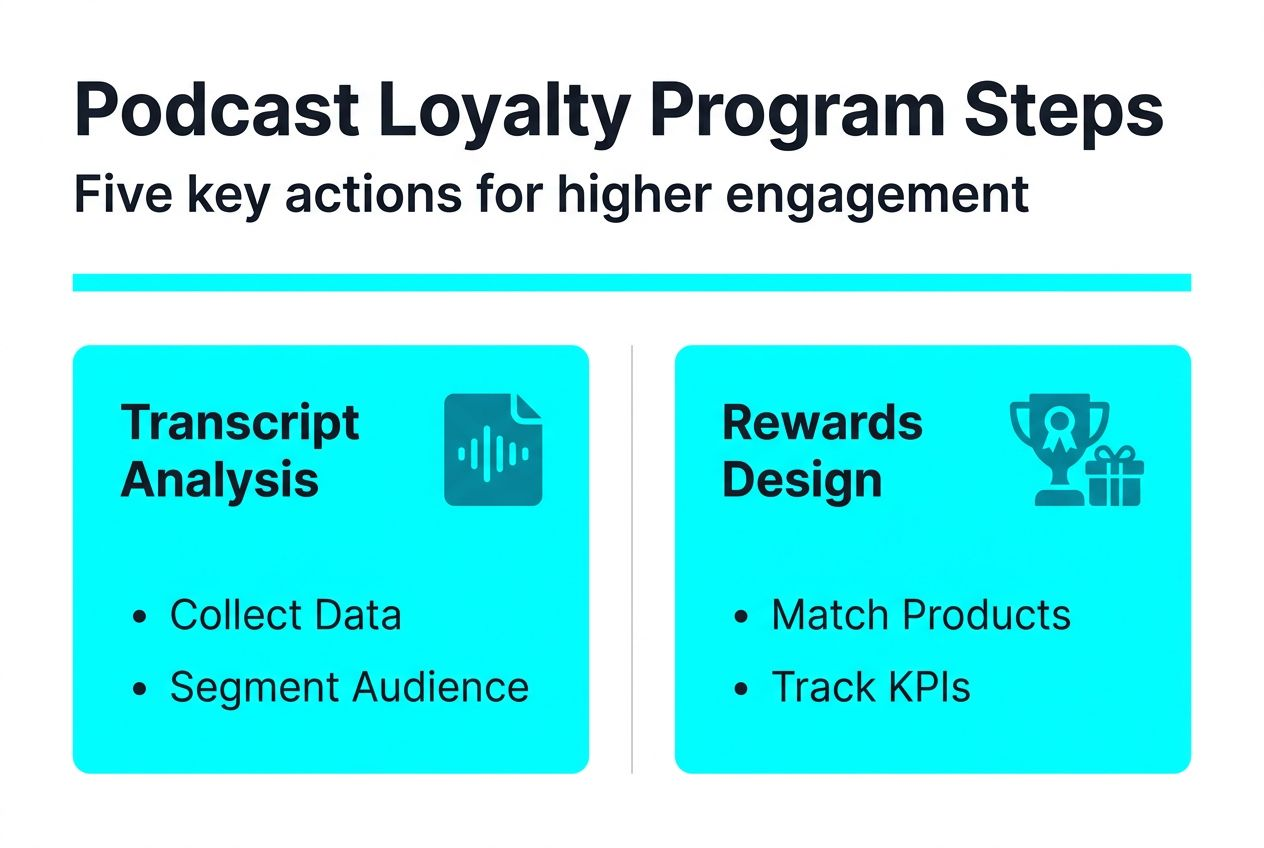
Step 5: Optimize with feedback loops. Survey participants monthly about reward relevance and redemption experience. Analyze which products drive highest engagement, doubling down on successful categories while phasing out low-performing offers.
Pro Tip: Source product mention data from multiple episodes before launching rewards. A single mention might be coincidental, but repeated references across episodes signal genuine host enthusiasm and audience interest worth rewarding.
Launching podcast loyalty program success requires continuous monitoring rather than set-and-forget approaches. Listener preferences shift as podcast content evolves, demanding ongoing alignment between mentions and rewards.
Conclusion: future trends and opportunities in podcast loyalty ecosystems
AI and analytics capabilities will expand, enabling real-time reward deployment as product mentions occur during live podcast recordings. Predictive models will anticipate which products listeners want before hosts mention them, based on content patterns and audience signals.
Commerce and content integration will deepen, erasing boundaries between entertainment and shopping. Podcasts will evolve into discovery platforms where listening and purchasing happen simultaneously through voice-activated rewards and instant fulfillment.
Emerging loyalty models will prioritize hyper-personalization. Two listeners of the same episode will receive different rewards based on purchase history, listening patterns, and stated preferences. Generic programs will become obsolete as expectations for relevance increase.
Key opportunities emerging in 2026 and beyond:
- Voice commerce integration allowing in-episode reward redemption without app switching
- Blockchain-based loyalty tokens enabling cross-podcast reward accumulation and redemption
- Predictive product matching suggesting rewards before listeners know they want them
- Community-driven rewards where listener voting determines partnership priorities
- Real-time trend response adjusting reward offerings based on breaking product news
Ongoing adaptation to listener behavior remains non-negotiable. The podcasts thriving in 2026 treat loyalty programs as living systems requiring constant refinement rather than static marketing initiatives.
Explore Prodcast solutions for podcast loyalty programs
Building effective loyalty programs requires accurate product mention data and trend insights. Prodcast’s AI platform analyzes thousands of podcast transcripts, identifying exactly which products resonate across fitness, business, and tech shows.

Our podcast moments discovery tool pinpoints high-value segments where hosts discuss trending products, giving you precise timestamps for reward integration. The platform reveals real-time product momentum, showing which supplements, software tools, and gadgets audiences care about right now.
Explore our data-driven marketing strategies blog for actionable frameworks optimizing loyalty programs through product discovery insights. Prodcast transforms podcast conversations into commercial opportunities, turning mentions into measurable engagement and revenue.
Frequently asked questions
What are podcast loyalty programs and why are they important?
Podcast loyalty programs reward listeners for engagement actions like subscribing, completing episodes, or purchasing mentioned products. They increase retention by 25 to 30% and create direct revenue streams through product partnerships. Programs transform passive audiences into active participants, building community while monetizing trust between hosts and listeners.
How can AI help identify trending products in podcasts?
AI parses podcast transcripts using natural language processing to detect brand names, product categories, and sentiment indicators. It distinguishes genuine endorsements from casual mentions, tracking momentum across thousands of episodes. Real-time trend analysis shows which supplements, tools, or gadgets are gaining traction, enabling timely loyalty reward integration.
What metrics measure podcast loyalty program success?
Retention rate tracks listener activity over 90 and 180 days, showing program stickiness. Purchase conversion measures reward redemptions and affiliated sales, revealing commercial impact. Engagement uplift compares interaction rates between program participants and non-participants. Average revenue per user quantifies the financial value loyalty members generate compared to regular listeners.
What common mistakes should podcasters avoid with loyalty programs?
Avoid generic discount strategies that create transactional rather than lasting relationships. Tailor rewards by audience segment since fitness listeners value different incentives than tech enthusiasts. Measure program impact regularly through retention and conversion metrics rather than assuming effectiveness. Integrate product mentions strategically with corresponding rewards instead of treating mentions as standalone content.